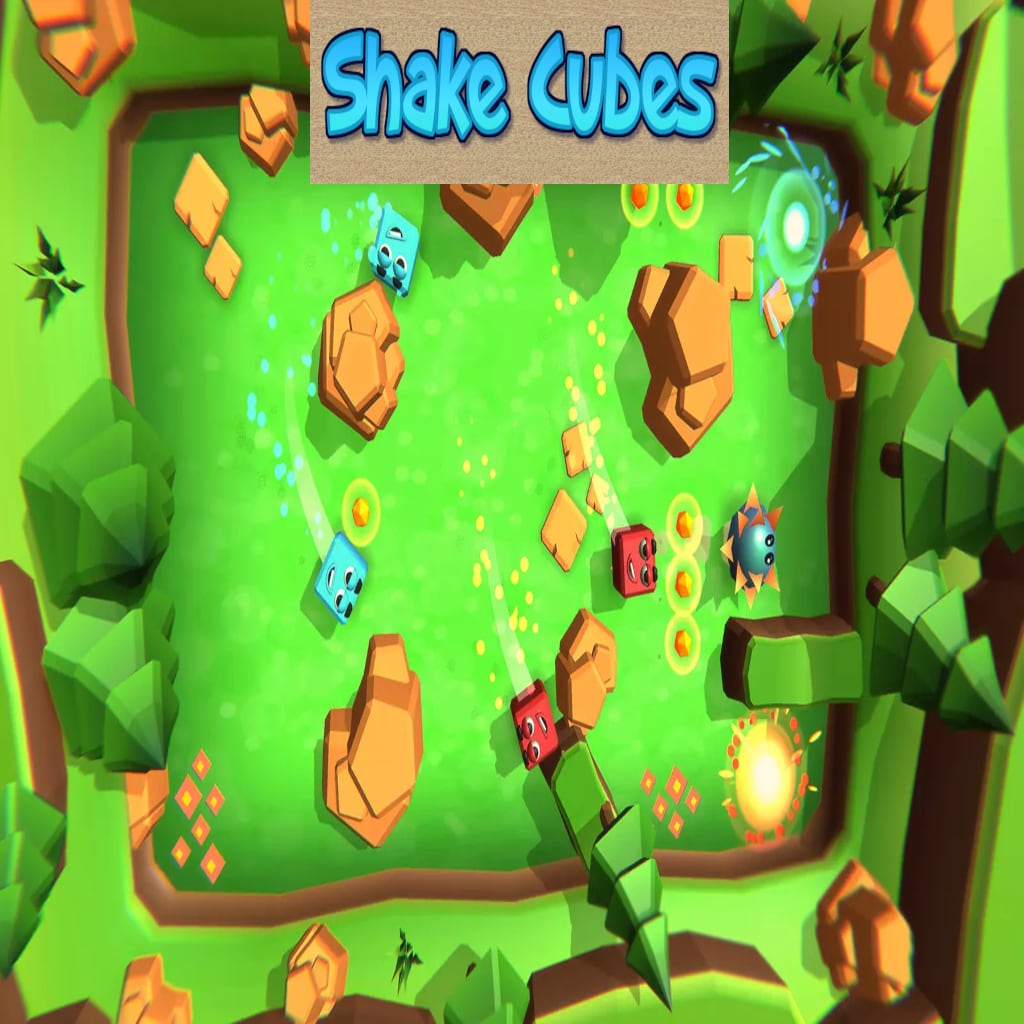
Puzzle games often live or die by a single question: does the core idea remain engaging once the novelty wears off? Shake Cubes approaches this challenge with a deceptively simple premise that gradually unfolds into something far more demanding than it first appears. On the surface, it looks like a clean, minimalist puzzler built around rotating and shaking clusters of cubes. In practice, it becomes a thoughtful test of spatial awareness, logic, and patience — one that rewards careful planning over quick reflexes.
Shake Cubes doesn’t attempt to overwhelm players with complex systems or elaborate presentation. Instead, it focuses on refinement, asking players to master a compact set of mechanics and apply them in increasingly inventive ways. The result is a puzzle experience that is easy to understand, steadily challenging, and quietly absorbing.
A Simple Concept with Room to Grow
At its core, Shake Cubes revolves around manipulating groups of cubes within confined spaces. Players must rotate, tilt, or “shake” formations to align cubes correctly, clear paths, or reach specific goals. The controls are intentionally straightforward, allowing the game’s challenge to emerge from puzzle design rather than mechanical complexity.
Early levels ease players in gently, teaching the rules through play rather than lengthy tutorials. You quickly learn how gravity affects the cubes, how rotations change their orientation, and how movement can either solve or complicate a situation. This onboarding process is one of the game’s strengths, as it avoids frustration while still encouraging experimentation.
As the game progresses, new constraints are introduced. Limited moves, restricted rotations, and increasingly intricate cube arrangements force players to think several steps ahead. Shake Cubes is not about reacting in the moment, but about visualising outcomes before committing to an action.
Puzzle Design and Difficulty Curve
The strength of Shake Cubes lies in its puzzle design. Levels are compact, carefully structured, and rarely feel arbitrary. Solutions usually make sense in hindsight, delivering that satisfying “click” moment that defines good puzzle games.
The difficulty curve is mostly well judged. Challenges escalate gradually, layering new ideas on top of existing mechanics rather than constantly introducing entirely new ones. This allows players to develop mastery and confidence, even as puzzles become more demanding.
That said, the game occasionally stumbles in its pacing. Some difficulty spikes arrive unexpectedly, presenting puzzles that require a sudden leap in spatial reasoning without much preparation. These moments can feel discouraging, particularly for players who have grown comfortable with the game’s earlier rhythm.
Fortunately, levels are quick to restart, and failure rarely feels punitive. The game encourages trial and error, and experimentation is often the fastest route to understanding a puzzle’s logic.
Controls and Responsiveness
For a game built around precise manipulation, control responsiveness is crucial — and Shake Cubes largely delivers. Movements are crisp, rotations are predictable, and the physics behave consistently. When mistakes happen, they are almost always the player’s fault rather than the game’s.
The “shake” mechanic adds an extra layer of depth, allowing players to subtly reposition cubes or disrupt carefully balanced structures. This mechanic is used sparingly at first, but later levels lean heavily on it, transforming what initially feels like a novelty into a core strategic tool.
However, the reliance on precision can occasionally work against the game. In a handful of puzzles, slight misalignments can undo careful planning, forcing repeated attempts to achieve the exact configuration required. While this reinforces the game’s emphasis on accuracy, it may frustrate players who prefer broader, more forgiving solutions.
Presentation: Clean and Functional
Visually, Shake Cubes embraces minimalism. Environments are clean, uncluttered, and focused entirely on the puzzle space. Cubes are clearly defined, colours are used effectively to distinguish elements, and animations are smooth without being distracting.
This restrained presentation works in the game’s favour. There’s no visual noise to obscure important details, and the clarity of the design helps players focus on spatial relationships. That said, the aesthetic is unlikely to leave a lasting impression. Shake Cubes looks pleasant and functional, but rarely striking.
Audio design follows a similar philosophy. Sound effects are subtle and informative, providing feedback without drawing attention to themselves. The soundtrack, when present, is understated and ambient, complementing the game’s thoughtful pace rather than attempting to energise it.
Accessibility and Approachability
Shake Cubes is approachable in terms of controls and basic mechanics, but it does demand a certain mindset. This is a game that rewards patience, careful observation, and willingness to rethink assumptions. Players who enjoy rushing through levels or relying on intuition may find themselves hitting walls as the puzzles grow more complex.
Accessibility options are limited, but the game’s clarity and lack of time pressure make it broadly playable. There are no strict timers pushing players forward, allowing everyone to solve puzzles at their own pace.
The lack of hints or assistance systems may be a drawback for some. While many puzzle fans will appreciate the purity of the challenge, others may wish for optional guidance to help overcome particularly stubborn levels.
Replayability and Longevity
Shake Cubes is not a game built around endless replayability. Once puzzles are solved, there is limited incentive to revisit them beyond personal satisfaction. The joy lies in discovery rather than optimisation.
That said, the game’s compact levels and clear solutions make it easy to dip back in, especially if you enjoy refining your approach or solving puzzles more efficiently. Completionists will appreciate the satisfaction of working through every challenge, even if the overall experience is relatively self-contained.
Who Is Shake Cubes For?
Shake Cubes will appeal most to players who enjoy pure logic puzzles and spatial challenges. Fans of minimalist puzzle games that prioritise design over spectacle will find plenty to enjoy here.
It may be less appealing to players seeking narrative context, visual flair, or varied gameplay systems. Shake Cubes is focused, deliberate, and unapologetically cerebral.
Final Verdict
Shake Cubes is a thoughtfully designed puzzle game that succeeds by refining a simple idea rather than expanding outward unnecessarily. Its strengths lie in clean presentation, logical puzzle construction, and a steady emphasis on spatial reasoning. While occasional difficulty spikes and limited accessibility options hold it back from greatness, the overall experience is satisfying and mentally engaging.
For players who appreciate carefully crafted puzzles and enjoy taking their time to think through problems, Shake Cubes offers a rewarding challenge that respects both intelligence and patience.