Few games in history are as instantly recognisable as Minesweeper. It’s a title most of us have encountered at some point — whether through a default PC install, a mobile remake, or just the legend of its deceptively simple mechanics. Minesweeper Classic doesn’t reinvent the wheel; instead, it honours the purity of the original design while polishing it for a modern audience.
Stripped of bells, whistles, and narrative trappings, Minesweeper Classic reminds us why minimalism can be powerful: when a game is built entirely around logic, anticipation, and deduction, every click carries weight. What seems straightforward at first quickly reveals deeper layers of tension and satisfaction, especially on higher difficulties or larger grids.
This review explores how Minesweeper Classic succeeds as both a nostalgic throwback and a legitimately engaging puzzle experience for new players.
Core Gameplay: Elegant Simplicity
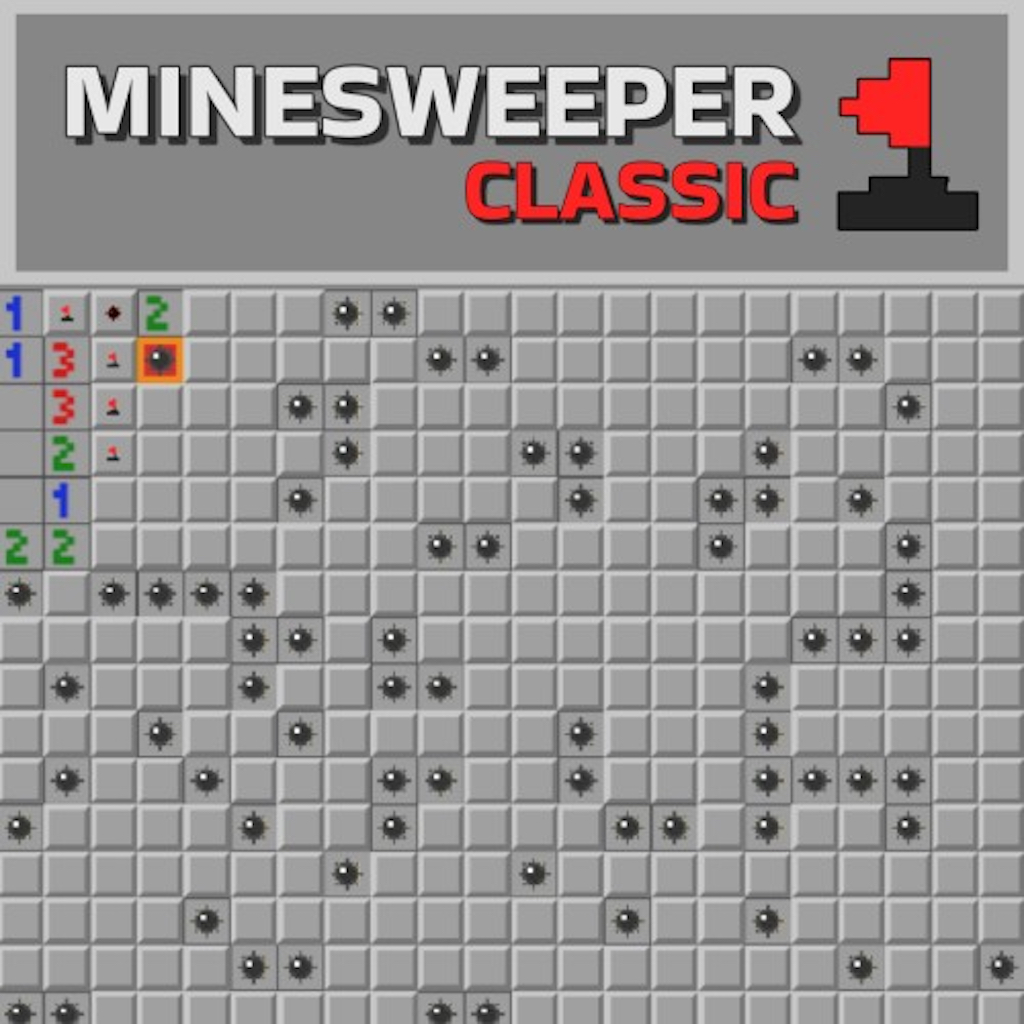
At its essence, Minesweeper Classic is about educated guessing and systematic deduction. Players are presented with a grid of covered tiles. Hidden beneath some are mines — step on one, and the game ends. Others are safe, and uncovering them reveals numbers indicating how many adjacent mines exist.
This simple premise gives rise to a surprisingly deep set of emergent behaviours. Each number becomes a clue, and players build logical “maps” in their minds to avoid danger, identify safe spots, and clear the board.
Clarity of Mechanics
Part of Minesweeper’s enduring brilliance is how transparent its rules are:
- Numbers always lie — but they never deceive.
Each revealed number is a precise count of adjacent mines. - Uncovered space always agrees.
Spatial relationships remain consistent, letting logic flourish. - Every puzzle is solvable — until it’s not.
Half the psychological thrill lies in moments of ambiguity where probability and choice intersect.
Modern iterations, including Minesweeper Classic, preserve these mechanics faithfully. The game delivers crisp feedback, with tile reveals that feel immediate and precise. Responsiveness matters here: hesitation in input or lag during reveals would erode trust in the system. Thankfully, the execution is sharp.
Difficulty and Pacing: A Spectrum of Challenge
Minesweeper Classic typically offers three default difficulty levels: Beginner (small grid, few mines), Intermediate (medium grid, moderate mines), and Expert (large grid, high mine density). Many versions also allow custom grid sizes and mine counts, expanding replayability.
Beginner: Accessible Yet Earnest
For newcomers, the beginner grid is an ideal introduction. It’s small enough to learn basic logic without feeling overwhelming, yet every mine location still matters. This tier serves as both tutorial and gentle entry point — essential for welcoming players new to logic puzzles.
Intermediate: Balanced Complexity
The intermediate level is where word-of-mouth begins. Grids are wider, mines are denser, and players must think several steps ahead. A single misclick can unravel a promising solution, and moments of near discovery give way to deep satisfaction when a puzzle finally resolves.
Expert: Pure Deduction
Expert mode separates casual puzzlers from dedicated tacticians. On these large grids, safe moves often require chaining several layers of inference. It’s not uncommon to reach a scenario where logic alone cannot fully resolve the final choices — forcing calculated risk with probability in mind.
But this is where Minesweeper truly shines: because even guesswork is informed by careful deduction. The thrill of clearing a massive board — tile by tile — at expert level is one of gaming’s purest rewards.
Presentation: Classic Visuals, Modern Functionality
Visually, Minesweeper Classic leans into clean minimalism. Grids are easy to read; numbers pop against the background; flags and markers are clear and distinct. The colour coding is functional, not flashy — exactly what a logic puzzle needs.
Some versions introduce themes, animations, or optional visual flourishes. While these can be enjoyable, they never distract from the core requirement: knowing where mines are (or aren’t) as efficiently as possible.
On mobile and console ports, touch and controller support vary in quality. The best implementations adapt grid navigation intelligently, using simple gestures or button mapping that feels natural. On PC, mouse control remains the gold standard: quick, precise, and intuitive.
Beyond aesthetics, sound design — subtle clicks, discreet taps, unobtrusive feedback — reinforces actions without overwhelming the senses. If anything, the audio design understands restraint: this is a title where silence and concentration are part of the experience.
Replayability and Longevity
Here’s where Minesweeper Classic continues to surprise. There’s no storyline, no unlockables, no meta-progression — and yet every game feels fresh. Why?
Because Minesweeper isn’t about reaching the “end.” It’s about the puzzle itself. Each board is a new scenario, and every solution is uniquely satisfying. Players find joy not in completion, but in deduction.
- Custom grids let enthusiasts tailor difficulty.
- Time trials invite speedruns and optimisation.
- Daily puzzles (in some versions) add fresh bite-sized challenges.
- Leaderboards (when supported) foster friendly competition.
This is longevity by design, not by padding. Once you understand the mechanics, the only limit is how much mental effort you’re willing to invest.
Accessibility: Inclusive Design in a Classic Framework
Simple rules + no narrative pressure = a puzzle game that’s remarkably accessible. Minesweeper Classic excels in this regard:
- Low entry barrier: Basics are easy to grasp.
- Adjustable pacing: Players set their own speed.
- Minimal UI clutter: Visual simplicity reduces cognitive load.
- Optional assists: Some ports offer hints, mine counting tools, or delayed activation to help newcomers.
The only real barrier is the nature of logic puzzles themselves — they demand thought. But that demand is the point. It’s a fair challenge that rewards attention rather than reflexes.
Where Minesweeper Classic Stumbles
While its strengths are many, Minesweeper Classic isn’t without minor shortcomings:
- Repetition can set in: Without narrative or evolving mechanics, extended play can feel methodical rather than dynamic.
- Guesswork moments: At higher difficulties, truly solvable configurations can become rare, forcing guess-based decisions that feel outside pure deduction.
- Feature inconsistency: Different platform versions vary in quality; UI and control quirks sometimes disrupt flow.
These issues don’t tarnish the core experience, but they do remind us that even timeless designs can benefit from thoughtful iteration.
Final Verdict
Pros:
- Classic puzzle design with elegant logic
- Accessible at all skill levels
- Endlessly replayable despite minimal presentation
- Sharp, responsive controls and clear visual feedback
Cons:
- Can feel repetitive without auxiliary modes
- High-difficulty guesswork may frustrate purists
- Quality varies across platform ports
Summary:
Minesweeper Classic isn’t flashy, and it doesn’t chase trends — but that’s precisely its strength. Its distilled logic gameplay, timeless design, and pure challenge make it one of the most enduring puzzles in gaming history. Whether you’re revisiting for nostalgia or diving in as a newcomer, this edition stands as a compelling example of how simplicity can yield deep, rewarding mechanics.
For lovers of cerebral challenges and players who appreciate games that make the mind hum, Minesweeper Classic is a delightful return to fundamentals.