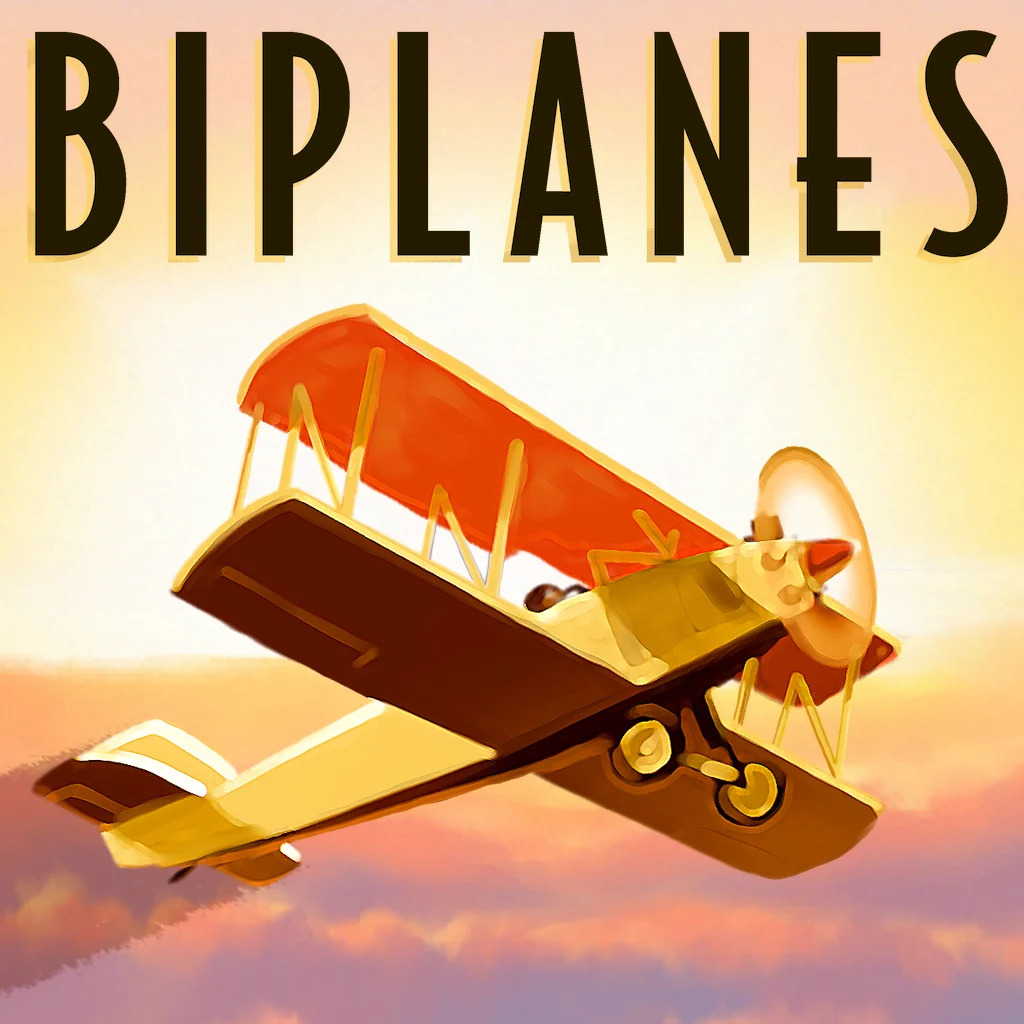
At a time when many competitive games lean heavily on progression systems, unlockable perks, and complex mechanics, Biplanes takes a refreshingly different approach. Inspired by early aviation and classic arcade dogfighters, it pares aerial combat back to its bare essentials — speed, positioning, and timing — and builds its experience around mastery rather than accumulation.
This is not a game about grinding. It’s about flying better than your opponent.
Biplanes may look simple on the surface, but beneath its minimalist presentation lies a surprisingly deep competitive experience that rewards practice, awareness, and raw piloting skill.
A Pure Focus on Flight
The core appeal of Biplanes lies in its uncompromising focus on flight mechanics. Players pilot nimble, early-era aircraft in tight aerial arenas, engaging in fast-paced dogfights that emphasise momentum and spatial awareness.
Controls are immediately responsive, but mastering them takes time. Turning too sharply can bleed speed, poor positioning can leave you exposed, and reckless aggression is often punished. Every movement feels deliberate, reinforcing the idea that success comes from understanding your aircraft rather than overpowering your opponent.
Unlike modern aerial combat games that layer on radar systems, lock-on missiles, and assist-heavy targeting, Biplanes trusts players to read the battlefield themselves. There’s a clarity to the experience — you always know why you won or lost an engagement.
Combat That Rewards Skill, Not Systems
Combat in Biplanes is straightforward by design. Planes are lightly armed, encounters are quick, and survivability depends entirely on how well you manage altitude, speed, and positioning.
This stripped-back design creates tense, high-stakes engagements. A single mistake can be fatal, but a well-timed manoeuvre can turn the tide instantly. There’s little room for error, and that’s precisely where the game’s appeal lies.
Importantly, Biplanes avoids overcomplicating progression. There are no bloated upgrade trees or stat-heavy loadouts that create uneven matches. Every player enters combat on equal footing, and victory is determined almost entirely by skill.
For competitive-minded players, this is a major strength. For newcomers, it can be intimidating — but the learning curve feels fair rather than punishing.
Multiplayer at the Core
Biplanes is, at its heart, a multiplayer-focused experience. Matches are quick, intense, and designed to encourage rematches. The game thrives on momentum, both in the air and between rounds.
The matchmaking experience is straightforward, prioritising speed over elaborate presentation. Once in a match, the focus is entirely on flying and fighting. There are no distractions, no unnecessary downtime — just aerial combat distilled to its essence.
Team-based modes add a layer of coordination without overwhelming the core mechanics. Communication and positioning become just as important as individual skill, rewarding players who can read both their allies and their opponents.
That said, Biplanes is unapologetically competitive. Players looking for a casual, low-pressure experience may find its intensity overwhelming, particularly in matches against more experienced pilots.
Visual Simplicity with Purpose
Visually, Biplanes adopts a clean, minimalist aesthetic that prioritises readability over spectacle. Aircraft designs are clear and distinct, environments are uncluttered, and visual noise is kept to a minimum.
This approach serves the gameplay exceptionally well. In a fast-paced dogfighting game, clarity is critical. Players need to track opponents, judge distances, and react quickly, and Biplanes ensures nothing gets in the way of that.
While the game won’t impress those looking for cutting-edge visuals, its art direction feels intentional rather than budget-driven. Everything exists to support the action, not distract from it.
Sound Design and Atmosphere
The audio design in Biplanes reinforces its mechanical focus. Engine sounds convey speed and momentum effectively, while weapon effects are sharp and impactful without becoming overwhelming.
There’s little in the way of bombastic music, and that restraint works in the game’s favour. Matches feel tense and focused, with sound cues playing a functional role rather than trying to create cinematic spectacle.
It’s an understated soundscape, but one that complements the game’s stripped-back philosophy.
Learning Curve and Longevity
Biplanes does not hold players’ hands for long. The basics are easy enough to grasp, but true mastery takes time. Understanding energy management, predicting opponent movement, and maintaining positional advantage are skills that only develop through repeated play.
This gives the game strong longevity for players willing to invest the time. Each match feels like an opportunity to improve, and progress is measured in performance rather than unlocks.
However, this same quality may limit the game’s broader appeal. Without extensive single-player content or progression-based rewards, players who rely on external motivation systems may struggle to stay engaged.
Biplanes knows its audience — and it caters to them unapologetically.
Where Biplanes Falls Short
The game’s narrow focus is both its greatest strength and its most notable limitation. There’s little in the way of variety beyond core multiplayer modes, and players looking for narrative context, customisation depth, or experimental mechanics may find the experience too lean.
Additionally, while the minimalist presentation supports gameplay, it can sometimes make matches feel visually repetitive over extended sessions.
These issues don’t undermine the game’s core design, but they do define its scope. Biplanes is a precision instrument, not a content-heavy package.
Final Verdict
Biplanes is a confident, uncompromising aerial combat game that understands exactly what it wants to be. By stripping dogfighting back to its fundamentals, it delivers a tense, skill-driven experience that rewards mastery and punishes complacency.
It won’t appeal to everyone — and it doesn’t try to. But for players who value pure mechanics, competitive integrity, and tight design, Biplanes offers a refreshingly focused alternative to modern multiplayer excess.
Sometimes, less really is more.