In a market saturated with gritty realism and high-budget spectacle, Bluebie VS The Army of Cyborgs arrives with a refreshing sense of personality and purpose. This PC action-platformer embraces colourful absurdity, straightforward mechanics, and classic arcade sensibilities to deliver a game that prioritises fun, responsiveness, and charm over complexity for complexity’s sake. It is a title that knows exactly what it wants to be: a fast-paced, accessible action game with enough depth to reward skill, but without the barriers that often alienate more casual players.
After extensive time with its campaign, optional challenges, and higher difficulty modes, Bluebie VS The Army of Cyborgs proves itself to be a confident and enjoyable experience. While it doesn’t aim for narrative profundity or cutting-edge technical innovation, it succeeds by refining familiar ideas into a cohesive, energetic package that feels consistently rewarding to play.
Premise and Identity
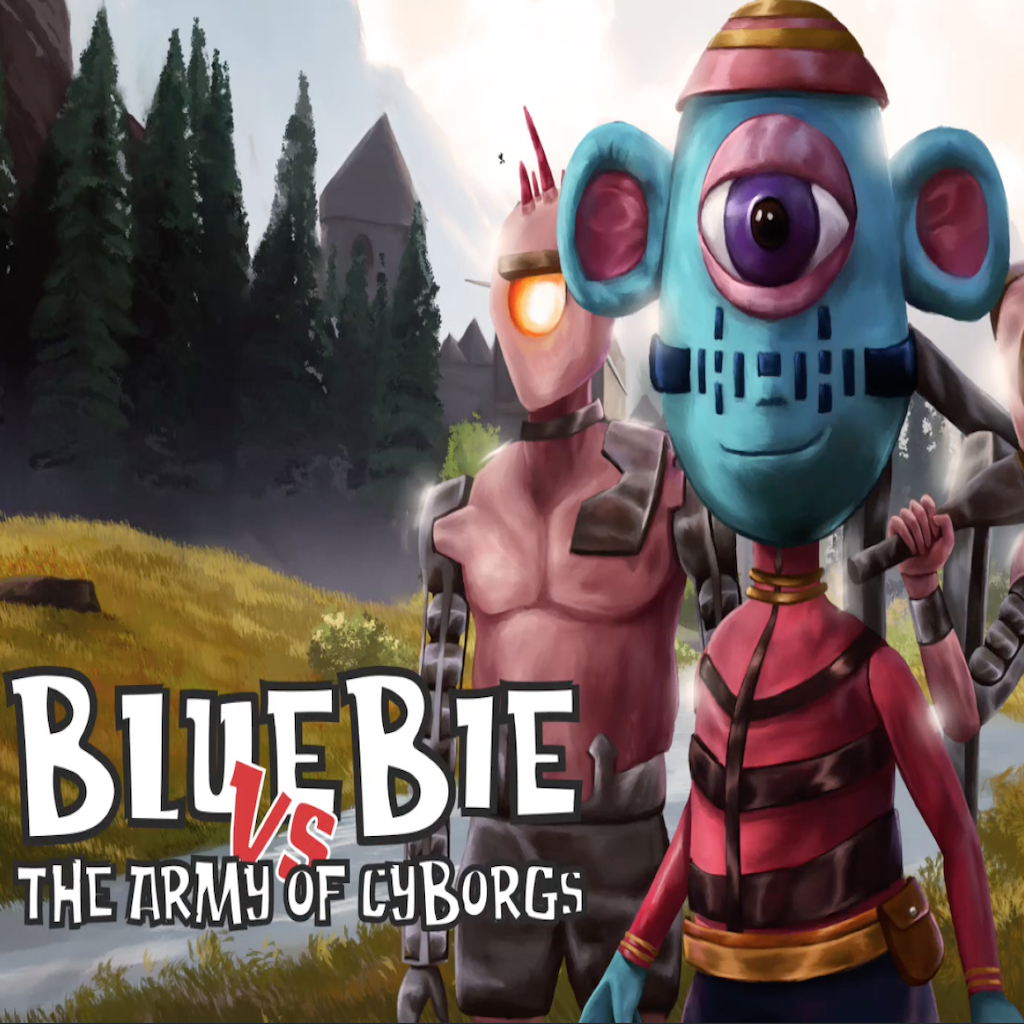
At its heart, Bluebie VS The Army of Cyborgs is a classic “hero versus overwhelming odds” story, presented with a playful tone and vibrant aesthetic. Players take control of Bluebie, a small but determined protagonist facing off against a mechanised cyborg army bent on domination. The setup is intentionally simple, allowing the game to focus on gameplay momentum rather than narrative exposition.
The story unfolds through brief cutscenes and visual cues rather than lengthy dialogue or lore dumps. This approach suits the game’s arcade-inspired structure, ensuring that the narrative enhances pacing instead of interrupting it. The cyborg antagonists are exaggerated and stylised, leaning more toward Saturday morning cartoon villainy than dystopian menace, which reinforces the game’s light-hearted identity.
Rather than attempting to deliver emotional gravitas, the game leans into humour, contrast, and charm. Bluebie’s expressive animations and the over-the-top enemy designs help establish a tone that is consistently upbeat, even when the challenge ramps up.
Visual Style and Presentation
Visually, Bluebie VS The Army of Cyborgs is immediately engaging. The game employs a bold colour palette, with Bluebie’s vibrant design standing out sharply against metallic environments, industrial backdrops, and neon-lit enemy facilities. This contrast is not only aesthetically pleasing but also functionally smart, ensuring excellent visual readability during fast-paced action.
Level environments are varied enough to maintain interest throughout the campaign. Players move through cityscapes, mechanical factories, underground labs, and hostile outdoor zones, each introducing subtle environmental hazards or traversal challenges. While these areas are not overly detailed, they are cleanly designed and easy to navigate, keeping the focus firmly on movement and combat.
Animations are smooth and expressive. Bluebie’s movements — from running and jumping to attacking and dodging — feel responsive and fluid. Enemy animations clearly telegraph attacks, which is crucial in a game that rewards timing and positioning. Visual effects such as explosions, energy blasts, and enemy destruction are colourful and satisfying without cluttering the screen.
Core Gameplay and Mechanics
Gameplay in Bluebie VS The Army of Cyborgs is built around traditional action-platforming fundamentals: precise movement, responsive combat, and escalating enemy encounters. Controls are intuitive and tight, allowing players to chain jumps, attacks, and evasive manoeuvres with confidence.
Combat is straightforward but effective. Bluebie has access to a small but versatile set of abilities that evolve over time. Basic attacks are quick and reliable, while special moves introduce area damage, ranged options, or defensive utility. These abilities are introduced gradually, ensuring that the learning curve remains approachable while still expanding tactical options as the game progresses.
Enemy variety plays a significant role in maintaining engagement. Early foes are simple and forgiving, allowing players to learn attack patterns and movement timing. As the game advances, cyborg enemies become more aggressive and specialised, introducing shields, ranged attacks, and coordinated behaviours that require more thoughtful engagement.
Boss encounters are highlights of the experience. Each major boss is visually distinct and mechanically unique, often built around multi-phase battles that test both reflexes and pattern recognition. These encounters strike a satisfying balance between challenge and fairness, rarely feeling cheap or overwhelming.
Level Design and Pacing
Level design in Bluebie VS The Army of Cyborgs is consistently strong. Stages are compact enough to avoid fatigue but layered enough to reward exploration and mastery. Hidden collectibles, optional paths, and bonus challenges encourage players to replay levels or deviate from the main route.
The pacing is particularly well-handled. Levels rarely overstay their welcome, and the game alternates between combat-heavy sequences and platforming-focused sections to prevent monotony. Checkpoints are placed generously, reducing frustration without trivialising challenge.
Difficulty ramps up steadily, especially in the latter half of the campaign. While the game remains accessible to less experienced players, those seeking a tougher test can engage with higher difficulty modes that demand tighter execution and more efficient use of abilities.
Progression and Replayability
Progression in Bluebie VS The Army of Cyborgs is intentionally streamlined. Rather than complex skill trees or RPG-style stat management, upgrades are focused on enhancing existing abilities or unlocking situational tools. This keeps the game’s systems easy to understand while still providing a sense of growth.
Replayability is supported through optional challenges, collectible hunting, and difficulty modes. Completing levels with higher performance ratings or uncovering all secrets adds longevity, particularly for players who enjoy mastering mechanics and optimising runs.
However, players looking for deep meta-progression or extensive post-game content may find the experience somewhat finite. Once the main campaign and optional challenges are complete, there is limited incentive beyond personal mastery to continue playing. This is not necessarily a flaw, but it does define the game’s scope.
Audio and Sound Design
The audio design complements the game’s energetic tone. Sound effects are punchy and clear, providing satisfying feedback for attacks, jumps, and enemy defeats. Audio cues play an important role in combat, helping players anticipate threats and react accordingly.
The soundtrack leans into upbeat electronic and action-oriented themes that suit the game’s pace. While not especially memorable on its own, the music effectively reinforces momentum and never becomes distracting or repetitive during extended play sessions.
Accessibility and Learning Curve
One of the game’s strengths is its accessibility. Controls are simple, tutorials are concise, and mechanics are introduced gradually. Players new to action-platformers will find the experience welcoming, while veterans can appreciate the responsive controls and refined design.
Accessibility options are functional but limited. While basic settings allow players to adjust difficulty and controls, additional features such as visual assist modes or advanced customisation could broaden the game’s appeal further.
Critiques and Limitations
Despite its many strengths, Bluebie VS The Army of Cyborgs is not without shortcomings. The narrative, while charming, remains shallow and largely secondary to gameplay. Players seeking deeper storytelling or character development may find the experience lacking in emotional depth.
Additionally, while enemy variety is solid, some late-game encounters rely heavily on familiar patterns rather than introducing entirely new mechanics. A broader range of late-game surprises could have elevated the final stretch of the campaign.
Final Verdict
Bluebie VS The Army of Cyborgs is a joyful and well-executed action-platformer that succeeds by embracing clarity, charm, and polished fundamentals. Its tight controls, colourful presentation, and satisfying combat make it an easy recommendation for players seeking an energetic, approachable experience.
While it may not push genre boundaries or offer extensive long-term systems, it delivers exactly what it promises: fast, fun, and engaging action from start to finish.