In a virtual reality ecosystem where intense shooters, puzzle expeditions, and narrative adventures all jostle for attention, Oldest Golden Treasure positions itself as a throwback to classic dungeon-delving and treasure-hunting thrills. On Meta Quest, the game blends environmental exploration, physics-driven interaction, and a minimalist emergent narrative to deliver a VR experience rooted in curiosity, spatial problem-solving, and the visceral joy of discovery. Over the course of extended play sessions, Oldest Golden Treasure proves to be an engaging entry in the VR adventure genre, offering satisfying variety in its environmental challenges and a strong sense of presence — even if some mechanical and progression systems hold it back from achieving outright greatness.
At its best, Oldest Golden Treasure delivers a tactile, immersive journey into labyrinthine tombs filled with environmental puzzles, hidden mechanisms, and atmospheric design. Moments of discovery — uncovering a secret chamber, assembling an ancient mechanism, or navigating perilous terrain — are consistently rewarding and often beautifully realised in VR. At its weakest, the title occasionally struggles with pacing, a somewhat repetitive core loop, and systems that feel under-scaffolded for players expecting deeper narrative or action complexity. Still, for anyone seeking an exploratory VR adventure grounded in embodied interaction and environmental storytelling, Oldest Golden Treasure is a richly textured world worth delving into.
Concept and Core Identity
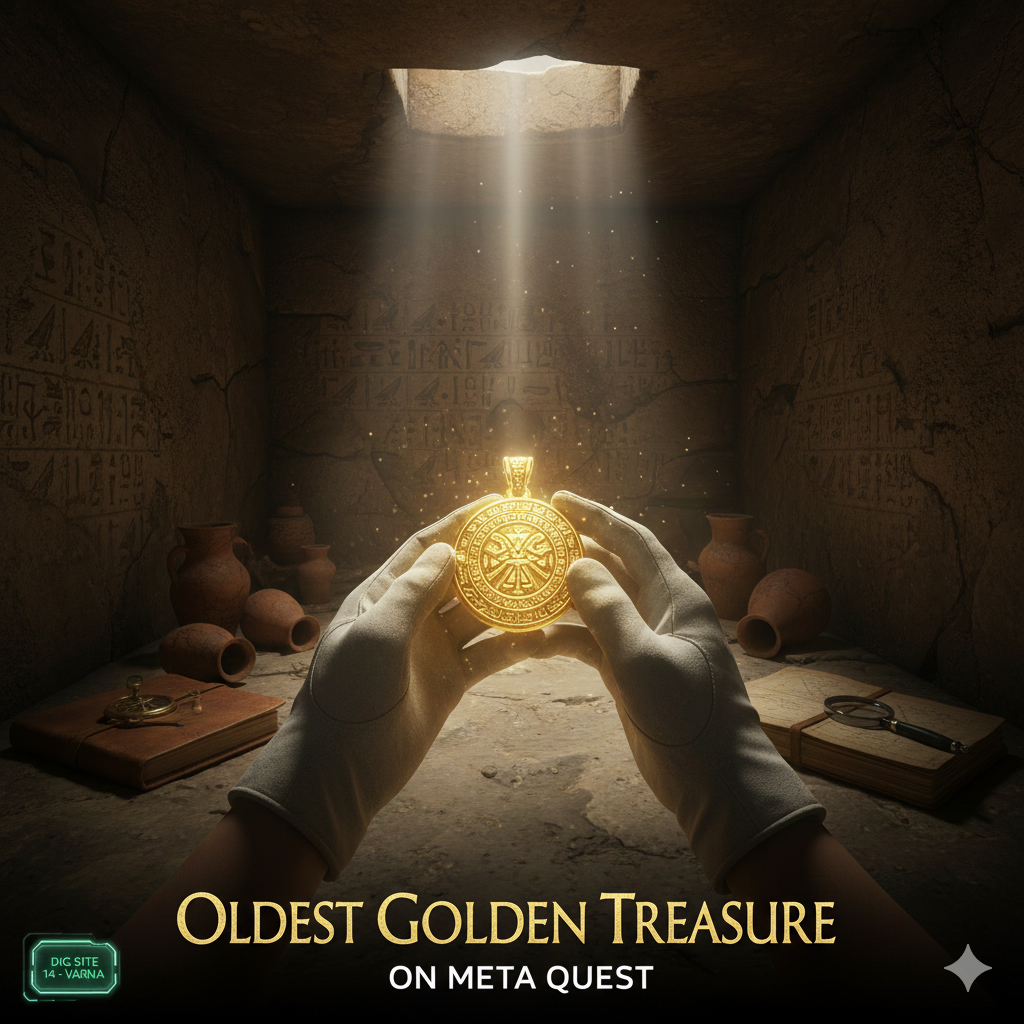
Oldest Golden Treasure invites players into a world where mystery, antiquity, and risk converge. From the outset, you are cast as a fortune-seeker navigating ancient ruins, forgotten crypts, and treacherous landscapes to uncover legendary treasures. Unlike action-focused VR titles that prioritise combat or timed encounters, this game emphasises environmental engagement. Players must decipher mechanisms, manipulate objects, and interpret spatial cues to progress deeper into the labyrinthine environments that hide the “golden treasure” at the game’s heart.
This focus on exploration and puzzle interaction gives Oldest Golden Treasure a distinct identity within Quest’s catalogue. The game doesn’t centre on narrative monologues or character arcs; instead, it uses environmental storytelling — hieroglyphs, architectural motifs, and contextual artefacts — to suggest a larger ancient world that existed long before the player arrived. The result is a simulation of excavation and discovery rather than a traditional guided story.
Environmental Immersion and World Design
The first striking feature of Oldest Golden Treasure is its environmental design. From moss-covered stone corridors to sun-dappled desert entrances, each zone feels like a distinct chapter in an archaeological saga. The game’s art direction blends realistic textures with stylised lighting that enhances readability without sacrificing mood. Environments are crafted with deliberate attention to detail — cracks in stone, shifted pillars, and weathered carvings all contribute to a living history that invites scrutiny.
VR’s immersive potential is fully leveraged here. The sense of presence when stepping into a vast chamber or peering down a dimly lit passage is palpably satisfying. Spatial audio reinforces this immersion: distant echoes, drops of water, wind through open ruins and subtle ambient cues help situate the player within each space rather than making it feel like a backdrop.
It’s in this immersive environmental canvas that the core joys of Oldest Golden Treasure reside. The game encourages you to observe, interpret, and touch the world, and its design consistently rewards engagement.
Puzzle Mechanics and Interaction
Interaction in Oldest Golden Treasure is primarily physics-based and tactile. Players climb ledges, manipulate levers, rotate ancient wheels, and assemble mechanisms with hand-based gestures that feel intuitive and physically grounded. These interactions go beyond superficial point-and-click mechanics; the VR system maps your movement in space to physical action in the game world, making every motion — from lifting a heavy stone slab to turning a cranked dial — feel embodied.
Puzzles vary in type and complexity. Some early interactions are introductory — simple switches or basic alignment challenges. Later, puzzles demand spatial reasoning, symbolic interpretation, and an understanding of interconnected systems. A particularly satisfying moment in the game comes when you uncover a hidden mechanism that reconfigures an entire chamber, opening new paths and recontextualising what you thought you understood about the environment’s architecture.
The tactile quality of these mechanics is one of the game’s greatest strengths. This isn’t just “interacting with hotspots”; it feels like manipulating relics. Pulling a massive stone block into place or carefully balancing rotating rings to match ancient inscriptions is gratifying because it directly reflects your body’s motion and intent.
Yet the puzzle pacing isn’t perfect. Some players may encounter moments where hints or gentle guidance would ease frustration; a handful of interactions feel ambiguous in purpose without subtle environmental cues to orient attention. Greater integration of environmental storytelling or dynamic feedback for partially solved mechanisms could help smooth these occasional rough patches.
Exploration and Navigation Structures
Navigation through Oldest Golden Treasure unfolds across several distinct zones, each introducing new visual themes and puzzle contexts. Environmental transitions — from open tomb entrances to claustrophobic interior corridors — work to pace exploration, introduce variety, and provide natural breathers between more demanding puzzles.
Rather than fixed linear corridors, the game offers semi-branching paths. Optional chambers often hide side puzzles or valuable artefacts, rewarding players who take the time to explore every niche. This non-linear approach enhances replayability and reinforces the sense that this world is rich with secrets — not simply a sequence to be memorised.
However, some navigation challenges arise from limited signposting. Occasional sections feel indistinct from one another, leading to moments of spatial confusion. While part of the joy in exploration is the joy of discovery, subtle navigational aids — carved trail markers, light cues, dynamic sound directionality — could help reduce aimless wandering without undermining the experience’s immersive intent.
Presentation, Audio, and Immersion
Visually, Oldest Golden Treasure balances graphical fidelity with performance considerations on standalone hardware. Textures, lighting, and spatial effects feel crisp and coherent. While not striving for hyperrealism, the aesthetic serves both readability and mood, ensuring that players can identify key objects and environmental cues without sacrificing atmosphere.
Audio design is another highlight. Spatial audio helps players locate interactive elements, and environmental ambiances are layered and contextually responsive. The sound of distant waterfalls in a cavern chamber or the hollow reverberation of an underground hall adds depth to exploration and enhances presence.
Music is used sparingly but effectively, with ambient themes that swell during key revelations or transitions. This judicious use of score allows silence and environmental sound to carry nuance, preserving tension and focus during puzzling sequences.
Accessibility and Comfort Considerations
Oldest Golden Treasure performs well in terms of accessibility. The game supports both seated and standing play and provides adjustable comfort settings that cater to VR newcomers and veterans alike. Locomotion systems are intuitive, and movement through space feels smooth without inducing undue motion sickness — a critical design requirement for exploratory VR titles.
Interactions are designed to be learnable without steep overhead. Tutorials — where present — are concise and contextual rather than intrusive, allowing players to get into the flow of exploration quickly. Still, adaptive hint systems or optional progress nudges could benefit players who prefer clearer guidance during complex puzzle segments.
Progression and Longevity
Progression in Oldest Golden Treasure is tied to exploration and puzzle mastery rather than linear narrative milestones or competitive scoring. Players unlock new zones and learn deeper environmental mechanics as they progress, which creates a sense of organic discovery. Optional chambers, hidden artefacts, and side puzzles bolster longevity for players who enjoy thorough exploration.
However, those seeking structured goals, achievement systems, or stronger narrative hooks may find the experience’s emerging storytelling approach less satisfying. While the environmental storytelling is rich and evocative, the lack of clearly articulated narrative progression — character arcs, climactic beats, or evolving plot revelations — means that the game’s emotional stakes are more atmospheric than dramatic.
Final Verdict
Oldest Golden Treasure is a thoughtfully crafted VR adventure that rewards presence, patience, and embodied exploration. Its environmental design, tactile mechanics, and immersive audio work together to create a compelling sense of being an explorer in alien yet believable ancient architectures. While its narrative structure leans toward the subtle rather than the explicit, and its pacing occasionally slows, the sensory experience and puzzle design make it a standout example of what VR can do when it foregrounds physical interaction and expressive space.