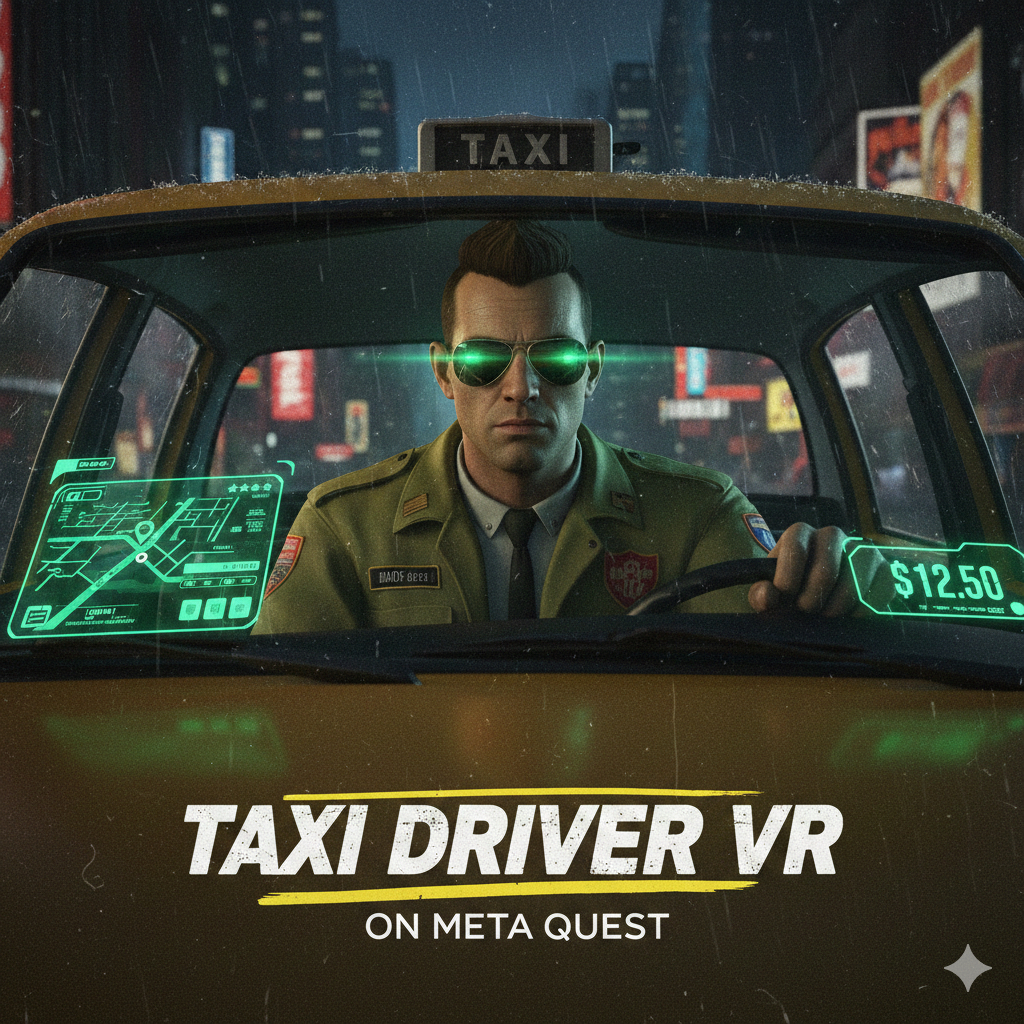
In a market saturated with action experiences, shooters, and puzzle-centric virtual reality titles, TAXI DRIVER VR stakes its claim as a decidedly grounded and character-driven simulation. Eschewing unrealistic fantasy or high-speed spectacle, this game casts you in the driver’s seat of a city taxi — complete with the mundane, the chaotic, and the delightfully unexpected moments that come with transporting strangers through an urban landscape. On Meta Quest hardware, TAXI DRIVER VR delivers an experience that is at once reflective, humorous, occasionally stressful, and remarkably immersive in its simplicity. By prioritising presence, environmental storytelling, and human interaction over bombastic set pieces or genre gimmicks, the game offers a compelling blend of quotidian life simulation and emergent narrative.
After extensive playtesting across varied city districts, shifts, and passenger types, TAXI DRIVER VR reveals itself as a thoughtful, playful, and engaging title that turns routine into rhythm and routine passengers into stories worth experiencing. Its strengths lie in environmental immersion, character interactions, and a clever blend of challenge and comedy. Its weaknesses, meanwhile, reside in limited long-term progression and occasional repetitive patterns. Ultimately, however, the game’s charm and VR presence make it an experience well worth exploring — especially for players seeking escape not through fantasy, but through lived, virtual experience.
Concept and Core Identity
At its core, TAXI DRIVER VR is built around an intuitive premise: you are a taxi driver navigating a bustling city, picking up passengers, and ferrying them to destinations while managing time, route efficiency, and the occasional social dynamic that comes with transporting another human being. There is no overarching fantastical storyline; instead, the game derives its depth from interactions, emergent scenarios, and subtle worldbuilding.
This conceptual focus on everyday life — on the friction and flow of humanity intersecting within the confines of your vehicle — sets TAXI DRIVER VR apart from most VR titles. Where many games rely on spectacle or scripted quests, this title asks you to find meaning and entertainment in the ordinary. The result is a game that feels less like a transient diversion and more like a lived experience.
Immersive Visual and Environmental Design
One of the most impressive aspects of TAXI DRIVER VR is its environmental presentation. The city feels alive: pedestrians mill about sidewalks, traffic lights change rhythmically, distant sirens wail, and neon signage casts vibrant reflections on wet streets at night. Weather cycles and day-night transitions are represented convincingly, and performance remains stable even during busy traffic or crowded districts.
The interior of your taxi is meticulously realised, too. Dashboard elements are tangible and functional, mirrors reflect the city with surprising fidelity, and sound cues (door chimes, honking horns, turn signals) are spatialised effectively. These details combine to deliver not just a game, but a presence — a feeling of sitting behind the wheel and weaving through an urban sprawl that feels genuinely inhabited.
Visually, the game strikes a balance between stylised rendering and recognisable realism. It doesn’t aim for photoreal fidelity, but the aesthetic choices support readability, creative expression, and visual charm — all of which enhance prolonged engagement without fatiguing the senses.
Gameplay Mechanics and Interaction
Driving mechanics in TAXI DRIVER VR are intuitive and responsive. Steering, acceleration, and braking are mapped naturally to the headset’s input systems, and vehicle handling feels grounded without being unwieldy. Navigating tight city streets, busy intersections, and parking challenges requires attention and rhythm, but rarely frustration. The game’s physics and collision feedback strike a rhythmic balance that rewards attention without punishing minor errors excessively.
Navigation is facilitated by an in-cab GPS system that provides clear, unobtrusive guidance. While players are free to plot their own routes, most passengers provide a destination, and the game’s routing feels fluid and forgiving. Route choices matter: quicker paths may involve congested streets, while longer avenues can mean smoother travel but delayed fares. This simple layer of choice introduces subtle strategic consideration that elevates what could otherwise be a purely rote task.
Passenger interactions are where the game truly comes alive. Characters pop in and out of your taxi with distinct personalities, vocal cues, and conversational snippets that vary based on mood, destination, and circumstances. Some passengers are chatty and friendly; others are taciturn or irritable. Occasionally, you’ll encounter passengers with uncommon requests — changes in destination mid-ride, unusual drop-off points, or urgent pleas that inject narrative spice into what would otherwise be a predictable journey.
Your responses — whether verbal, gestural, or through menu options — influence passenger satisfaction, tips, and in some cases subsequent narrative threads. While these interactions do not constitute a branching story arc, they do create emergent moments that feel shared rather than scripted.
Daily Rhythm and Progression Structure
The game employs a shift-based structure: players take on a “workday” that spans a series of rides, earnings, and experience progression before ending the shift and evaluating performance. Earnings can be spent on cosmetic upgrades, taxi customisation, and modest performance enhancements (e.g., handling or fuel efficiency). While these progression mechanics are not deep, they provide incremental goals that help sustain long-term play.
Daily objectives — such as achieving a certain number of high-satisfaction rides, completing rides within a time limit, or navigating special events (e.g., weather challenges, peak hour chaos) — inject variety into the routine. Yet some players may find that these goals begin to repeat over time. The game’s strength lies more in moment-to-moment engagement than in an overarching campaign arc.
Audio Design and Character Identity
Audio in TAXI DRIVER VR plays a central role in shaping presence. Spatially accurate city ambience (horns, footsteps, distant chatter, ambient music from street performers) keeps the world sounding vibrant even on quieter streets. The voice acting for passengers is expressive and varied, though infrequently fully scripted; most interactions are short, but enough to imbue characters with identifiable personalities.
Music — both licensed and ambient — is integrated tastefully. Playlists play in the background during transit, and the soundtrack adapts subtly based on urban zones, weather conditions, and time of day. This dynamic layering gives the city life beyond visuals and mechanics, making each shift feel atmospherically unique.
Accessibility and Comfort Options
Taxi Driver VR makes smart use of accessibility settings. Players can select between smooth or teleport locomotion for entering/exiting the taxi, enjoy adjustable comfort vignette settings, and choose seated or standing play modes. The menu system is clear and intuitive, and prompts guide players through mechanics without interrupting flow.
These comfort options are essential in a simulation that relies on extended play and physical gestural engagement. Whether you prefer short bursts or marathon sessions, the game’s flexibility helps accommodate diverse play styles and motion tolerances.
Critiques and Limitations
Despite its many strengths, TAXI DRIVER VR is not without limitations. Progression systems, while functional, lack depth. Story arcs are emergent rather than structured, which can be either a strength or weakness depending on player preference. Some may crave a more dramatic narrative framework or long-term objectives beyond daily shifts.
Additionally, while passenger interactions are engaging, they are largely dialogue snippets without long-term ramifications. There’s a sense that deeper character development or ongoing storylines could have elevated the game’s emotional resonance without compromising its simulation focus.
Finally, while the city is expansive and varied, zoning can feel visually repetitive after extended hours. Distinct architectural landmarks and district identities help, but over time the core urban layout can begin to feel familiar rather than continuously novel.
Final Verdict
TAXI DRIVER VR crafts a compelling blend of lived experience, character interaction, and tactile engagement that distinguishes it from many VR titles. It isn’t a high-octane action ride, nor a sprawling narrative epic; instead, it offers the satisfying rhythm of routine — punctuated by human stories, time-pressured challenges, and unforeseen encounters that bring personality to every shift. Its fidelity to physical movement, environmental immersion, and emergent storytelling marks it as one of the strongest simulation experiences on Meta Quest.