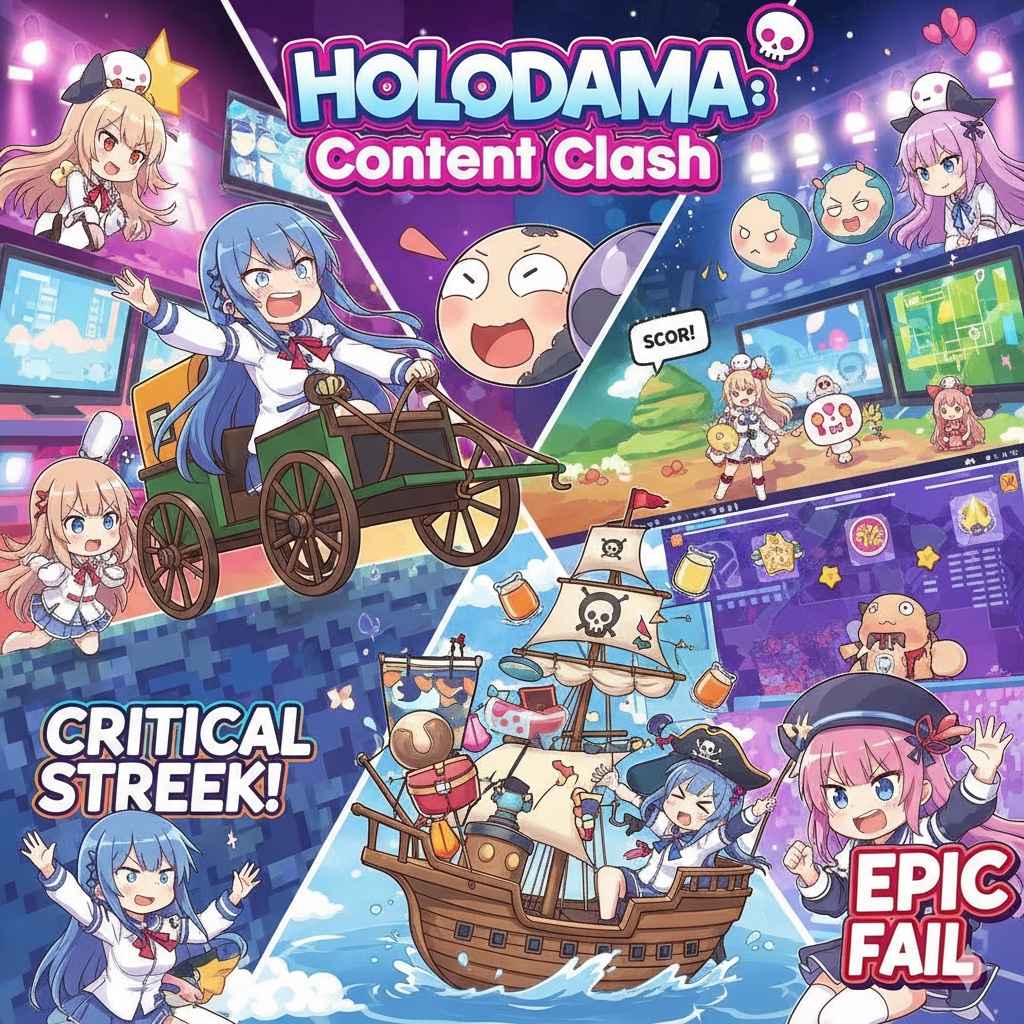
In a saturated arena-combat landscape dominated by hero shooters and live-service shooters, HOLODAMA: Content Clash stakes its claim with a bold proposition: chaotic, fast-paced multiplayer combat driven by dynamic gadgets, environmental mayhem, and a distinctly stylised visual identity. Developed by Mirowin Interactive, this online-only title blends elements of arena shooters, capture-the-flag objectives, and unpredictable level hazards to deliver an experience that is as volatile as it is vibrant.
HOLODAMA does not present itself as a hyper-realistic tactical simulator. Instead, it wears its arcade heart on its sleeve, emphasising immediacy and spectacle over deep systematic mastery. What emerges is a game that thrives in frantic engagements, unpredictable outcomes, and tactical invention — but one that also contends with balance challenges and feature gaps that temper its broader appeal.
Concept and Core Loop
At its core, Content Clash is about engagement and escalation. Matches are structured around short, explosive rounds featuring two opposing teams vying for objectives that shift dynamically across maps. Players choose from a roster of operatives — each equipped with distinctive gadgets, movement abilities, and combat roles — and must adapt on the fly to environments that can change mid-match.
This environmental dynamism is among the game’s most uniquely defining features: arenas can transform dramatically during a clash, triggered by timers, score thresholds, or random events. Platforms may retract, hazards can activate, and sections of the level can collapse or reconfigure entirely, forcing players to think fluidly rather than relying on memorised routes or safe zones.
The result is an emergent, almost unpredictable combat rhythm. A hillside flank you relied upon moments ago may vanish under toxic mist; a sniper perch you held may become inaccessible due to an environmental reset. This conceit pushes HOLODAMA into a niche between traditional arena shooters and interactive multiplayer environments — a space where environmental awareness matters as much as aiming skill or gadget timing.
The core loop — enter match, secure objectives, adapt to shifting terrain, and compete for a round victory — is tight and repeatable. Most matches conclude in under ten minutes, allowing players to jump in and out without feeling bogged down by overlong sessions. This arc is ideal for casual players seeking instant gratification, as well as for competitive players who appreciate rapid turnover in tactical scenarios.
Combat Mechanics and Movement
Combat in HOLODAMA is intentionally brisk. Weapons are responsive, movement is fluid, and the tactile feedback of gadgets and weapon fire hits with satisfying punch. The arsenal spans conventional firearms, energy-based tools, deployables, and signature abilities tied to each operator class.
Movement is a highlight. Dodges, short boosts, and situational traversal tools (such as grappling hooks or hover jets) ensure verticality and momentum play significant roles. Mastering spatial navigation is as important as marksmanship, and the interplay between movement and combat often catalyses spectacular exchanges that feel both improvisational and narratively driven by player decisions.
Gadget design is similarly thoughtful. While some abilities feel more utility-centric (deployable shields, scanning pulses), others enable dramatic plays (area denial fields, concealment zones, mobility enhancers). These tools are not merely embellishments; they materially alter how engagements unfold, especially when combined with the mutable arenas. Players who internalise the synergies between gadgets, terrain shifts, and team coordination tend to outperform those who rely solely on raw aim.
However, this richness also introduces balance challenges. Some gadget combinations — particularly in higher tiers of play — can feel disproportionately powerful, creating scenarios where matches tilt heavily in favor of certain loadouts. While regular balance patches have mitigated the most egregious examples, HOLODAMA’s dynamic systems occasionally produce match outcomes that feel more dictated by meta cheese than by player skill.
Visuals, Audio, and Presentation
Visually, HOLODAMA embraces a stylised, high-contrast palette that balances clarity with flair. Characters are easily distinguishable in combat, even amidst environmental chaos, and weapon effects, ability animations, and environmental hazards are distinct without oversaturating the screen.
Maps are crafted with intention. Each environment feels unique — from urban sprawls with vertical rooftops to industrial complexes defined by conveyor belts and shifting platforms. Variable lighting, thematic diversity, and interactive elements enhance visual interest without sacrificing readability during intense combat.
Sound design is strong, if occasionally uneven. Weapon fire and ability cues carry satisfying punch, and ambient audio effectively conveys environmental shifts. However, voice communication cues can sometimes lack prominence in the mix, which can hinder coordinated play in situations where audio callbacks would otherwise strengthen tactical awareness.
The user interface is clean and informative. Ability cooldowns, objective status, and minimap data are integrated into HUD elements without cluttering the screen, contributing to a smooth gameplay flow even when matches become chaotic.
Modes, Progression, and Longevity
HOLODAMA offers a variety of modes that cater to different competitive appetites. Standard team deathmatch and objective-based clashes anchor the rotation, while limited-time events and map variants introduce seasonal novelty. These modes help sustain engagement by avoiding stagnation in gameplay routines.
Progression is handled through an unlock tree that rewards experience with new cosmetic options, operators, and gadget evolutions. While cosmetics are plentiful and visually expressive, deeper progression elements — such as robust loadout customisation tied to meaningful stat shifts — are more modest. Some competitive players may find this lack of mechanical progression limiting, especially in the absence of ranked ladders or seasonal objectives tied to long-term goals.
Multiplayer matchmaking, generally stable, benefits from cross-regional queues but can show variance in connection quality depending on server population. Community systems — including clan support, in-game friends management, and spectator modes — are serviceable but feel under-developed compared to major esports titles.
Strengths and Weaknesses
Strengths:
- Dynamic arena design that elevates tactical depth and unpredictability.
- Fluid movement and gadget interaction that reward skill and spatial awareness.
- Accessible core loop with short, repeatable match cycles.
- Stylised audiovisual presentation that balances clarity and spectacle.
Weaknesses:
- Balance volatility due to powerful gadget synergies and evolving meta.
- Progression limitations that may dampen long-term competitive investment.
- Audio clarity issues in team communication cues.
- Feature gaps in ranked play and structured progression.
Final Verdict
HOLODAMA: Content Clash is an ambitious, kinetic arena combat experience that takes familiar multiplayer foundations and electrifies them with environmental dynamism and responsive movement systems. Its core strength lies in how its mutable arenas, gadget interactions, and fast-paced engagements promote tactical inventiveness and emergent play. Moments of coordinated play — when teams adapt to sudden terrain shifts or execute well-timed gadget combinations — are deeply gratifying and evoke the best moments of competitive multiplayer.
Yet HOLODAMA also confronts challenges common to emergent systems: balance complexity, progression limitations, and feature parity with more mature esports platforms. These do not diminish the quality of the gameplay itself, but they may temper its appeal for players seeking structured, long-term competitive frameworks.
For players drawn to dynamic multiplayer combat, expressive movement, and tactical adaptability, Content Clash is a compelling entry that delivers memorable matches and surprises by design. It may not yet redefine arena shooters, but it pushes the genre forward in interesting directions.