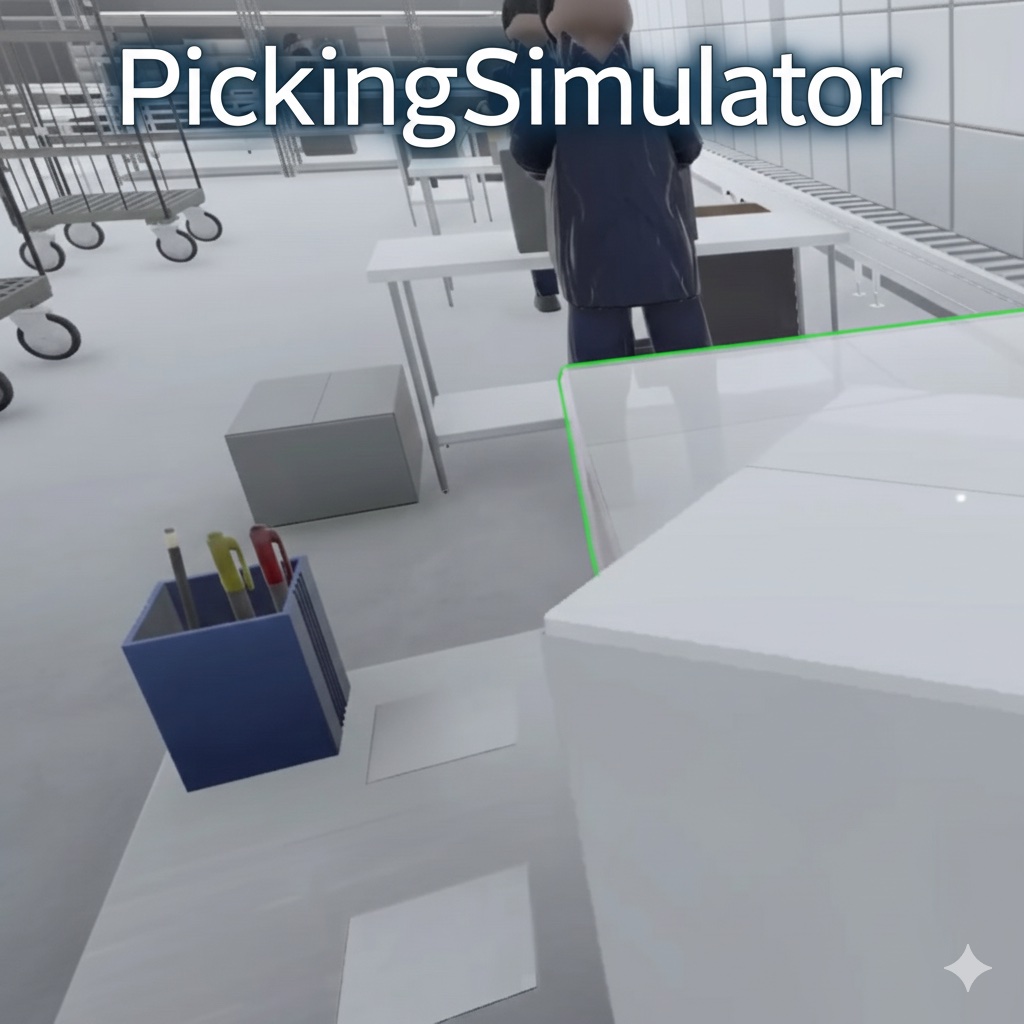
In a world where simulators span everything from farming to flight control, PickingSimulator stakes its claim in the intriguing niche of item interaction and environmental mastery. On its surface, the title’s concept is simple: pick things up, sort them, organise them, and discover the subtle satisfaction of inventory control. Yet beneath that simplicity lies a surprisingly layered experience that blends methodical mechanics, tactile feedback, and ambient problem-solving into a simulator that is far more engaging than its minimal premise might suggest.
PickingSimulator finds its strength not in flashy spectacle or rapid progression, but in the meditative rhythm of thoughtful interaction. Like its spiritual predecessors in the “sim” genre — titles that ask players to find reward in repetition, pattern recognition, and incremental optimisation — PickingSimulator is a game that rewards patience and observational acuity. Its focus is narrow, yes, but through that narrow focus it delivers a distinct kind of satisfaction that resonates once you settle into its cadence.
Premise and Core Loop
At first glance, PickingSimulator is deceptively straightforward: a world populated with assorted items awaits your attention. These items vary in shape, size, colour, and function, and the player’s objective is to collect, categorise, and organise them according to the rules of the current environment. Some levels demand simple classification; others layer constraints such as time limits, environmental hazards, or complex inventory systems that require strategic management.
What distinguishes PickingSimulator from more superficial “collect-and-sort” titles is its tactile focus. Picking up objects feels intentional, with responsive controls that prioritise clarity over abstraction. The game refrains from simulating unwieldy physics for their own sake; instead, it keeps manipulation direct and predictable, ensuring that the core interaction — lifting, moving, placing — never feels cumbersome.
The central loop — pick, sort, refine — plays out steadily, and while it risks repetition in theory, in practice the game introduces enough variation and incremental complexity to keep engagement sustainable. New environmental mechanics, item types, and sorting constraints are introduced at a thoughtful pace, ensuring that players are consistently learning without feeling overwhelmed.
Mechanics and System Design
Mechanically, PickingSimulator balances simplicity with subtle depth. At its heart is a system of object interaction that is consistent and responsive. Players use a combination of direct input and context-sensitive actions to pick up items, rotate them, inspect their properties, and place them in designated spaces. This tactile interface provides a satisfying feedback loop: the slight pause when an item snaps into its correct location, the visual confirmation of a successful classification, and the rhythm of clearing a cluttered space all contribute to a deceptively relaxing experience.
Organisational challenges grow in complexity over time. Early levels focus on straightforward classification — by colour, shape, or basic tags. But as the game progresses, PickingSimulator introduces multi-attribute sorting criteria, nested priority lists, and time-based objectives that require not just manual dexterity, but planning and spatial reasoning. For example, certain levels enforce priority access (placing specific items in limited slots before others), while others introduce weight or volume constraints that turn inventory management into a subtle optimisation problem.
These systems are not presented as overwhelming rulesets. Instead, the game layers them gradually, allowing players to absorb one mechanic before introducing the next. Tutorial segments are minimal but effective, providing enough guidance to reduce confusion without interrupting flow. In this way, PickingSimulator mirrors the rhythm of its own core activity: incremental mastery rather than sudden mastery.
Visual and Audio Presentation
Visually, PickingSimulator adopts a clean, functional aesthetic that serves its gameplay focus well. Environments are clear and uncluttered, with objects distinguished by easily readable shapes, colours, and labels. While the art direction is not destined for visual-design awards, it is precisely calibrated to support the player’s task — clarity over ostentation, readability over ornamentation.
The subtlety of the visual design works in concert with a restrained audio landscape. Ambient soundscapes — gentle hums, the faint rustle of object movement, the soft click of placement confirmations — reinforce the game’s contemplative tone. Music, where present, is light and unobtrusive, mixing ambient pads and minimal melodic cues to accentuate focus rather than break concentration.
This harmonious visual and auditory design reinforces the title’s identity: a simulator that is less about spectacle and more about presence. Many hours into play, the lack of frenetic music or sensory overload feels like a deliberate choice rather than a limitation. PickingSimulator is content to let players find pleasure in the rhythm of sorting itself.
Pacing and Player Engagement
Where PickingSimulator truly shines is in its pacing. The game understands that tension in this genre does not derive from dramatic encounters or surprise twists, but from the internal satisfaction of clearing a backlog, solving an organisational puzzle, or streamlining a chaotic space into a well-ordered system. Each level feels like a self-contained challenge with attainable goals and a clear sense of completion.
Progression is calibrated to sustain engagement without artificially stretching content. Early levels build confidence; mid-game challenges introduce complexity without frustration; and later levels synthesise all mechanics into multi-layered problems that feel both demanding and fair. The moment of completing a loosely labelled “end” level — where multiple sorting criteria intersect under time constraints — carries genuine satisfaction precisely because the mechanics leading up to it were thoughtfully paced.
Replayability exists in pursuit of better completion metrics — faster times, cleaner categorisation, fewer mistakes — but also in the joy of reducing chaos. Some levels invite repeated revisits simply because refining a strategy can be its own form of play. This low-pressure approach invites players to define success on their own terms: perfect execution, exploration, or meditation through interaction.
Strengths and Limitations
Strengths:
- Intuitive and satisfying core interaction: Picking up and manipulating objects always feels direct and responsive.
- Thoughtful pacing and layered complexity: New mechanics are introduced gradually and coherently.
- Clear presentation: Visual and audio design serves gameplay clarity over unnecessary distraction.
- Meditative rhythm: The loop of sorting and organising is genuinely relaxing and absorbing.
- Replay value through mastery goals: Time trials, score optimisation, and repeated strategy refinement.
Limitations:
- Niche appeal: Players seeking narrative drive or dramatic action may find the gameplay too subdued.
- Visual simplicity: The functional aesthetic, while effective, lacks standout artistic flair.
- Limited narrative context: Narrative elements are minimal, leaving some players wanting more thematic grounding.
Final Verdict
PickingSimulator is a deceptively simple title that delivers precisely on its promise: a focused, tactile, and methodical simulation of picking, sorting, and organising. It thrives on clarity of interaction, thoughtful escalation of mechanics, and an ambience that rewards sustained attention. While its niche may not attract those seeking high-octane action or rich narrative, for players inclined toward contemplative gameplay and systematic problem-solving, it offers a uniquely satisfying journey.
Rather than trying to be everything, PickingSimulator excels at being exactly what it sets out to be — a game that finds delight in interaction, mastery in order, and presence in the everyday act of organisation.