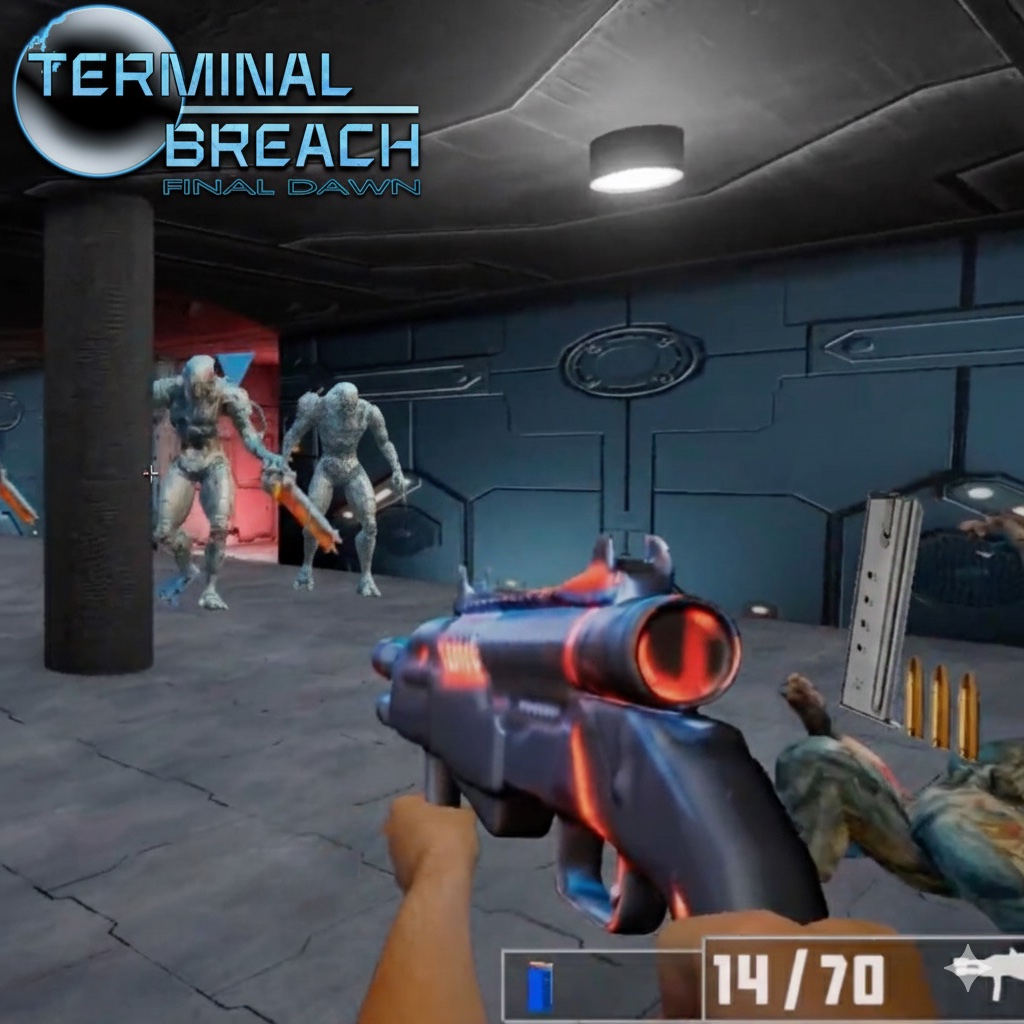
Terminal Breach: Final Dawn arrives as the culminating chapter in a cyberpunk survival-horror saga that has steadily carved out a distinctive niche among narrative-driven shooters. As both a conclusion to a broader arc and a standalone experience, Final Dawn embraces the genre’s grit, angst, and systemic paranoia, pushing its thematic ambitions further than previous entries. It is a game that heavily leans into atmosphere and consequence — rewarding patience, tactical thinking, and narrative investment even when its mechanical ambitions occasionally teeter on overreach.
At its core, Terminal Breach: Final Dawn retains the series’ signature blend of tactical third-person combat, layer-ed survival systems, and dystopian storytelling. Yet this iteration feels bigger, darker, and more methodical, with an explicit focus on narrative payoff and strategic depth. It is less about sprinting through corridors with guns blazing, and more about careful planning, resource allocation, and navigating moral ambiguity in a world where trust is a liability and hope is a rare commodity.
Thematic and Narrative Premise
At the start of Final Dawn, players once again step into the shoes of Alex Rourke, a cybernetically augmented operative caught between warring factions in a fractured megacity teetering on the brink of collapse. The central conceit involves a newly discovered “Terminal Breach” anomaly — a corrupted digital signal with the apocalyptic potential to unravel the thin veneer between cybernetic augmentation and biological humanity. With corporations jockeying for control and underground resistance movements growing increasingly radicalised, the narrative sets up a high-stakes collision between personal agency and systemic determinism.
The strength of Final Dawn lies not in a simple binary of good versus evil but in how it complicates that dichotomy. Characters, whether faction leaders or opportunistic mercenaries, possess tangible depth; dialogue choices and allegiances have real consequences that ripple throughout the game. Trust is always provisional, and decisions that seem strategically sound in the short term can carry ruinous long-term repercussions. The writing avoids melodrama without forsaking emotional texture, and its willingness to let narrative outcomes hinge on player insight is consistently rewarding.
Importantly, Final Dawn avoids narrative bloat. While its story is ambitious, it does not overwhelm with needless exposition. Instead, lore and plot threads are revealed organically — through environmental storytelling, overheard comms, data logs, and faction encounters that feel contextual rather than contrived. This measured pacing allows the narrative to breathe at moments of tension and deliver meaningful resolution without resorting to predictable twists.
Gameplay: Strategy, Survival, and Systems
While narrative depth sets Final Dawn apart, its gameplay systems are equally ambitious. The title blends third-person tactical shooter mechanics with survival elements, RPG progression, and resource management. Combat is visceral and weighty, with weapons that feel grounded despite their futuristic trappings. Enemies — whether augmented operatives, rogue AI constructs, or rival faction fighters — are smart and varied, requiring adaptive strategies rather than rote tactics.
Movement and targeting feel responsive and intuitive, and cover mechanics are robust, encouraging players to treat the environment as a partner in combat rather than a backdrop. Situational awareness is critical: sound cues, line-of-sight, and tactical positioning all matter, especially in encounters where ammunition is scarce and fallback options are limited.
The survival dimension adds another layer of strategic consideration. Resources — ammunition, medical stimulants, power cells — are finite, and crafting stations are dispersed unevenly throughout the world. This scarcity encourages conservative engagement in some scenarios, rewarding players who can balance risk and reward. Inventory management also demands attention; equipping the right gear and allocating stat upgrades can make the difference between victory and a costly retreat.
Augmentation systems are expansive. As the story progresses, players unlock cybernetic upgrades that alter playstyle. Enhanced visual targeting, reflex boosters, integrated defenses, and sensory augmentations each offer tactical advantages, but they also come with trade-offs — energy demands, increased visibility to enemy AIs, or social stigma within the game’s world. These choices reinforce the central thesis of Final Dawn: progress comes at a cost, and every enhancement shifts not just capabilities, but identity.
However, while the ambition of these systems is admirable, occasional design friction emerges. Resource scarcity can sometimes veer into frustration when it feels artificial rather than tension-building. Similarly, while the augmentation choices are meaningful, they can occasionally feel under-balanced, with certain builds outpacing others in ways that reduce tactical variety at higher levels of play. These issues do not derail the experience, but they are noticeable in extended sessions.
Worldbuilding and Environmental Design
The art direction in Terminal Breach: Final Dawn is a standout feature. The megacity is a sprawling, neon-haunted labyrinth of decaying infrastructure and corporate sprawl. Rain-soaked alleyways, abandoned precincts, and towering skyscrapers set against polluted skies create a world that feels lived-in and consequential. Environmental storytelling is woven into every district — graffiti markers from resistance groups, flickering news feeds broadcasting propaganda, and remnants of everyday life that hint at the collapse of civic order.
Lighting and weather dynamics contribute significantly to mood. Day/night cycles influence enemy behaviour and mission accessibility, while visual effects like fog, glare, and digital artifacts heighten the sense of disorientation in key narrative moments. Sound design complements these visuals with a soundscape that ranges from pounding electronic ambience to the eerie quiet of locked-down sectors.
One of the game’s notable design decisions is its minimal reliance on fast travel. While this choice reinforces immersion and the sense of urban density, it can also slow pacing in sprawling districts. Traversal can feel tedious on repeat runs, particularly when objectives require backtracking without compelling narrative incentives.
Replayability and Player Investment
Final Dawn offers significant replay value, largely driven by its branching narrative and tactical diversity. Key choices early in the narrative — which factions to trust, how to resolve moral quandaries, which augmentations to prioritise — can lead to dramatically different late-game scenarios. Multiple endings reflect the cumulative effects of these decisions, encouraging players to revisit the experience with alternate strategies or allegiance choices.
Skill progression also contributes to replayability. Players can experiment with distinct approaches: “ghost” builds that prioritise stealth and evasion; heavy-combat builds focused on brute force; or tech-oriented builds leveraging environmental hacking and sensory disruption. These varying playstyles ensure that a second playthrough can feel substantively different rather than merely familiar.
Strengths and Weaknesses
Strengths:
- Rich, morally complex narrative with meaningful choices
- Tactical combat that rewards strategy and awareness
- Immersive worldbuilding and atmospheric environmental design
- Deep augmentation and progression systems with narrative resonance
- High replay value driven by branching outcomes and playstyle diversity
Weaknesses:
- Resource balance can feel uneven, leading to artificial scarcity
- Some augmentations lack balance at higher levels
- World traversal pacing occasionally feels sluggish
- Occasional UI opacity in advanced tactical menus
Final Verdict
Terminal Breach: Final Dawn is an ambitious and atmospheric conclusion to a narrative arc that never settles for superficial spectacle. It marries tactical combat with survival instincts and philosophical inquiry into identity, agency, and consequence. While it stumbles at points under the weight of its own complexity, the overall experience is compelling, thought-provoking, and emotionally resonant.
For players who appreciate shooter mechanics intertwined with meaningful narrative stakes, Final Dawn offers one of the most substantial sci-fi action-horror experiences in recent memory. Its commitment to consequence — both mechanical and narrative — elevates it beyond genre trappings into a story about survival, choice, and what it means to remain human in a world increasingly defined by augmentation and automation.