Puzzle games often thrive on a deceptively simple premise. The most enduring examples are those that appear approachable on the surface but gradually reveal layers of strategic depth, encouraging players to refine their thinking rather than rely on reflexes alone. One More Gem fits comfortably into this tradition. It is a compact, tightly focused puzzle experience that understands the value of restraint, building tension and satisfaction through incremental complexity rather than sheer volume of mechanics.
At first glance, One More Gem presents itself as a minimalist puzzle title centred on collection and optimisation. The objective appears straightforward: gather gems, clear stages, and progress. Yet as the game unfolds, it becomes clear that each decision carries weight. The challenge lies not in what to do, but in how and when to do it, with the game consistently encouraging players to think several moves ahead.
Core Gameplay and Puzzle Design
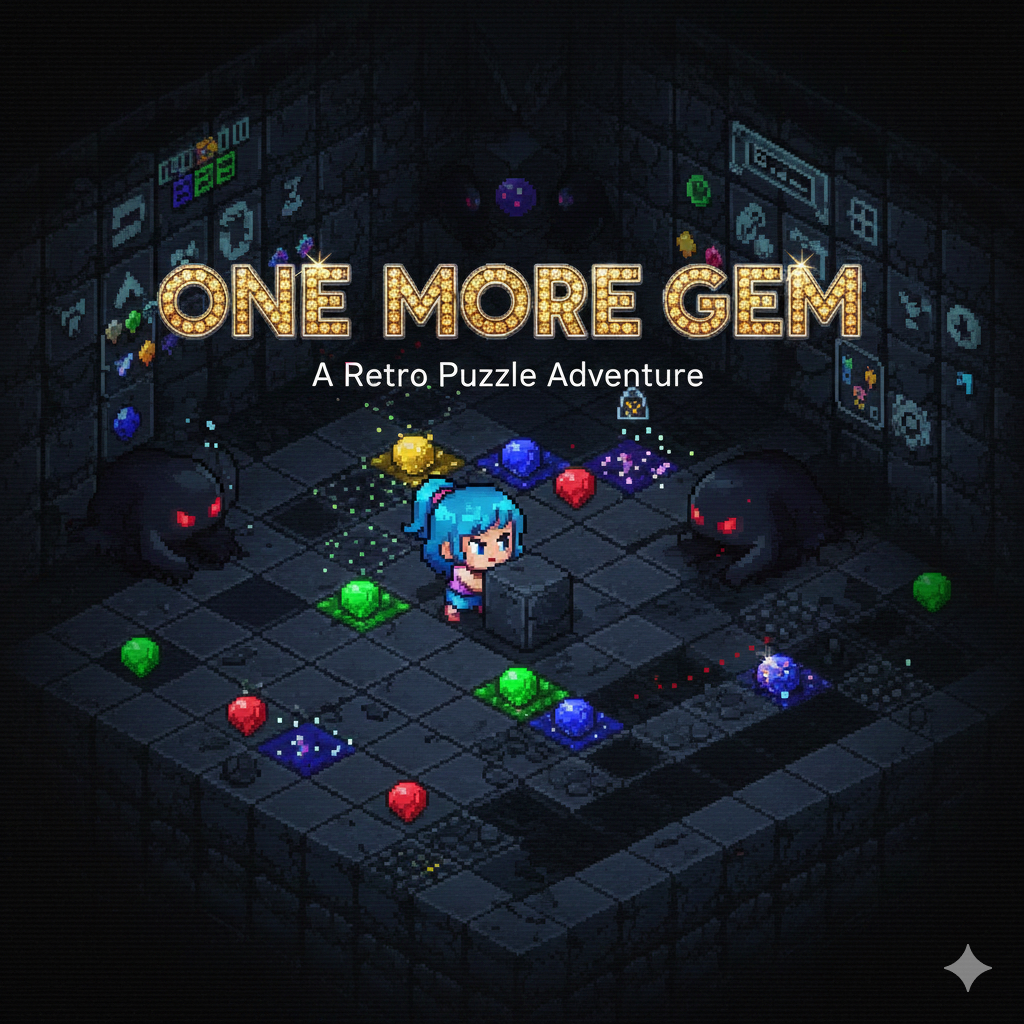
The heart of One More Gem lies in its grid-based puzzle structure. Each level presents a confined space populated by gems, obstacles, and interactive elements that must be navigated in the correct order. Movement is limited, actions are deliberate, and mistakes are rarely recoverable without restarting the level.
This structure fosters a strong sense of tension. Players are constantly balancing risk and reward, asking themselves whether collecting one more gem is worth the potential consequences. The game’s title becomes more than a phrase; it encapsulates the central dilemma that defines every level. Greed is tempting, but caution is often the wiser path.
Puzzle design is consistently thoughtful. Early stages introduce mechanics gradually, allowing players to internalise the game’s logic without overwhelming them. As new elements are layered in—such as environmental hazards, conditional triggers, or limited-use actions—the puzzles become increasingly intricate. Importantly, solutions are almost always logical. When failure occurs, it feels instructional rather than punitive, highlighting flawed assumptions or overlooked details.
The game avoids excessive hand-holding, trusting players to learn through experimentation. This approach may deter those looking for constant guidance, but it reinforces the sense of accomplishment when a solution finally clicks.
Pacing and Difficulty Curve
One More Gem demonstrates a strong understanding of pacing. Levels are concise, encouraging repeated attempts without frustration. This structure supports a “just one more try” mentality that can quickly turn a short session into a longer playthrough.
The difficulty curve is steady and well-judged. While later puzzles demand careful planning and foresight, the game rarely resorts to unfair trickery. Complexity increases through combination rather than escalation, forcing players to apply familiar mechanics in new contexts rather than simply reacting to novel obstacles.
Optional challenges and bonus stages add further depth for players seeking mastery. These sections often require near-perfect execution or particularly efficient solutions, extending the game’s longevity without alienating more casual players.
Visual Presentation and Interface
Visually, One More Gem embraces a clean, minimalist aesthetic. The art style prioritises clarity over ornamentation, ensuring that interactive elements are immediately readable. Gems are visually distinct, hazards are clearly signposted, and the grid-based environments remain easy to parse even as complexity increases.
This restraint works in the game’s favour. By avoiding visual clutter, One More Gem ensures that players can focus entirely on problem-solving. Animations are subtle but effective, providing feedback without distraction. When a move succeeds or fails, the game communicates the outcome clearly and immediately.
The user interface is intuitive and unobtrusive. Menus are streamlined, level selection is straightforward, and restarting a puzzle is quick and painless. These quality-of-life considerations may seem minor, but they play a significant role in maintaining engagement during repeated attempts.
Audio Design and Atmosphere
Audio design in One More Gem is understated but purposeful. Sound effects are crisp and functional, reinforcing actions such as movement, collection, and failure states. Each interaction has a satisfying auditory response that subtly reinforces player feedback.
The soundtrack, while not prominent, complements the game’s contemplative tone. Music tends to remain in the background, providing a gentle rhythmic presence without distracting from concentration. Silence is used effectively, particularly in more demanding puzzles, allowing players to focus fully on planning their moves.
Strategy, Planning, and Player Agency
What truly elevates One More Gem is its emphasis on player agency. Success depends not on speed, but on foresight. Players must consider not only their immediate move, but its implications several steps ahead. This forward-thinking approach transforms each level into a small strategic exercise.
The game also respects player intelligence by offering multiple viable solutions in certain scenarios. While some puzzles demand a specific approach, others allow for creative problem-solving. This flexibility encourages experimentation and reinforces the sense that players are mastering systems rather than memorising solutions.
Failure, when it occurs, feels fair. The game does not obscure information or rely on randomness. Outcomes are predictable, reinforcing the idea that improvement comes from understanding rather than luck.
Technical Performance and Polish
From a technical standpoint, One More Gem is solid and dependable. Performance is smooth, load times are minimal, and transitions between levels are seamless. The simplicity of the presentation contributes to this reliability, ensuring that technical issues rarely interrupt the experience.
Minor repetition in visual themes may become noticeable over longer sessions, but this is a small concern in a game focused on mechanics rather than spectacle. Overall polish is strong, and the experience feels cohesive from start to finish.
Overall Impression
One More Gem succeeds by committing fully to its core idea. It does not attempt to pad its runtime with unnecessary mechanics or narrative framing. Instead, it offers a pure puzzle experience built around decision-making, restraint, and strategic thinking.
While players seeking narrative depth or high-energy action may find it limited, those who appreciate thoughtfully constructed puzzles will find much to enjoy. Its minimalist design, fair challenge, and emphasis on player agency make it a compelling addition to the puzzle genre.