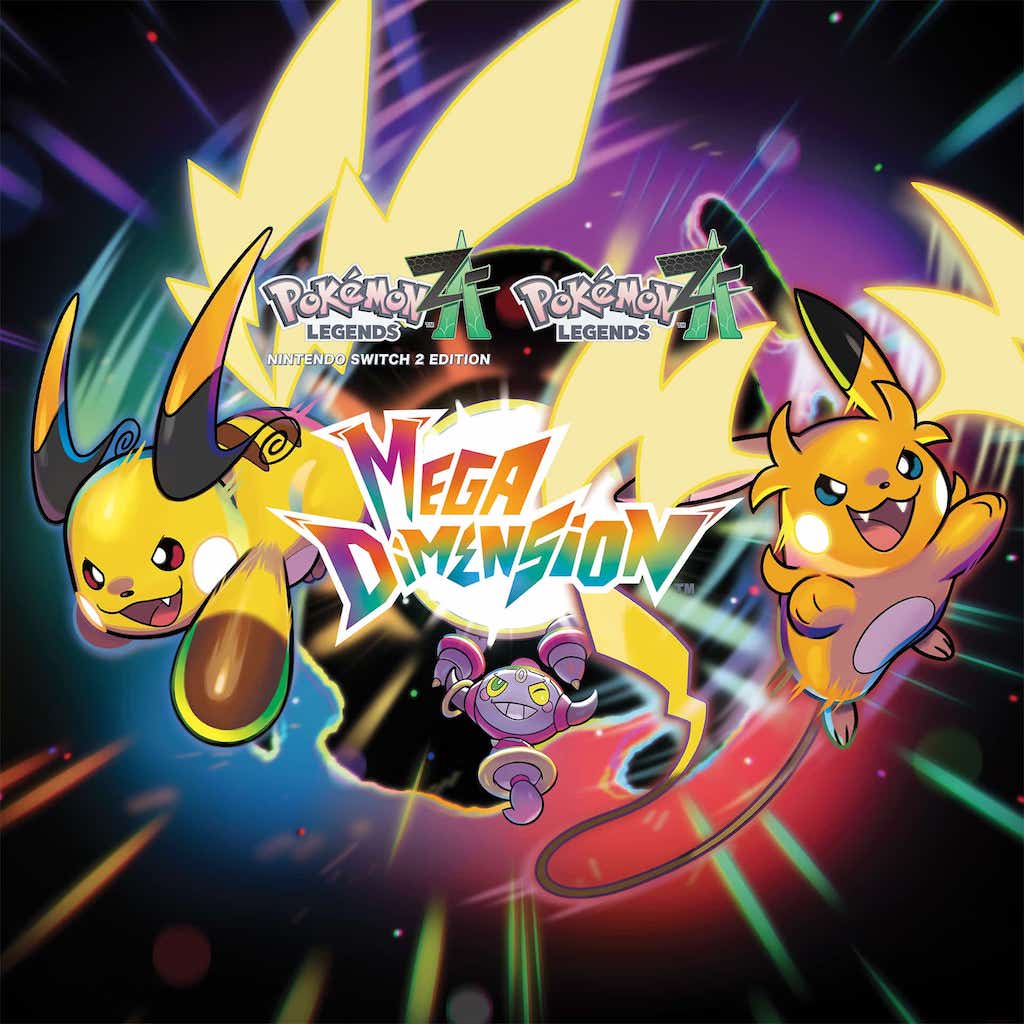
Pokémon Legends: Z-A – Mega Dimension represents perhaps the boldest evolution yet in the Pokémon franchise’s foundational open-world lineage. Where prior titles flirted with semi-open exploration or incremental narrative expansion, Mega Dimension embraces full immersion on a scale that justifies its subtitle. A direct successor in spirit to Pokémon Legends: Arceus and Pokémon Legends: Z-A, this iteration leans into depth—mechanical, narrative, and experiential—while fully utilising the improved hardware capabilities of the Nintendo Switch 2.
The result is not merely a larger Pokémon game. It is a Pokémon world that feels structurally denser, more reactive, and notably more demanding of player investment.
A World Expanded and Enriched
Mega Dimension’s most immediately striking quality is its world scale. Regions once framed as “open areas” now feel like genuinely interconnected ecosystems with layered verticality, environmental diversity, and expressive biomes that reinforce thematic identity rather than existing as backdrop.
Environmental storytelling is more pronounced. Abandoned ruins whisper of past civilizations, mountain passes are patrolled by weather-conditioned Pokémon, and regional mysteries—often hinted at in subtext rather than explicit dialogue—reward the curious player. The Switch 2’s hardware delivers this expanded world with smooth performance and minimal load times, enabling seamless exploration that encourages both curiosity and tactical movement.
Yet breadth does not overshadow intentional design. Each locale feels sculpted with purpose: desert plateaus conceal nesting grounds for rare species, flooded forests obscure pathways until the player adapts traversal methods, and highland ruins serve dual roles as puzzle arenas and narrative loci. This coheres into an exploratory ethos where every corner of the world feels worth crossing.
Combat Systems: Evolution, Not Revolution
Mega Dimension refines combat without unmaking it. The core turn-based battle system remains recognisable to series veterans, but encounters now carry increased tactical depth. Dual-stance battles—where Pokémon can transition between standard combat postures and more aggressive modes—add a layer of real-time decision-making without straying into action-combat territory.
Trainer battles and wild engagements alike unfold with a level of visual and mechanical polish that feels appropriately consequential for a late-generation title. Territories now feature roaming conflict zones, environmental hazards (e.g., sudden sandstorms, frost layers) that affect typing and movement, and pacing that insists players balance party resilience with risk.
Mega Dimension also introduces Link Mechanics—temporary, situation-specific boosts that reflect narrative progress, environmental familiarity, or synergy between specific Pokémon traits. Their use is not limited to power spikes; rather, they shape tactical choice. In high-tension encounters, Link Mechanics reward preparation as much as execution.
Narrative: Interwoven, Layered, and Unafraid of Complexity
Narrative scope in Pokémon Legends: Z-A – Mega Dimension is ambitious. Meta-plot threads weave through personal journeys, regional histories, past calamities, and—most boldly—temporal echoes that tie Mega Dimension to franchise lore without reducing the story to fan service.
Unlike earlier entries where plot punctuated exploration, here narrative and gameplay intersect more integrally. Story beats arise organically from exploration milestones, Pokémon research objectives, and evolving regional socio-ecology rather than heavily scripted cutscenes alone. NPC relationships feel more dynamic, benefiting from branching NPC dialogue that reflects player reputation, past decisions, and even prior expedition outcomes.
This integrated storytelling does not come at the cost of clarity; objectives remain trackable and meaningful, though the narrative itself is unafraid to assume player investment. Diplomacy with factions, moral choices around Pokémon conservation, and the unsettling mystery of dimensional rifts demand reflection rather than rote progression.
Progression, Customisation, and Reward Systems
The progression model in Mega Dimension respects player choice without abdicating challenge. Trainer rank, Pokémon attributes, and crafting—now more robust and context-sensitive—interact in ways that reinforce agency rather than grind. Rare resource nodes are tied to environmental expertise and exploration proficiency, not random encounter algorithms.
Crafting mechanics—central to expedition readiness—benefit from refinement. Items, buffs, and expedition gear are balanced so that resource gathering feels rewarding and strategic rather than instrumental. The interplay between expedition planning and actual terrain challenge reinforces a satisfying feedback loop: preparation materially affects encounter outcome.
Customization is more expressive, too. Character aesthetic options, base settlement building, and even Pokémon accessory crafting feel like extensions of personality rather than superficial rewards. These layers contribute to a sense of ownership over both avatar and adventure.
Visual and Audio Design
On Switch 2 hardware, Mega Dimension capitalises on improved performance without overreaching. Textures are detailed where they should be, animations are fluid, and draw distance remains generous without unsettling framerate dips. Weather transitions are especially impressive—sunlight, fog, snowfall, and storms each carry distinct visual signatures that matter in exploration as well as aesthetics.
The audio design supports immersion effectively. Voice cues (limited but impactful), environmental audio, and dynamic music transitions complement rather than compete with gameplay. The soundtrack balances homage to classic Pokémon motifs with fresh compositions that underscore regional identity and narrative mood.
Accessibility and Difficulty Balance
Mega Dimension is neither “easy mode” Pokémon nor an esoteric, difficulty-intensive RPG. Rather, it strikes a midline: accessible to newcomers yet layered enough to engage seasoned trainers. Difficulty calibrates around exploration choices and expedition preparation more than rigid level thresholds.
Optional challenges, elite wild encounters, and post-game exploration content offer genuine tests without resorting to artificial stat inflation. These end-game systems feel like extensions of the core loop rather than modular difficulty spikes.
That said, complexity may feel overwhelming to players expecting a more traditional linear Pokémon experience. The game assumes curiosity, strategic forethought, and a willingness to engage with systems holistically.
Final Verdict
Pokémon Legends: Z-A – Mega Dimension is a confident evolution of the Pokémon formula. It synthesises open-world exploration, narrative depth, tactical combat refinement, and meaningful progression into an experience that feels both familiar and substantively new. Its ambition is real, its execution mostly successful, and its integration of hardware capabilities into gameplay thoughtful rather than superficial.
This is not merely an expansion in scale. It is an expansion in design philosophy—one that asks players to think, adapt, and invest in the world they inhabit rather than passively traverse it.