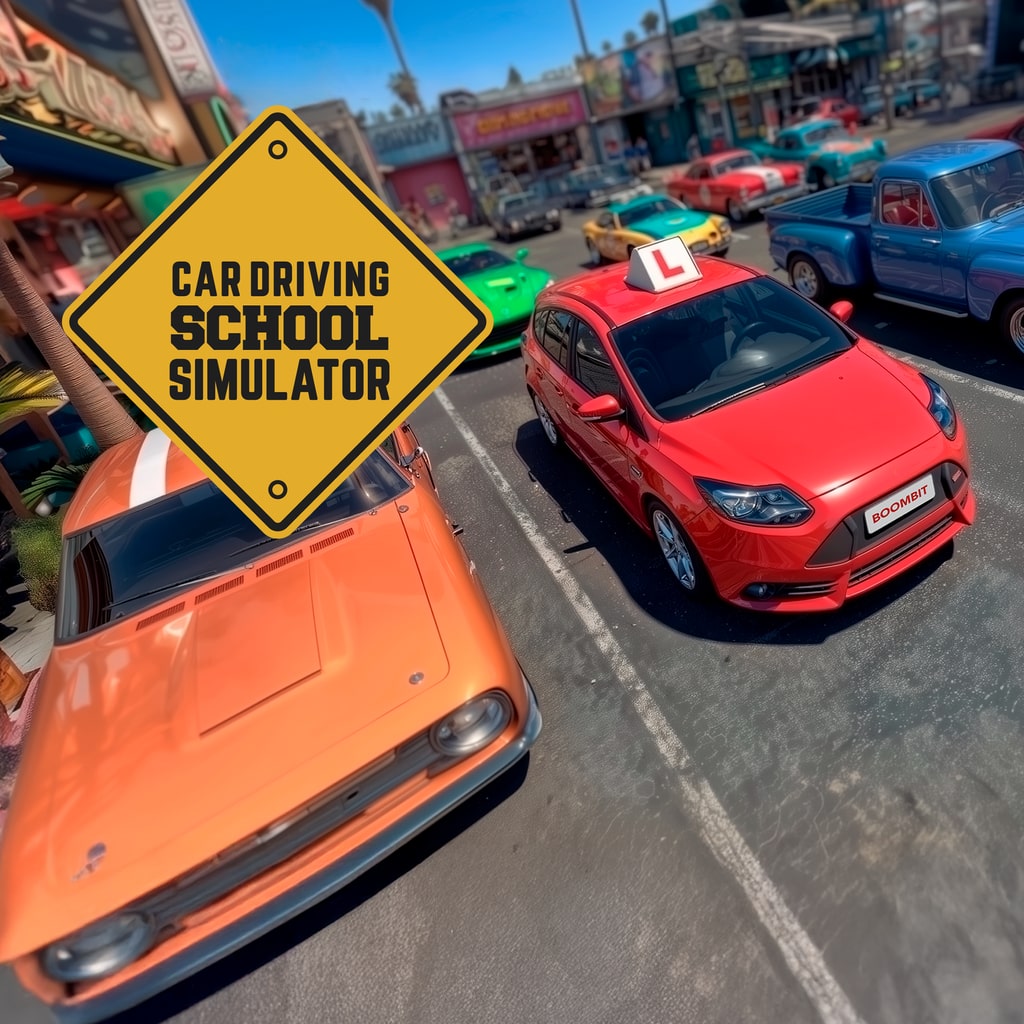
Car Driving School Simulator by BoomBit Games Ltd occupies a very specific niche within the driving game genre. Rather than chasing speed, spectacle, or competitive racing, it positions itself as an instructional-style experience focused on road rules, vehicle control, and disciplined driving behaviour. It is a game that trades adrenaline for structure, offering players a slower, more deliberate take on virtual driving. While its ambitions are modest, Car Driving School Simulator succeeds in delivering a focused and accessible experience, albeit one that carries clear limitations in depth and presentation.
A Clear Educational Focus
From the outset, Car Driving School Simulator makes its purpose clear. This is not a racing game, nor is it a freeform driving sandbox. Instead, it is built around teaching players how to drive “correctly,” emphasising traffic laws, situational awareness, and precise vehicle handling. Missions are framed as lessons, tests, or challenges that simulate real-world driving scenarios such as obeying speed limits, yielding at junctions, parking correctly, and navigating traffic without incidents.
This educational framing gives the game a distinct identity. It feels closer to a digital learner’s environment than a traditional video game, and that will immediately define its audience. Players looking for thrills will find the pace subdued, but those interested in structured progression and rule-based challenges may appreciate the clarity of intent.
Core Gameplay Mechanics
The gameplay loop in Car Driving School Simulator is straightforward and consistent. Players select a vehicle, choose a lesson or test, and are placed into controlled environments where specific objectives must be completed. Points are awarded for correct driving behaviour and deducted for infractions such as speeding, collisions, or ignoring traffic signals.
Vehicle handling is intentionally restrained. Cars respond predictably, steering is smooth, and braking is forgiving. This design choice supports the game’s instructional nature, ensuring that failures are more often due to poor decision-making than mechanical difficulty. While this accessibility is a strength for casual players, it also means that experienced driving game fans may find the handling lacking nuance or challenge.
The variety of vehicles adds some interest. Different cars handle slightly differently, encouraging adaptation, but the differences are subtle. This reinforces realism at a basic level, though it stops short of true simulation depth.
Mission Design and Progression
Mission variety is one of the game’s stronger aspects. Lessons cover a wide range of driving scenarios, from simple lane discipline to more complex urban navigation. Parking challenges, in particular, stand out as some of the most engaging tasks, requiring careful positioning and spatial awareness.
Progression is steady and clearly structured. Completing missions unlocks new vehicles, environments, and challenges, providing a tangible sense of advancement. This steady drip-feed of content helps maintain motivation, especially in shorter play sessions.
However, repetition eventually sets in. While objectives change, the underlying structure remains largely the same throughout. The game rarely introduces mechanics that fundamentally alter how players approach driving, relying instead on incremental difficulty increases. For many, this will be sufficient; for others, it may feel monotonous over longer periods.
World Design and Traffic Systems
The environments in Car Driving School Simulator are functional rather than immersive. Cities, highways, and suburban areas are clearly laid out, with readable signage and predictable traffic patterns. This clarity supports the game’s educational goals, ensuring players can focus on learning rules rather than deciphering complex layouts.
Traffic AI behaves consistently, adhering to basic rules and reacting to player actions in a believable, if simplified, manner. While this predictability helps reinforce correct driving behaviour, it also limits emergent moments. Unexpected situations are rare, and once players understand traffic patterns, encounters become largely procedural.
There is a sense that the world exists primarily as a testing ground rather than a living space. While this is thematically appropriate, it does reduce immersion for players hoping for a more organic driving experience.
Presentation and Technical Performance
Visually, Car Driving School Simulator is modest. Vehicle models are serviceable, environments are clean but sparse, and lighting is functional without being atmospheric. The presentation is clearly designed to run smoothly across a wide range of systems, particularly on mobile platforms, and it generally succeeds in that goal.
Animations are basic but readable, and performance is stable. Frame rate drops and technical issues are minimal, which is important for a game where precision and timing matter.
Audio design is similarly understated. Engine sounds are adequate, traffic noise provides context, and interface cues offer clear feedback. Music, where present, is unobtrusive, often fading into the background. While nothing stands out as particularly memorable, nothing detracts from the experience either.
Accessibility and Audience Fit
One of Car Driving School Simulator’s greatest strengths is its accessibility. Controls are intuitive, instructions are clear, and failure is rarely punishing. This makes the game approachable for younger players, casual audiences, or those entirely new to driving games.
That same accessibility, however, limits depth. There are few advanced systems to master, and the game rarely challenges players beyond careful observation and basic control. Players seeking a hardcore simulation or a deep mechanical sandbox will find the experience too shallow.
Final Verdict
Car Driving School Simulator by BoomBit Games Ltd delivers exactly what its title promises: a structured, rule-focused driving experience that prioritises correctness over excitement. Its clear objectives, approachable mechanics, and steady progression make it a solid choice for casual players and those curious about driving fundamentals.
However, its limited mechanical depth, restrained presentation, and repetitive structure prevent it from achieving lasting impact beyond its niche. It is a competent, well-executed concept that succeeds within its self-imposed boundaries, but rarely pushes beyond them.
A reliable and accessible driving experience that fulfils its educational intent, but one whose simplicity and repetition hold it back from broader appeal.