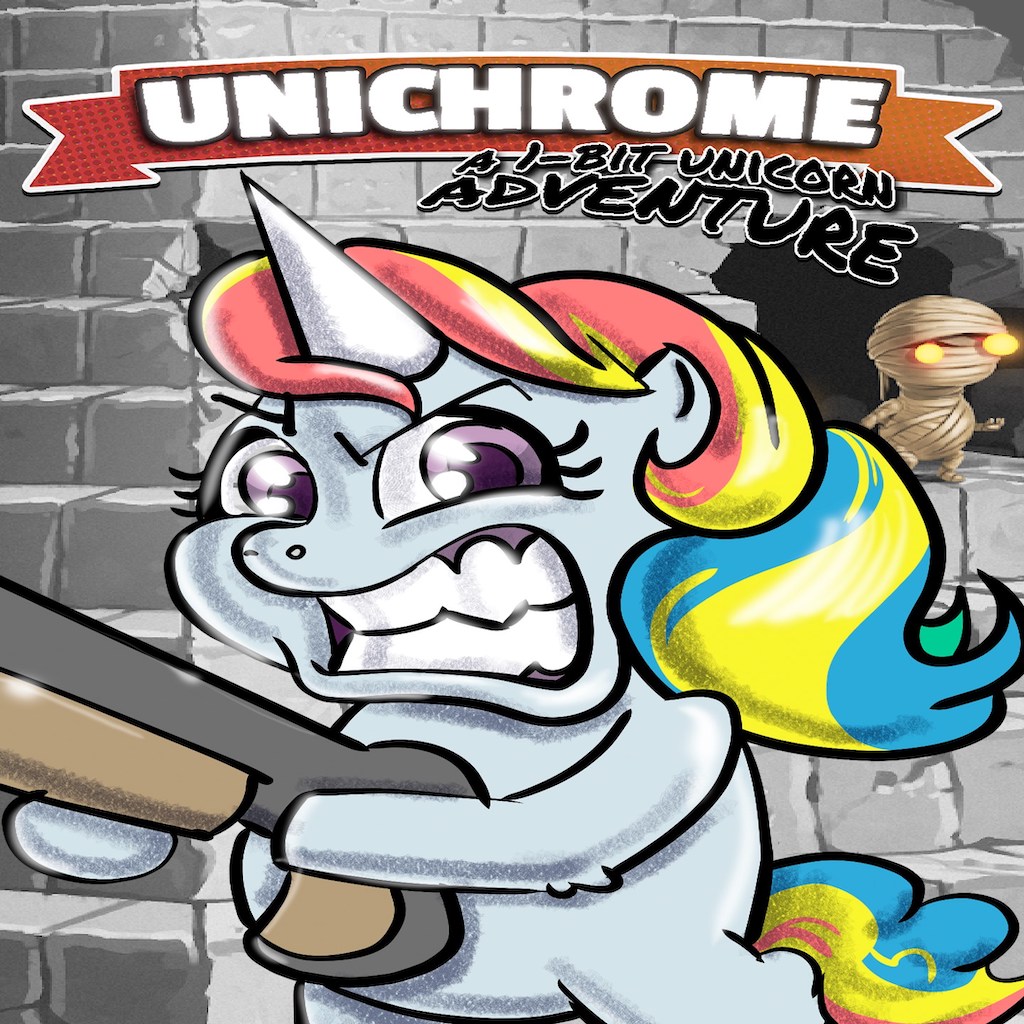
There are plenty of games that take themselves very seriously. There are also games about heavily armed unicorns firing rainbow ammunition at anything unfortunate enough to get in their way. Unichrome: A 1-Bit Unicorn Adventure firmly belongs in the second category, and thank goodness for that. It is the sort of wonderfully oddball retro adventure that seems to have been created because someone looked at a unicorn, an old Atari console and a ridiculously oversized weapon and thought, “Yes, that should work.”
Created by solo developer and gallery artist Super8bitRafa, Unichrome is a fast-moving run-and-gun platformer that wears its retro influences proudly. Everything is deliberately stripped back into a distinctive 1-bit visual style, creating a monochrome world that feels as though it has been pulled from an alternate history where arcade games never stopped evolving. Yet beneath those stark visuals lies an energetic mix of platforming, shooting, boss battles and bullet-hell mayhem that gives the adventure considerably more bite than its minimalist appearance might suggest.
The basic premise is wonderfully simple. Your unicorn is searching for colour, but getting there involves travelling through eight monochrome worlds containing more than 40 levels, dealing with enemies, traps and increasingly chaotic encounters along the way. Naturally, this is not a peaceful journey of self-discovery involving gentle woodland creatures and inspirational conversations. This unicorn is armed with a rainbow shotgun, and it intends to make its journey considerably more explosive.
One Bit, Plenty of Character
The first thing that sets Unichrome apart is its visual presentation. The 1-bit aesthetic could easily have become a gimmick, but the artwork has enough personality to make the limitation feel deliberate rather than restrictive. Black-and-white imagery creates a stark backdrop for the action, while the character designs and animations provide just enough detail to give the world its own identity.
It is particularly impressive given the game comes from an artist whose background includes gallery work and oil painting. That artistic sensibility seems to have found an unexpected home within a deliberately constrained retro framework. Instead of throwing colours and effects at the screen to make everything look exciting, Unichrome achieves its impact through shapes, movement, contrast and animation. The result is an aesthetic that feels both extremely old-school and surprisingly distinctive.
There is also something refreshing about the confidence of it all. The game is not embarrassed by its limitations and does not try to disguise them. It embraces the idea that a game can look incredibly simple while still having plenty of visual personality, and the monochrome worlds become part of the experience rather than simply a technical curiosity.
That visual identity also helps the game maintain a consistent sense of place. You immediately know when you are playing Unichrome, which is something many modern retro-inspired games struggle to achieve. It has its own visual language, and that goes a long way towards giving the adventure a character that extends beyond its deliberately ridiculous premise.
Run, Gun and Don’t Stop
Once the shooting starts, Unichrome reveals another side of itself. This is not a slow platformer where you can casually wander from one screen to the next. It wants you moving, jumping, dashing and shooting with a sense of urgency, blending traditional platforming with run-and-gun action in a way that can become wonderfully frantic.
The unicorn has several tricks available, including horn dashes, homing missiles, automated turrets and ice beams. These abilities give the combat more variety than simply pointing a weapon at whatever happens to be standing in front of you. The rainbow shotgun is naturally the star of the show, but having additional tools available means that encounters can become more about managing threats than simply holding down the fire button.
That becomes particularly important once the game starts filling the screen with enemies and projectiles. The bullet-hell elements can create some spectacular moments, with the player weaving through attacks while attempting to maintain enough momentum to avoid being overwhelmed. When everything comes together, there is a satisfying rhythm to it, with movement and combat becoming almost one continuous action rather than separate systems.
The controls are generally tight enough to support that pace, which is essential for a game built around fast reactions. When you are being asked to jump over an obstacle while firing at one enemy and avoiding another, the controls need to get out of the way and let the player concentrate on the challenge. Unichrome mostly understands this, although some of its platforming physics can feel looser than the precision of its combat would ideally suggest.
A Little Bit of Platforming Frustration
That looseness is one of the game’s more noticeable weaknesses. Retro platformers live or die by how their characters feel under your fingers, and Unichrome occasionally finds itself caught between the deliberately chaotic nature of its combat and the precision required by its platforming. A jump that feels perfectly manageable in isolation can become considerably more awkward when the screen is packed with projectiles and enemies.
This becomes more apparent in some of the tougher encounters. Bullet hell design can be thrilling when patterns are readable and the player understands what is expected, but once the screen becomes too busy, the challenge can start to feel less like a test of skill and more like a test of patience. There are moments when the visual clutter makes it difficult to immediately identify what is dangerous and where you are supposed to move.
That said, there is a fine line between frustrating difficulty and the kind of difficulty that makes you want to improve, and Unichrome generally stays on the right side of it. Even when a boss wipes the floor with you, there is usually a nagging feeling that another attempt might go better. That is an important quality in an arcade game, because the desire to immediately try again is often more valuable than an artificially forgiving difficulty curve.
The best encounters are the ones where you gradually learn the patterns. You start by surviving for a few seconds, then a little longer, and eventually you begin to recognise the rhythm of the attacks. When you finally defeat an enemy that previously seemed overwhelming, the victory feels earned rather than handed to you.
Bosses Big Enough for a Unicorn
Boss encounters are a major part of the experience, with 16 screen-filling bosses delivering some of the game’s biggest spectacles. That is an impressive number, particularly for an adventure otherwise built around relatively compact levels. These encounters give the journey a sense of progression and provide memorable punctuation between the more straightforward platforming sections.
The bosses also play into the game’s willingness to embrace excess. This is not subtle game design, and it is not supposed to be. Screens fill with enemies, projectiles and attacks as the unicorn attempts to find an opening. The resulting chaos can be exhilarating when the player understands what is happening, although the visual clutter can occasionally make these fights harder to read than they need to be.
There is something inherently funny about watching a tiny monochrome unicorn go toe-to-toe with enormous enemies while firing increasingly ridiculous weaponry. That humour helps soften some of the game’s harsher moments. You may be frustrated after being defeated for the fifth time, but there is still something charming about the sheer absurdity of the situation.
It is here that Unichrome feels most like an arcade game. The bosses are not simply obstacles standing between you and the next level. They are events, designed to test everything you have learned while providing a suitably dramatic conclusion to each section of the adventure.
The Voice of a Very Strange Adventure
The fully voiced characters are another unexpected addition. Voice acting is not something you necessarily expect in a game built around a 1-bit aesthetic, yet it gives the characters considerably more personality than the visuals alone might suggest. Combined with the quirky comedy, it helps Unichrome feel like more than a collection of retro mechanics stitched together around a gimmick.
The humour is important because the game’s premise could easily have become tiresome. A unicorn searching for colour while carrying an arsenal of ridiculous weapons is funny because the game commits to the idea. It does not spend its time apologising for being silly, and that confidence gives the adventure a playful energy.
The comedy also provides welcome relief from the difficulty. When the action becomes intense and the screen starts filling with projectiles, having a quirky story and eccentric characters in the background prevents the experience from becoming relentlessly aggressive. There is a genuine sense that the developers want players to have fun with the absurdity of it all.
It may not be the kind of narrative that you will be discussing years from now, but it does not need to be. The story exists to give the action a reason to keep moving, and the characters provide enough personality to make the journey more entertaining.
Chiptunes and Controlled Chaos
The Jaggy Fox soundtrack is another piece of the retro puzzle, fitting neatly into place. A game like Unichrome needs music that keeps pace with its action, and the chiptune approach is a natural match for the visual style. The soundtrack helps maintain the arcade atmosphere while giving the various stages an extra sense of momentum.
Good retro music can be surprisingly important, as repetition is inevitable in a game built around replaying difficult sections. If the soundtrack becomes irritating after repeated attempts, the whole experience can start to feel exhausting. Unichrome benefits from music that contributes to the excitement rather than simply filling silence.
There is also a pleasing consistency between the audio and visual design. The monochrome artwork, chiptunes, fast movement and old-school mechanics all feel as though they belong to the same creative vision. Nothing feels bolted on simply because modern games are expected to have it. That cohesion is one of the game’s greatest strengths. Unichrome knows exactly what it wants to be, and it rarely strays from that identity.
A Retro Oddity Worth Discovering
Unichrome: A 1-Bit Unicorn Adventure is not a perfect platformer, and its occasional loose physics and visually cluttered bullet hell encounters keep it from reaching the genre’s highest heights. At times, the challenge feels tougher than it needs to be, particularly when precise platforming collides with screen-filling combat. Some players may wish for slightly clearer projectile patterns or a little more consistency in movement.
Yet there is something genuinely likeable about the whole package. The unusual visual style immediately gives it an identity; the shooting is satisfyingly punchy; the bosses provide plenty of spectacle; and the absurd story keeps everything from becoming too serious. It is the kind of game that feels like it was made because its creator had an idea they simply could not resist bringing to life.
That enthusiasm comes through in the design. You can feel the affection for classic arcade games, but Unichrome is not merely copying an old formula. It combines run-and-gun platforming, bullet hell encounters and modern progression ideas with an artistic style that belongs entirely to itself. The result is rough around the edges in places, but it is also considerably more memorable than many technically polished retro throwbacks.
For achievement hunters and retro enthusiasts, there is plenty here to enjoy, particularly if you like games that reward repeated attempts and gradual improvement. It is also an excellent fit for anyone who has become tired of games that all seem to be chasing the same visual style. There is no mistaking Unichrome for anything else, and that alone is worth celebrating.
Most importantly, it has soul. Beneath the 1-bit artwork, ridiculous weaponry and frantic arcade action is a game with a very clear personality. It is strange, colourful in spirit if not in appearance, occasionally frustrating and frequently entertaining. There is something wonderfully refreshing about a game that simply wants to make you smile while throwing an unreasonable number of projectiles at your unicorn.
Unichrome: A 1-Bit Unicorn Adventure may not reinvent retro platforming, but it does give the genre a genuinely memorable new mascot. When that mascot happens to be a heavily armed unicorn looking for colour, you know you are in for a rather unusual ride.