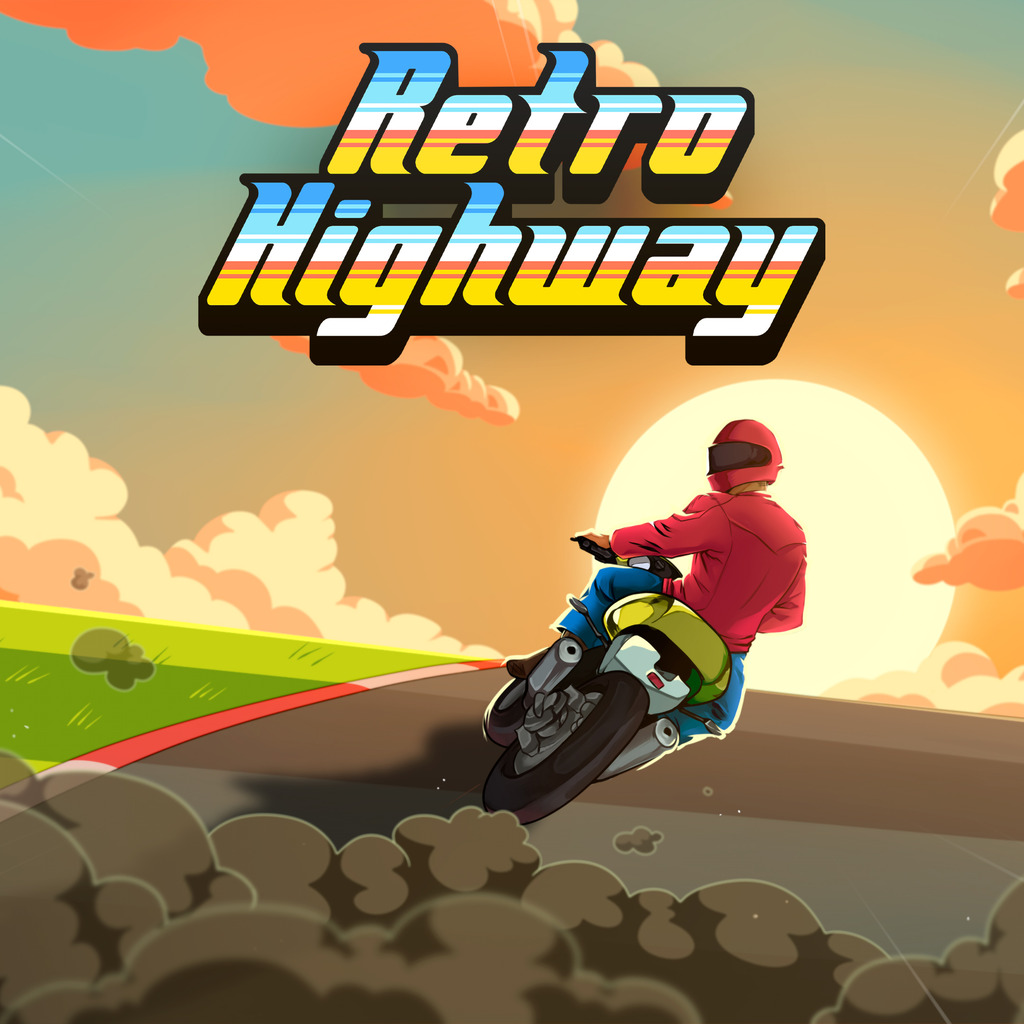
There was a time when getting behind the handlebars of a virtual motorbike was enough to make your palms sweat. You did not need an enormous open world, a 100-hour career mode or a garage containing hundreds of different machines. You simply needed a road disappearing into the distance, a ridiculous amount of speed and the growing realisation that the vehicle in front of you was about to ruin everything. Retro Highway understands that particular kind of arcade magic and sets out to recreate it with colourful pixel art, chiptune music and a gameplay loop that is almost dangerously good at encouraging “just one more go”.
Developed and published by Danish indie outfit Gearhead Games, Retro Highway is an unabashed love letter to the 16-bit era. Its influences are immediately apparent, with the spirit of classics such as Super Hang-On, OutRun and Road Rash running through its high-speed motorcycle action. Yet this is not simply a museum piece dressed in pixels. Underneath the nostalgic presentation is a modern endless-runner structure, designed around short sessions, increasingly difficult challenges and the eternal pursuit of a better score.
Released for modern consoles, Retro Highway is at its best when you approach it on its own terms. This is not trying to be a comprehensive motorcycle racing simulation, and it does not have the structure of a traditional championship racer. Instead, it wants to give you a road, a bike, some traffic and enough speed to make your next mistake feel entirely your own fault. That simplicity is both the game’s greatest strength and, eventually, one of its limitations.
Speed Without the Brakes
The first thing that Retro Highway gets right is speed. There is no brake button to save you from your mistakes, which immediately changes the rhythm of the game. You are constantly moving forward, constantly reacting and constantly making split-second decisions about whether there is enough space to squeeze between two vehicles. It creates a feeling of momentum that is simple to understand but surprisingly difficult to master.
That absence of braking sounds like a small design decision, but it gives the game its character. You cannot simply slow down whenever the road becomes crowded and wait for an opportunity. You have to commit to your movements, anticipate gaps and learn how traffic behaves. The further you travel, the more that seemingly harmless decision to move into another lane becomes a test of reflexes and judgement.
It creates exactly the sort of arcade tension that the game is clearly aiming for. When you are travelling at full speed and spot a narrow gap between two vehicles, there is that wonderful moment of hesitation when your brain says, “That’s probably not enough room.” Then the arcade instinct takes over, you commit and somehow squeeze through. When it works, it feels brilliant, because for a brief moment everything has gone exactly according to plan.
When it does not work, you immediately want another attempt. That is the magic of a good arcade game, where failure does not necessarily make you angry but instead convinces you that you could have done better. Retro Highway understands this beautifully. It makes the difference between a great run and a terrible one feel as though it is always sitting just one decision away.
Six Roads to Somewhere
The game takes you through six distinct environments, and the visual variety is welcome because the core gameplay remains deliberately focused. One moment you are tearing along a sun-baked desert highway, while later you can find yourself racing through much more futuristic surroundings, eventually reaching a moon base that feels like a wonderfully daft destination for a game inspired by 16-bit motorcycle racers. The journey has a nice sense of escalation, even though the basic objective remains unchanged.
The environments do more than simply provide different backdrops. Each new setting helps create the impression that your journey is progressing, even though the fundamental objective remains the same. You are still dodging traffic, collecting coins and looking for opportunities to build a better run. It is a relatively small touch, but changing the scenery gives you something new to look at when the underlying gameplay begins to feel familiar.
Visually, this is where the retro aesthetic really earns its place. The pixel art is bright, colourful and full of the exaggerated visual personality that suits an arcade game perfectly. It does not attempt to recreate realism, and that is absolutely the right decision. Retro Highway is much more interested in looking like the sort of game you might have discovered glowing beneath a television in an arcade than in delivering photorealistic motorcycles.
The 60 frames per second presentation also helps enormously. At a game speed where every movement matters, smooth scrolling and responsive controls are important, and Retro Highway benefits from feeling immediate. There is very little between you and the action, which is exactly how an arcade game like this should feel. When a car suddenly moves into your path, you want to know that the crash was caused by your reaction rather than a sluggish control system.
A Garage Full of Temptation
The game adds a welcome sense of progression through its collection of bikes and upgradeable power-ups. There are more than ten motorcycles to unlock, giving you plenty of reasons to keep earning coins and improving your runs. While the progression is not particularly complicated, it gives repeated attempts a purpose beyond simply chasing a higher number on a leaderboard.
This is where the modern influence becomes particularly noticeable. Rather than simply chasing a high score and starting again with exactly the same tools, you have the sense that your repeated failures are gradually contributing towards something. Unlocking another bike or improving an ability gives you a small reward for continuing to play, even if your latest run ended rather abruptly. It is a familiar structure, but it works well within the game’s bite-sized design.
The power-ups add another layer to the decision-making. Turbo boosts can give you a burst of extra speed, while other abilities can help with survival and collecting resources. The trick is knowing when to use them rather than simply activating everything the moment it becomes available. A well-timed boost can turn an ordinary run into a very good one, while using an ability at the wrong moment can leave you wishing you had saved it.
It is not a particularly deep progression system, but it does not need to be. This is arcade racing rather than a serious motorcycle simulator, and the garage exists primarily to give you another reason to return to the road. Every new bike provides a little extra motivation, particularly when you have just enough currency to unlock something you have been eyeing for the last few runs. It is simple, but satisfying.
The “One More Go” Effect
If there is one phrase that sums up Retro Highway, it is “one more go”. The game is almost perfectly structured around the idea that your next attempt might be the one where everything comes together. You might crash because you moved into traffic too early, misjudged a ramp, or simply reacted a fraction too slowly, but there is always another attempt waiting.
The challenge system reinforces this mentality by giving you additional objectives beyond simply surviving. Completing challenges provides another reason to experiment with your approach and deepen your understanding of the game’s mechanics. Rather than blindly repeating the same run, you begin to think about how you can achieve something specific while still travelling as far as possible.
There is also a competitive element for players who enjoy comparing scores with friends or chasing positions on global leaderboards. This is where Retro Highway feels most authentically arcade-like. The game is not asking you to finish a story and move on. It wants you to improve, beat your previous score, and then immediately wonder whether you can squeeze a little more out of the next attempt.
For some players, that loop will be wonderfully addictive. There is something inherently satisfying about watching your score climb as you become better at reading traffic and reacting to danger. The trouble is that this same structure eventually exposes the game’s biggest weakness, because there is only so much variation you can introduce into a game built around the same basic endless driving formula.
When the Road Starts Looking Familiar
As enjoyable as the core gameplay is, Retro Highway cannot entirely escape the limitations of its endless-runner foundations. The lack of deeper race modes means the experience ultimately revolves around the same basic cycle of driving, dodging, collecting and surviving. That works brilliantly in short bursts, but over longer sessions the repetition becomes much more obvious.
There are no substantial rival racers to battle in the traditional sense, and the focus is not on competing in structured championship races. You are essentially competing against the road, the traffic and your own previous performance. That can be hugely appealing if you enjoy chasing high scores, but it does mean that players looking for a broader motorcycle-racing experience may eventually feel that something is missing.
The six environments help, but they cannot completely disguise the fact that you are performing variations of the same activity. Once the novelty of a new location has worn off, the familiar rhythm returns. You are still weaving through traffic, collecting coins, using power-ups and trying to survive for another few seconds.
This is particularly noticeable if you approach the game expecting something closer to OutRun or Road Rash. Those comparisons are useful for explaining its influences, but Retro Highway is ultimately a much more compact experience. It borrows the sensation of classic arcade riding without attempting to recreate every aspect of those games, and understanding that distinction is important when deciding whether its deliberately simple structure will appeal.
A Soundtrack Made for Speed
The chiptune soundtrack deserves special mention because it fits the game beautifully. There is something about hearing energetic electronic music while weaving through traffic at ridiculous speed that makes the whole experience feel more exciting. It reinforces the idea that this is an arcade game first and everything else second.
The music is not trying to create a cinematic score that fades into the background. It is part of the game’s personality, just as much as the pixel art and bright environments are. The combination of colourful visuals, electronic sounds and constant movement creates an atmosphere that feels deliberately nostalgic without becoming entirely dependent on nostalgia.
This gives the overall presentation a lovely consistency. The visuals, sound and gameplay all share the same assignment, and none of them is trying to be realistic, complicated or overly serious. Everything is designed around speed, accessibility and immediate fun, which is precisely why the game is so easy to pick up.
Arcade Fun With a Short Fuse
There is a lot to like about Retro Highway, particularly if you have a soft spot for old-school arcade games. Its controls are accessible, its presentation is charming, and its high-speed gameplay can produce genuinely satisfying moments. The ability to unlock bikes and upgrade power-ups gives the experience enough progression to keep you returning, while challenges and leaderboards provide additional reasons to chase better runs.
At the same time, it is important to understand what kind of game this is. Retro Highway does not offer the depth of a full motorcycle racing game, nor does it provide a huge selection of modes to keep the experience constantly changing. Its endless-runner foundations are evident, particularly once the initial excitement begins to wear off, and the late game can start to feel like repeatedly travelling the same road in search of a slightly higher score.
But perhaps that simplicity is part of its charm. There is something wonderfully honest about a game that asks you to get on a bike and see how far you can go. It does not need a sprawling narrative or a complicated progression system to create excitement. The thrill comes from the road rushing towards you, the traffic getting denser, and that tiny gap between two cars looking just about wide enough to squeeze through.
Retro Highway is at its best when played in short bursts, ideally when you have a few minutes to kill and fancy chasing a score. It is the sort of game that can sit quietly on your console for weeks before suddenly becoming exactly what you want to play when you need something immediate. The fact that it does not demand a huge investment of time is one of its strengths, even if the same design eventually limits its longevity.
It may not have enough variety to sustain endless sessions forever, but that does not stop it being a thoroughly enjoyable little arcade racer. For anyone who remembers the appeal of 16-bit speed, pixel art, and games that measured success in “how long can you survive?”, Gearhead Games has delivered a nostalgic ride with plenty of character. It is fast, colourful, and wonderfully uncomplicated, even if the road eventually starts to feel a little too familiar. Just be prepared to crash. Quite often. Then, almost inevitably, press restart and tell yourself that the next run will be different.