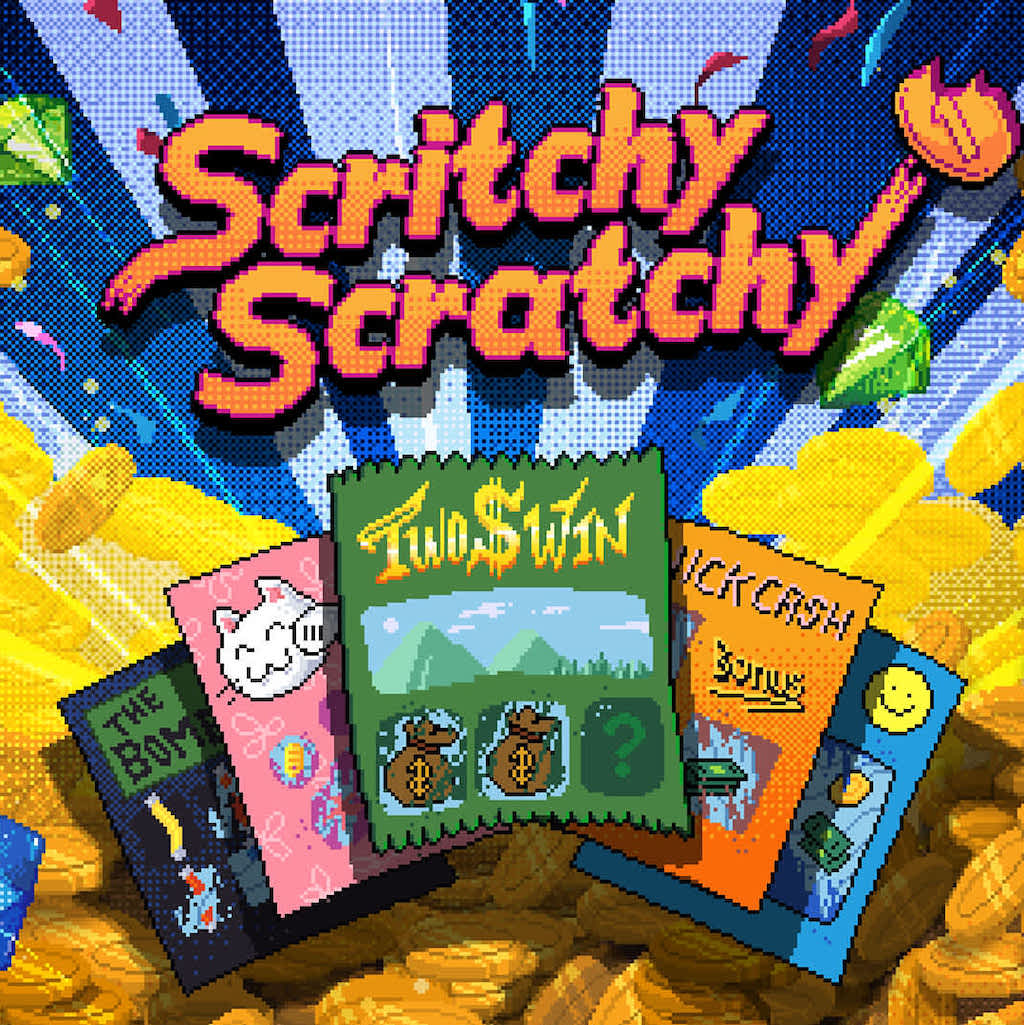
There is something wonderfully ridiculous about Scritchy Scratchy. At first glance, it sounds like an idea that should last about five minutes before you wonder why on earth you are still playing it. Scratch cards? As a game? Surely the novelty would wear off almost immediately. And yet somehow Scritchy Scratchy manages to take one of the simplest forms of gambling entertainment imaginable and turn it into a surprisingly absorbing incremental game that can make the words “just one more ticket” increasingly dangerous.
Developed by Lunch Money Games and published by Funday Games, Scritchy Scratchy takes the humble scratch card and builds an entire progression system around it. You buy tickets, scratch away the silver covering, discover your winnings, and then immediately start thinking about how to make the next ticket even more profitable. Before long, what began as a novelty becomes an increasingly elaborate machine of upgrades, automation, risk and reward.
The concept is deliberately silly, colourful and a little bit shameless, but there is a clever understanding of what makes incremental games work beneath all that glitter. Every scratch has the potential to reveal something exciting, and every reward can be reinvested to make the next scratch more lucrative. It is a simple loop, but goodness me, it knows how to get its hooks into you.
The Pleasure of the Scratch
The first thing Scritchy Scratchy gets right is the scratching itself. There is a tactile satisfaction in physically revealing the symbols beneath the silver surface, and the game understands that this small action is the star of the show. Whether you are using a mouse, a touchscreen, or another supported input method, uncovering each section feels pleasantly immediate.
That might sound like a tiny detail, but it is surprisingly important. Incremental games can sometimes feel abstract because you are watching numbers rise rather than actively doing anything. Scritchy Scratchy places physical interaction at the heart of its progression. You are not simply waiting for a counter to increase. You are scratching away the ticket yourself and watching the result appear.
Of course, this is where the game’s psychological trickery begins. A disappointing ticket is rarely enough to make you stop, because the next one could be different. Then you get a decent payout, which gives you enough money for more tickets. Then an upgrade becomes affordable. Suddenly you are scratching faster, earning more, and unlocking something new, and the whole process starts feeding into itself. It is remarkably effective.
Building a Jackpot Machine
The incremental side of the game is where Scritchy Scratchy grows beyond its initial gimmick. Your winnings are not merely numbers that sit in an account. They become the fuel for upgrades and new opportunities, allowing you to gradually build a machine that becomes more efficient and more profitable.
You can improve your odds, increase payouts and speed up scratching, gradually turning what begins as a manual process into something considerably more powerful. There is a lovely sense of progression here, as you can feel the difference between the early stages and later runs. What initially takes effort eventually becomes a much more streamlined operation.
Then along comes Scratch Bot. This little mechanical helper is one of the game’s most important additions because it shifts the experience from something you actively operate to something you can increasingly automate. Scratch Bot can keep revealing rewards for you, allowing the numbers to climb while you sit back and watch the machinery you have created do its thing.
That is the point where Scritchy Scratchy really starts behaving like a classic incremental game. You are no longer simply scratching tickets. You are constructing an increasingly efficient economy centred on scratching tickets.
Sometimes It Pays to Be Sensible
The game also recognises that making everything progressively easier would eventually become dull. That is where its different scratch card variants come into play. Some offer relatively reliable returns, while others introduce much greater risks in exchange for the possibility of enormous rewards.
This creates genuinely interesting decisions. Do you stick with a safer option and steadily build your balance, or do you take a punt on something that could produce a ridiculous payout? The game does not exactly hide the fact that it wants you to take risks, but it gives you enough control over your progression to make those decisions feel like part of your own strategy.
Some tickets can also introduce nasty consequences, meaning that a huge potential reward comes with the possibility of doing serious damage to your current run. It adds a nice layer of tension to what could otherwise become an entirely predictable progression system.
And there is something amusing about the game’s own description of this dilemma. You can apparently play like a sensible adult or gamble like a degenerate in a neon casino. It is exaggerated, tongue-in-cheek and completely in keeping with the game’s personality.
Prestige and the Art of Starting Again
Eventually, as with many incremental games, you reach the point where simply continuing the current run is no longer enough. That is where the Prestige system comes in.
Prestiging resets your progress but awards Jack Points that can be spent on permanent upgrades. In other words, you willingly sacrifice the progress you have worked to build in exchange for becoming stronger on your next attempt. It is a familiar concept, but it works particularly well here because each reset feels like another opportunity to build the machine more efficiently.
The permanent upgrades also give you some control over the kind of progression you want. You can focus on steady growth, pursue bigger and riskier payouts, or create something that feels considerably more chaotic. That gives the game a little more strategic personality than simply buying the most expensive upgrade available every time you have enough money.
There is undeniable satisfaction in returning to the beginning and realising just how much faster you can now progress. The first few scratches that once felt significant suddenly become tiny stepping stones towards something much larger.
The Danger of the Grind
The biggest problem with Scritchy Scratchy is that its strengths can eventually become its weaknesses. The central loop is extremely effective, but there is only so much variation you can introduce into the act of scratching tickets before repetition becomes noticeable.
That is particularly apparent later in the game. Once you have unlocked much of the core upgrade structure, progression can slow, and the Prestige cycle can start to feel more like maintenance than discovery. The excitement of unlocking something new gradually gives way to watching familiar numbers climb again.
For an incremental game, repetition is hardly an unexpected problem. The entire genre is built around repeating actions in pursuit of increasingly impressive numbers. Nevertheless, there is a point where the promise of the next upgrade is not quite enough to disguise the fact that you have effectively been doing the same thing for quite some time.
It does not ruin the experience, but it does mean that Scritchy Scratchy is likely to be much more appealing to players who genuinely enjoy incremental progression than to anyone hoping for a traditional game with constantly evolving mechanics.
A Surprisingly Cosy Casino
Visually, Scritchy Scratchy has a pleasant personality that helps it stand out from what could otherwise have been an extremely dry concept. The presentation has a colourful, almost cosy quality that contrasts nicely with the exaggerated casino language and the ridiculous scale of the jackpots.
That balance is important. The game is clearly having fun with its subject matter rather than presenting itself as a serious simulation of lottery gambling. Everything is exaggerated, from the potential payouts to the upgrades and risks, giving the experience a playful identity.
It also helps that the core interaction remains so accessible. There is very little friction in picking up the game and understanding what you are supposed to do. Scratch a ticket, collect the money, buy improvements and do it again. Before long, you are making decisions about efficiency and risk without necessarily realising just how deep you have wandered into the loop.
One More Ticket
There is a particular kind of game that makes you lose track of time without ever seeming particularly complicated. Scritchy Scratchy is absolutely one of those games. It does not require lightning reflexes, an enormous story commitment or an encyclopaedic knowledge of complicated systems. It simply gives you a ticket, a potential reward and the promise that the next one might be better.
That is why its overwhelmingly positive reception from players is not surprising. The core scratching mechanic is satisfying, the progression is easy to understand and the incremental systems provide enough carrots to keep you moving forward. There is also something undeniably funny about watching a simple scratch-card operation gradually turn into an absurdly profitable jackpot empire.
It is not perfect, and anyone who reaches the later stages may eventually wish for greater variety. But getting there requires spending enough time with the game to discover just how effective its central loop really is.
Final Verdict
Scritchy Scratchy takes one of the simplest gambling-inspired concepts imaginable and somehow turns it into a genuinely addictive incremental experience. The physical act of scratching is satisfying, the progression system gives every payout a purpose, and the introduction of Scratch Bot creates a wonderfully amusing transition from manually revealing tickets to effectively running your own automated jackpot factory.
The risk-and-reward mechanics add welcome personality, while the Prestige system provides a reason to keep starting over and experimenting with different approaches. It is particularly good at creating those tiny moments of satisfaction that incremental games depend on, whether that comes from revealing a surprisingly large payout, unlocking a new ticket, or watching an upgrade suddenly accelerate your income.
The cracks only really begin to show once the novelty has settled and the later progression starts to feel repetitive. The Prestige grind can become slower than the earlier game, and there is only so much variation that can be squeezed from scratching tickets. Players looking for constant mechanical evolution may eventually hit a wall.
For everyone else, though, there is an awful lot of fun hiding underneath that silver foil. Scritchy Scratchy is silly, tactile, colourful, and surprisingly difficult to put down. It understands exactly why people enjoy incremental games and wraps that addictive progression around an interaction that feels satisfying every single time you drag across the ticket. Just remember that when you say, “I’ll scratch one more,” the game has already won.