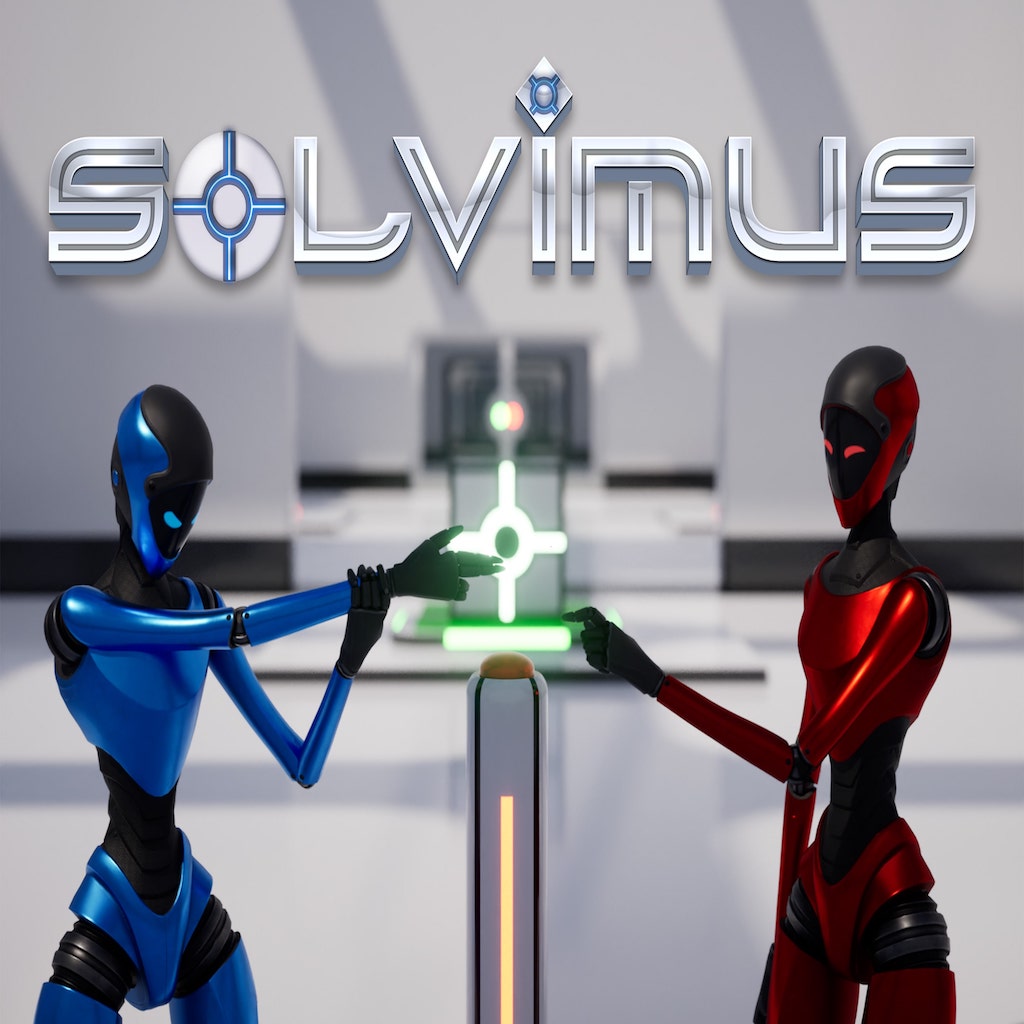
There are plenty of cooperative games that ask you to work together, but Solvimus takes teamwork and gives it a mischievous twist. This is a game that wants you and a friend to succeed, certainly, but it also seems to take enormous pleasure in watching the two of you completely misunderstand each other before finally stumbling upon the solution. Developed and published by Iocus GmbH, Solvimus is a two-player cooperative puzzle adventure built around communication, asymmetric perspectives and the increasingly desperate realisation that your partner is looking at something you cannot see.
Set inside the suspiciously acronym-heavy facilities of the I.N.T.E.L.L.I.G.E.N.C.E. Initiative, the game wastes little time establishing its sense of humour. The organisation claims to be interested in testing exceptional logic, intuition, genius, charisma and a frankly excessive number of other qualities, but it quickly becomes apparent that the real experiment might be discovering just how long two friends can remain civil while solving increasingly complicated puzzles. Across 30 puzzles divided between five test zones, you and your partner are placed in environments where neither player has all the information required to progress.
That simple design decision is the heart of Solvimus. You cannot simply wander around looking for the answer yourself because your partner may possess the vital clue on the other side of the room, or even in an entirely different version of the environment. You have to talk, listen, describe what you can see and trust that the other person understands what you are trying to explain. It sounds straightforward, but when lasers are firing, platforms are moving and time-sensitive mechanisms are involved, “the blue thing on your left” suddenly becomes a remarkably complicated instruction.
Communication Is Everything
The asymmetric approach gives Solvimus its identity. Both players use their own device and perspective, so there is no split screen and no opportunity to simply peek at what your partner is doing. Instead, each person becomes a piece of the puzzle. One player might have access to a switch while the other can see the consequences of activating it, creating a constant exchange of information that makes even relatively simple challenges surprisingly satisfying.
This is where the game can be absolutely hilarious. There is a particular kind of comedy that emerges naturally when two people are trying to communicate under pressure, and Solvimus understands it beautifully. You might know exactly what needs to happen, but explaining it to somebody who cannot see what you are seeing is another matter entirely. A conversation that begins with “just press the button” can very quickly become “NO, THE OTHER BUTTON”, followed by a few seconds of silence and the inevitable “I told you which one!”
Thankfully, Iocus has included several useful communication tools. Built-in voice chat allows players to communicate directly, while a ping system provides another way of drawing attention to something important. More than 30 emotes add another layer of personality, allowing players to celebrate a solution, express confusion, or silently communicate that they are becoming increasingly unimpressed with their partner’s decision-making.
The important thing is that these features never replace communication. They simply support it. The best moments in Solvimus still come from two people working things out together, especially when a complicated sequence suddenly clicks into place and both players realise they have finally understood what the game has been asking of them.
Five Flavours of Puzzle
The 30 puzzles are spread across five distinct test zones, each introducing its own ideas and challenges. Dynamic Duo serves as an introduction to the game’s fundamental concepts, giving players a chance to understand how asymmetric information works before things become considerably more demanding. It is a sensible opening that allows the relationship between the two players to develop naturally rather than throwing them into the deep end immediately.
Things become considerably more interesting as the game introduces environmental complications. Vertigo Venture plays with gravity, while Beam Bafflement brings lasers and mirrors into the equation. Suddenly, simply understanding where something is located is no longer enough. You need to work out what happens when your partner interacts with an object and how that action affects the environment from your own perspective.
Hostile Havoc understandably adds another layer of pressure, with environmental dangers and faster sequences demanding more immediate communication. This is where Solvimus can turn from a relaxed puzzle game into a full-blown shouting match between friends. Fortunately, those moments of frustration are generally followed by the kind of satisfaction that makes the argument worthwhile.
The later challenges introduce time manipulation and increasingly elaborate logic. These puzzles are particularly effective because they build on lessons learned earlier rather than simply making everything bigger and more complicated. The best puzzle design teaches you a mechanic, allows you to become comfortable with it, and then asks you to look at it from another angle. Solvimus understands that principle well.
Trial, Error and That One Missing Piece
One of the game’s greatest strengths is how it encourages experimentation. Failure rarely feels like punishment because the real reward is understanding why something went wrong. You might spend several minutes on a sequence only to realise you have been approaching the entire problem backwards. Once the penny drops, the solution can suddenly seem obvious.
That feeling is crucial in a cooperative puzzle game. If every failure felt like wasted time, frustration would quickly overwhelm the fun. Instead, Solvimus makes mistakes part of the conversation. You learn what your partner can see, discover how the environment reacts, and gradually develop a shared language for dealing with the game’s challenges.
There is also a competitive element for players who cannot resist turning everything into a contest. Global leaderboards track performance, giving successful duos an incentive to return and improve their completion times. For some players, simply reaching the end will be enough, while others will inevitably start shaving seconds from their runs and analysing every movement.
The leaderboard system works particularly well because it does not undermine the cooperative nature of the experience. You still need to solve the puzzle together before you can worry about doing it faster. That creates a natural second layer of replayability for pairs who enjoy mastering challenges rather than simply completing them.
A Clean, Futuristic Playground
Visually, Solvimus adopts a clean science-fiction aesthetic that keeps the puzzles front and centre. The testing facilities are filled with geometric structures, bright lights, switches, platforms, lasers and other interactive machinery, giving the game a distinct laboratory feel without drowning the player in unnecessary visual clutter. That clarity is particularly important when each person is already trying to process information from their own perspective.
The presentation is supported by responsive animations and clear visual feedback. When something changes, the game makes it apparent, reducing the risk of losing progress simply because an environmental interaction was hard to notice. It is not trying to compete with the latest cinematic blockbuster, but it does not need to. The clean design complements the puzzle mechanics rather than distracting from them.
The audio takes a similarly functional approach, with switches, machinery, alarms and environmental effects providing useful feedback. There is also an electronic soundtrack that gives the test chambers a suitably futuristic atmosphere without becoming intrusive. In a game where two people are likely to spend a considerable amount of time talking over the action, keeping the music restrained is a wise choice.
A Game That Could Ruin Your Friendship
The biggest limitation of Solvimus is also what makes it special. This is absolutely a game for two people, and there is no pretending otherwise. If you do not have someone willing to sit down and communicate properly, the experience loses much of its appeal. It is not something you can casually pick up alone for ten minutes, and the requirement for both players to own the game and have a stable internet connection may also limit its audience.
For the right pair, however, that focus becomes a strength. There is something wonderfully old-fashioned about a game that asks you to actually talk to another human being. Not through a list of automated commands or a cooperative matchmaking system, but through genuine conversation, confusion, laughter and the occasional accusation that your partner absolutely did not follow the instructions.
The humour helps considerably, too. Solvimus knows that puzzle games can become rather serious affairs, so it constantly injects personality into the experience. The ridiculous I.N.T.E.L.L.I.G.E.N.C.E. Initiative, the playful presentation and the game’s willingness to poke fun at its own testing procedures prevent the experience from becoming overly clinical.
There are also secrets to discover, including an Easter egg treasure hunt leading towards a mysterious golden prize. These optional distractions give dedicated players another reason to explore beyond simply reaching the end of the campaign. It is a nice touch that rewards curiosity without forcing additional content into the main progression.
Final Verdict
Solvimus is a clever and genuinely entertaining cooperative puzzle game that understands exactly what makes playing with another person so rewarding. Its asymmetric design ensures that communication is never optional, while the steadily evolving puzzle mechanics provide enough variety to keep the 30 challenges feeling fresh. The humour, emotes, ping system and built-in voice chat complement the central concept nicely, although the strict two-player requirement means this is very much a game that needs the right partner.
What makes Solvimus memorable is not necessarily any single puzzle. It is the conversations that happen while solving them. It is the moment when your friend finally understands the bizarre explanation you have been trying to give for five minutes, the sudden silence before somebody presses the correct button, and the inevitable celebration when the whole room finally falls into place. Those moments cannot really be scripted, and that is precisely why they work.
Iocus GmbH has created a game that turns communication itself into a gameplay mechanic, and when everything comes together, it is tremendous fun. It may test your patience, your memory and your ability to explain where a particular laser is pointing, but it also creates the sort of shared gaming memories that can stick around long after the final puzzle has been solved.