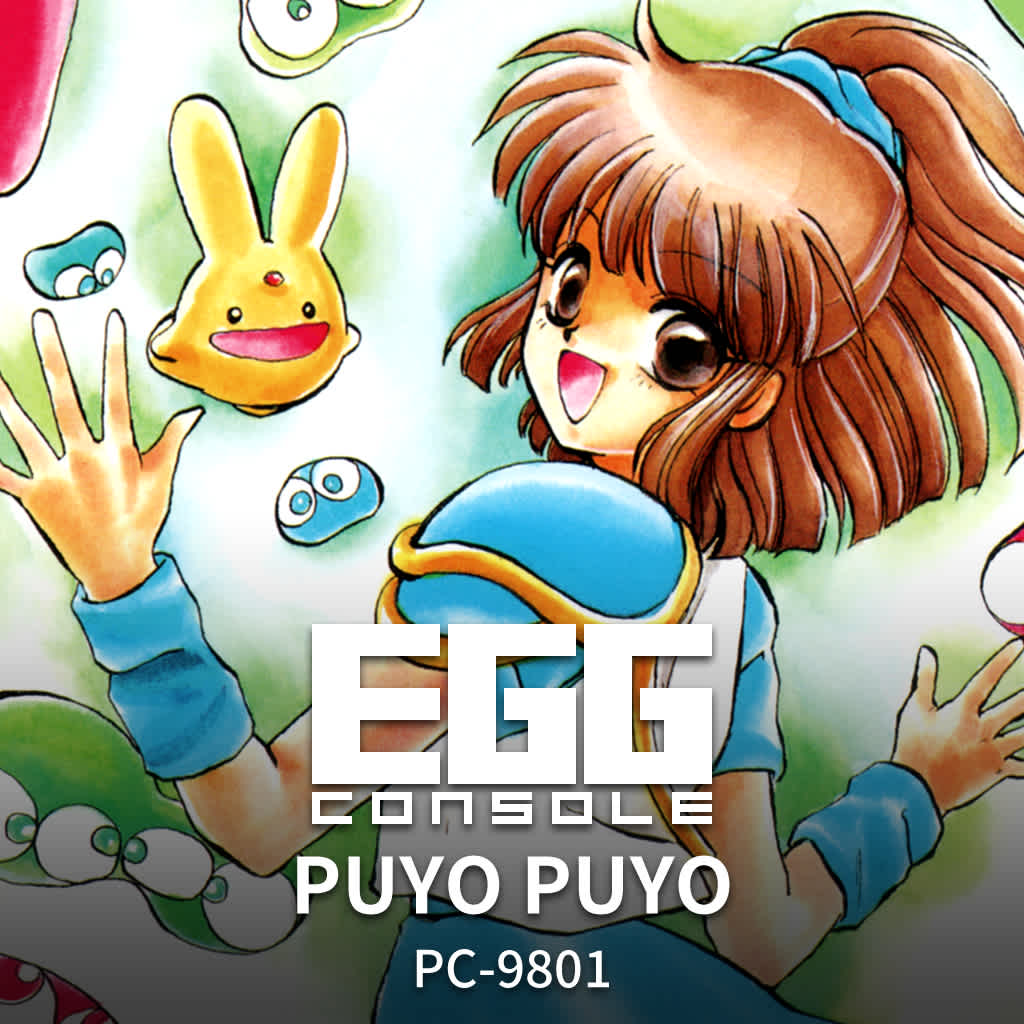
Some puzzle games you play for a few minutes and then move on from, while others somehow get their hooks into you. Puyo Puyo belongs firmly in the latter category. It looks wonderfully simple at first glance, with a handful of colourful blobs dropping towards the bottom of the screen, but spend a little time with it and you quickly discover there is considerably more going on beneath that cheerful exterior. EGGCONSOLE PUYO PUYO PC-9801 brings one of the earliest versions of Compile’s beloved puzzle classic to the Nintendo Switch, offering a fascinating glimpse into where this hugely influential series began.
Originally released in Japan in 1993 for the PC-9801, this version captures Puyo Puyo at an interesting point in its history. The fundamentals are already firmly in place, with players dropping pairs of Puyos into a grid, matching four or more of the same colour and building chains that can turn an apparently losing position into a spectacular victory. What makes this particular release interesting is that it is not simply another version of a game most players already know. It is a preserved piece of Japanese PC gaming history, complete with its own quirks, presentation and a slightly different feel.
The Birth Of A Puzzle Phenomenon
The basic premise of Puyo Puyo is beautifully straightforward. Coloured Puyos fall from the top of the screen in pairs, and you have to position them carefully before they land. Connect four or more Puyos of the same colour and they disappear, causing everything above them to tumble down. If those falling pieces form another group of four, another clear occurs, and suddenly your modest little move has sparked a chain reaction.
That is where the magic happens. A simple clear might remove a few Puyos, but a carefully constructed arrangement can produce a chain that continues several times in succession. Each additional link makes the resulting attack more powerful, sending Nuisance Puyos onto your opponent’s board. Those unwanted pieces may not look particularly threatening at first, but they can quickly turn an orderly playing field into a nightmare.
The real challenge is learning not merely to clear Puyos, but to deliberately create situations where one clear triggers another. You are effectively building a puzzle within a puzzle, carefully stacking colours and leaving spaces for the next collapse. It is an incredibly satisfying system because the player is constantly learning to see possibilities that were not obvious a few seconds earlier.
A Battle Of Brains And Nerves
The competitive side of Puyo Puyo is where the game truly comes alive. Going head-to-head with another player is not simply about clearing your own board as quickly as possible. You need to consider what your opponent is doing, how much pressure they are applying, and whether to focus on building your own chain or disrupt their plans.
The Nuisance Puyos are crucial to this battle. Triggering large clears and impressive chains sends these troublesome pieces towards your opponent, giving you a way to put them under pressure without directly interacting with their board. The best matches can develop into wonderful little battles of nerve, with both players quietly building enormous chains, knowing that one mistake could leave them buried.
It is worth remembering that this early version lacks the refinements that would arrive in later entries. Players familiar with Puyo Puyo 2 and subsequent games may notice the absence of some of the more advanced mechanics and counterplay. That can initially make the experience feel somewhat basic, but there is also something refreshing about returning to the foundations and seeing how much depth Compile managed to extract from such a straightforward ruleset.
Four Ways To Play
EGGCONSOLE PUYO PUYO PC-9801 offers a decent selection of modes, giving the game enough flexibility to accommodate different types of players. Solo Puyo Puyo pits you against the computer as you progress through increasingly demanding opponents, while Duo Puyo Puyo allows two human players to settle their differences in a traditional competitive fashion. There is nothing quite like sitting beside someone and watching their carefully constructed board suddenly collapse because of a chain you managed to set up.
Endless Puyo Puyo provides a more relaxed alternative for players who simply want to keep going and chase a high score. Without the pressure of progressing through an opponent ladder, it becomes an exercise in concentration and survival. You can experiment with different arrangements, practise your chains, and see just how long you can keep your board under control.
Then there is Riddle Puyo Puyo, which offers something a little different. Rather than simply asking you to outlast an opponent, it challenges your brain in a more deliberate puzzle-solving environment. Having these different options means the game is not entirely dependent on competitive battles, and it gives newcomers somewhere to learn the fundamentals before throwing themselves into the deep end.
Arle, Carbuncle And A Little Personality
One of the things that helped Puyo Puyo stand out from many other falling-block puzzlers was its personality. Compile did not simply create an abstract puzzle game and leave it at that. The story mode features an eccentric cast of characters, with Arle Nadja and her companion Carbuncle at the centre of the adventure.
Between battles, players are treated to humorous character scenes featuring a colourful cast of monsters and personalities. These moments might not constitute a deep narrative by modern standards, but they give the game a sense of identity that many puzzle games of the period lacked. There is a genuine charm to seeing these strange characters appear between stages, particularly when you remember that this game dates from 1993.
That characterisation also gives the single-player progression a little more purpose. You are not simply working your way through a series of anonymous computer opponents. There is a sense that you are travelling through a peculiar little world, meeting increasingly memorable characters and trying to overcome each one.
The PC-9801 Difference
For anyone approaching this release from a modern Puyo Puyo perspective, the PC-9801 version has some fascinating differences. The most immediately noticeable is how upcoming Puyos are displayed. Rather than a conventional preview box, the next pieces appear in vertical columns at the side of the screen, offering a slightly different way to read the upcoming sequence.
It is a small change, but it has a meaningful impact on how you approach the game. Once you become accustomed to the layout, those previews become another part of your planning process. You can look ahead, consider which colours are coming, and start preparing your board rather than simply reacting to whatever lands next.
This version also lacks battle voices and some of the more sophisticated enemy behaviour found in later versions. Again, that may sound like a drawback, but in the context of an archival release it is more interesting than disappointing. This is Puyo Puyo as it existed on the PC-9801, warts and all, and that authenticity is a large part of its appeal.
Retro Charm On Nintendo Switch
Visually, EGGCONSOLE PUYO PUYO PC-9801 is unmistakably a product of its time. The pixel art has that unmistakable early 90s Japanese computer aesthetic, with colourful Puyos, expressive character artwork and compact playing fields. It is not going to compete with modern high-definition puzzle games for technical spectacle, but judging it by those standards rather misses the point.
There is something wonderfully nostalgic about seeing the original presentation preserved rather than heavily modernised. The colours remain bright and readable, which is particularly important as the pace increases, and the character artwork provides plenty of personality between matches.
The audio complements the presentation with its period FM synthesis and classic computer-game sound. It has that distinctive slightly crunchy quality that immediately transports you back to the era of Japanese home computers. It is not polished in the modern sense, but it has character, and that counts for a lot when playing an archival release such as this.
The EGGCONSOLE Treatment
D4 Enterprise’s EGGCONSOLE releases play an important role for anyone interested in gaming history, and this is another good example of why preservation matters. Being able to experience a PC-9801 release on a modern console makes something that would otherwise be considerably harder to access available to a much wider audience.
The usual convenience features make the experience considerably more approachable than attempting to play an original 1993 computer release today. Save and load functionality, controller customisation and screen options mean you can enjoy the game without treating it like an archaeological expedition.
There is still a certain rawness to the experience, of course. This is an old game rather than a modern remake, and players expecting extensive tutorials, modern presentation or a wealth of contemporary conveniences may find it somewhat austere. For those willing to meet it on its own terms, though, that simplicity is part of the attraction.
Final Verdict
EGGCONSOLE PUYO PUYO PC-9801 is a lovely reminder that great puzzle design does not need complicated ingredients. Compile took a handful of colourful Puyos, a grid, a simple matching rule and the possibility of cascading chains, then created a competitive puzzle system with remarkable depth. Even decades later, there is an unmistakable thrill in watching a carefully prepared chain unfold exactly as planned.
The PC-9801 version may lack some of the refinements that would become familiar to fans of later Puyo Puyo games, and its presentation inevitably shows its age. Yet that is also what makes it worth experiencing. This is an important part of the series’ history, and EGGCONSOLE gives modern players a straightforward way to discover it.
More importantly, the fundamental gameplay remains brilliant. Whether you are battling the computer, challenging a friend, chasing a high score or wrestling with a Riddle Puyo Puyo puzzle, there is always another chain to build and another mistake to learn from. It is simple enough for almost anyone to pick up, yet capable of revealing extraordinary depth once you start thinking several moves ahead.
For retro enthusiasts and puzzle fans alike, EGGCONSOLE PUYO PUYO PC-9801 is well worth a look. It may be a historical curiosity on the surface, but beneath that vintage PC presentation beats the same addictive puzzle heart that helped turn Puyo Puyo into a gaming institution.