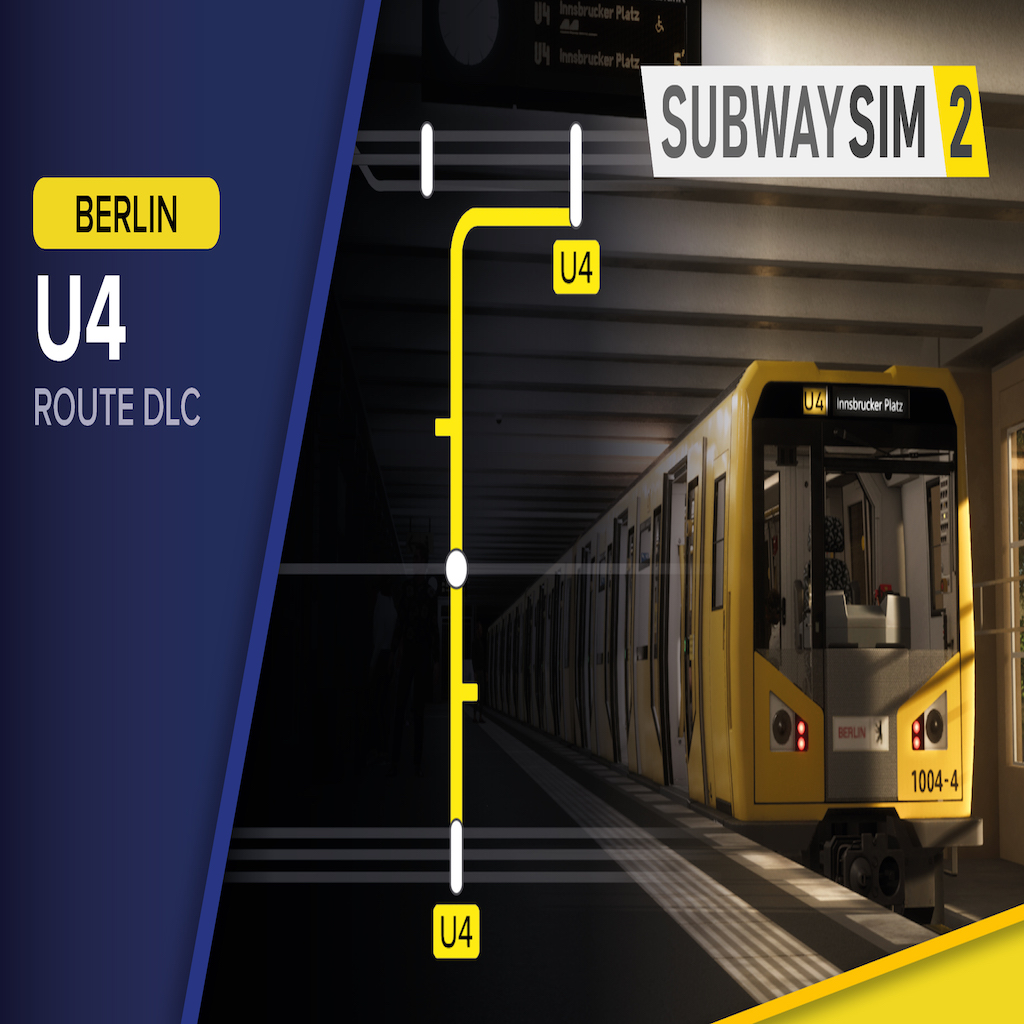
There is something special about driving a railway line that has been part of a city’s identity for more than a century. You are not simply moving a train from one station to another. You are stepping into a little piece of history, following tracks that have carried generations of passengers through the same tunnels and past the same platforms. That sense of history is exactly what makes the U4 such an interesting addition to SubwaySim 2, even though it is one of Berlin’s shortest underground lines.
The SubwaySim 2: Berlin Route DLC U4 expansion takes players onto the historic U4 between Innsbrucker Platz and Nollendorfplatz, adding five stations and another distinctive slice of Berlin’s U Bahn network to the existing game world. Developed by Simuverse Interactive in collaboration with 3DZug and published by Aerosoft, the DLC focuses on authenticity rather than padding things out with unnecessary extras. There is a new signalling system, detailed station recreations, timetable operations and four dedicated scenarios, all designed to make this compact route feel like a genuine part of the wider simulation.
A Small Line With A Big History
The first thing to get out of the way is the U4’s length. This is not a sprawling route that will have you driving for hours before reaching the end of the line. In the real world, the U4 is famously short, and that is reflected here. Rather than pretending otherwise, the DLC embraces the route’s character and uses its compact size to focus on operational detail.
That actually works surprisingly well. A short route can be incredibly enjoyable in a train simulator when there is enough going on to make every journey feel purposeful. The U4’s historic stations and infrastructure give the line an identity of its own, while the relatively brief journeys make it easy to settle into the rhythm of repeated services.
There is also something satisfying about becoming familiar with a route. After a few runs, you begin to recognise the stations, anticipate the braking points and understand how the signalling affects your progress. It stops being a collection of scenery and becomes a railway you know.
Five Stations, Plenty Of Character
The U4 takes you through five stations, each recreated with careful attention to the distinctive architecture and atmosphere of Berlin’s historic Kleinprofil network. Innsbrucker Platz, Rathaus Schöneberg, Bayerischer Platz, Viktoria Luise Platz and Nollendorfplatz each provide their own visual landmarks, helping prevent the journey from becoming visually repetitive.
Station detail is particularly important on a route this short. With only a handful of stops, you will see them regularly, so they need to feel convincing. The careful recreation of platforms, entrances, tiles and other characteristic details gives the line a sense of place rather than making it feel like another generic underground railway.
There is also a certain charm in the older architecture. Modern transport systems can sometimes look almost interchangeable, but the U4’s historic character gives it personality. You begin to appreciate the little differences between stations, and those details help sell the idea that you are actually operating within Berlin rather than simply driving through a collection of computer-generated tunnels.
Signalling That Demands Attention
Perhaps the most significant technical addition is the new signalling system. This is not merely a cosmetic change designed to give the DLC another bullet point on its feature list. The signalling and associated operational procedures have been developed to more closely reflect the real-world behaviour of the U4, adding another layer of responsibility to the driver’s role.
For experienced simulation players, this is exactly the sort of addition that makes a route interesting. Driving a train is not simply a matter of accelerating away from a station, reaching the next stop and hitting the brakes. You have to pay attention to what the railway is telling you and understand how the signalling affects your operation.
That makes the U4 feel a little more demanding than a straightforward point-to-point journey. You need to keep your eyes open, particularly when conditions change or operations do not go exactly as planned. It is a subtle addition, but one that helps transform the DLC from a scenery pack into something with genuine operational depth.
Timetable Driving
Timetable Mode is where the U4 settles into its most natural rhythm. You are given regular services to operate, passengers to collect, and schedules to maintain, with different times of day and weather conditions providing welcome variation.
There is a strange satisfaction in doing an apparently mundane journey properly. Leaving a station on time, approaching the next platform smoothly, stopping accurately, and opening the doors for waiting passengers may not sound thrilling, but train simulation has always understood that routine can be rewarding when the details are right.
The U4 benefits from that philosophy. It does not need to manufacture excitement around every journey. Sometimes the pleasure comes from simply operating the service correctly. When everything lines up and you complete a run without a mistake, there is a quiet sense of achievement that fans of the genre will immediately recognise.
When Things Go Wrong
The four bespoke scenarios offer a welcome change of pace. Rather than simply asking you to complete another timetable service, they present specific operational situations where things do not necessarily go as expected.
That is where the DLC gets a chance to show a different side of the U4. A regular service lets you settle into a routine, whereas scenarios can force you to react. You have to think about what is happening around you rather than simply following the timetable and waiting for the next station.
It is a sensible balance. Too many scripted scenarios could make the route feel artificial, while relying exclusively on routine timetable services might leave the DLC feeling a little thin. Four dedicated scenarios provide enough variety to complement the main experience without taking over.
A Berlin Underground That Feels Connected
One of the strongest aspects of the DLC is its integration with the existing SubwaySim 2 Berlin world. The U4 does not feel like an isolated route in its own bubble. Instead, it becomes another part of the wider network, making the Berlin environment feel more complete.
That seamless integration matters more than it might first appear. A new route is always more enjoyable when it feels like an addition to an existing railway rather than something simply placed alongside it. The inclusion of AI traffic and operational elements reinforces that sense of a functioning network.
It also makes the expansion feel more worthwhile for players who already know the Berlin map. You are not starting from scratch in an entirely unrelated environment. You are discovering another part of a city you have already spent time exploring.
The Little Details Matter
Visual quality is always important in a train simulator, but the finer details are arguably even more valuable than flashy scenery. The U4’s recreation benefits from period-influenced station architecture, track infrastructure and platform details that give the route its own personality.
The passenger information systems also contribute to authenticity. Displays and operational information help make the stations feel active rather than static, while dynamic passengers and AI traffic give the impression that you are operating within a real public transport system.
Underground lighting also plays a part in the atmosphere. The tunnels are not simply dark spaces between stations, and changes in illumination help give the journey visual variety. Track reflections and tunnel shadows add further depth, particularly when combined with the movement of the train through the environment.
Listen To The Railway
The audio design is another area where the U4 benefits from attention to detail. The motor hum, wheel noise, switch crossings and pneumatic door sounds all contribute to the familiar soundtrack of underground railway operation.
There is something particularly satisfying about the sound of a train arriving at a station. The mechanical noises build as you approach the platform, the train settles into its stop, and the doors hiss open. It is mundane in the best possible way.
Station acoustics also help create the feeling of being underground. Echoes and shifts in ambience make the environments feel less sterile, while the mechanical sounds of the train give the player a constant reminder that they are operating a physical machine rather than simply moving an icon along a route.
A DLC For The Dedicated Driver
The U4 is unlikely to convert anyone with no interest in train simulation into a railway enthusiast. It is a focused expansion aimed squarely at those who appreciate the finer details of railway operation, and that is perfectly fine.
The short route length will inevitably be the biggest sticking point for some players. Even with the additional scenarios and signalling systems, there simply is not the same sheer mileage as on a much longer route. However, judging the U4 solely by distance misses the point.
This is a route built around familiarity, precision and atmosphere. Its appeal lies in learning its stations, understanding its signalling and gradually becoming comfortable with its operational rhythm. For simulation fans, that can be every bit as rewarding as tackling a much longer journey.
The Verdict
SubwaySim 2: Berlin Route DLC U4 is a carefully crafted expansion that proves a railway need not be enormous to be interesting. The U4’s short length is part of its identity, and the DLC wisely focuses on making those few kilometres feel authentic rather than artificially stretching them.
The detailed stations, new signalling system, timetable services and four scenarios provide enough substance to make the route feel like a genuine addition to SubwaySim 2. The seamless integration with the existing Berlin world is particularly welcome, while the atmospheric sound and visual detail help create the feeling of operating a real underground railway.
It is not going to be the most expansive route available for the simulator, and players who measure value purely by mileage may struggle to justify it. For those who care more about authenticity than raw size, however, there is plenty to appreciate. The U4 has history, personality and a distinctive operational character, and this DLC captures those qualities surprisingly well.
Sometimes a route does not need to take you across an entire country to be memorable. Sometimes five stations are enough, provided those five stations feel like somewhere worth visiting.