There is something wonderfully cruel about a puzzle game that asks you to remember where you are going, then immediately takes away your ability to see where you are going. Dark Dungeon Head Haze builds its entire identity around that simple idea, dropping you into a gloomy dungeon where the world becomes almost completely hidden after you take your first step. What follows is less about lightning-fast reflexes and more about memory, instinct, patience and the ability to keep your nerve when the floor beneath you could disappear at any moment.
It is a deceptively simple concept, too. The controls are straightforward, with directional movement and a jump button doing most of the work, yet the situations those controls create can become surprisingly demanding. With 40 puzzle rooms to conquer, Dark Dungeon Head Haze steadily teaches you that looking carefully before moving is just as important as knowing what to do once the darkness arrives. It is a compact experience, but one with enough personality and clever ideas to make it considerably more memorable than its low-poly appearance might suggest.
Welcome to the Darkness
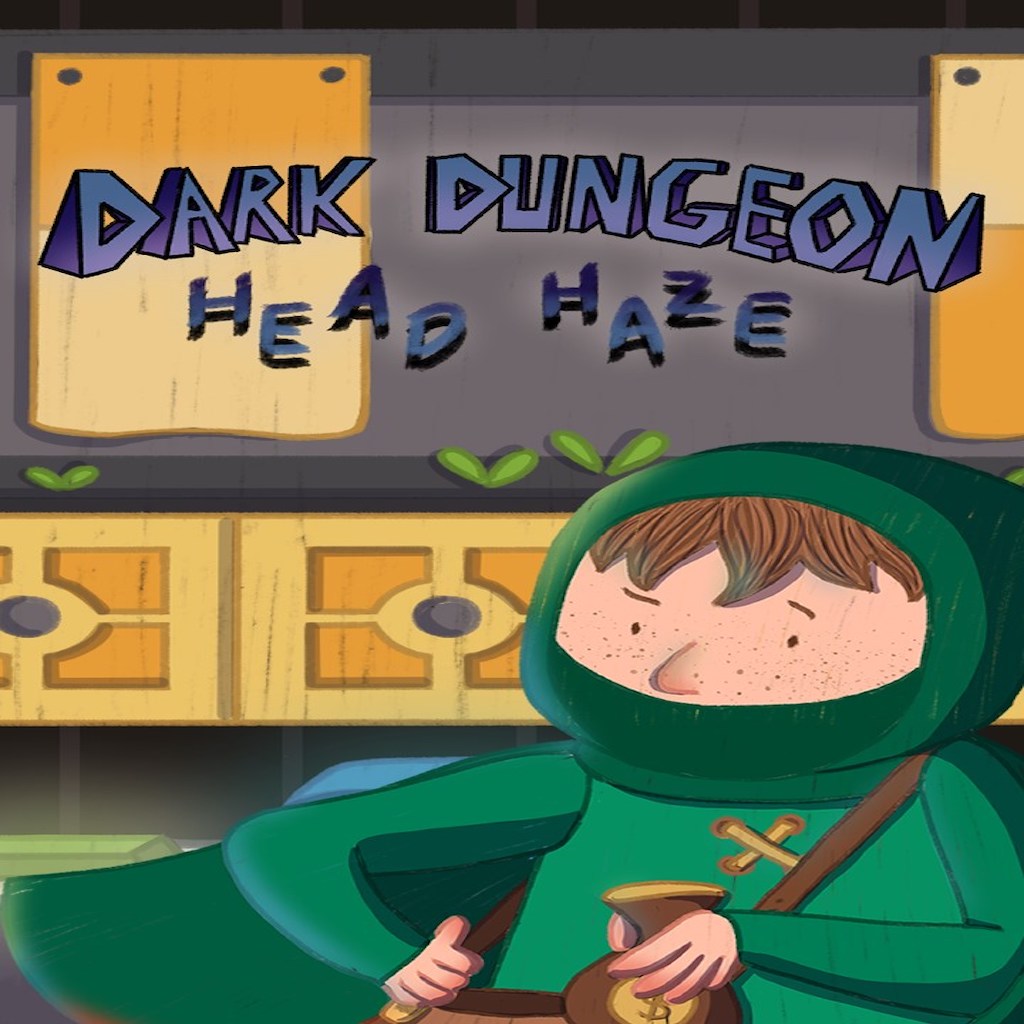
The setup is suitably ridiculous in the best possible way. A thief, lured into a mysterious Dark Dungeon by the promise of riches, takes a single step inside and is swallowed by darkness. What begins as a routine attempt to steal treasure quickly becomes a fight for survival, though the biggest enemy is not necessarily whatever lurks in the shadows.
The dungeon itself is the real antagonist. Before moving, you are given a brief glimpse of the room and its layout, allowing you to study platforms, gaps, doors, buttons and hazards. Then you move. The lights go out, and suddenly you are relying on the mental picture you created moments earlier.
That creates a fascinating little psychological battle. You might know the next platform is somewhere to your right, but do you remember exactly how far away it was? Was there a gap before it? Was that button safe to step on, or did it activate the spikes you noticed at the beginning? Dark Dungeon Head Haze constantly encourages you to question your own memory, and there is a lovely sense of satisfaction when you navigate an entire room correctly without ever needing to see the route again.
Memory Is Your Greatest Weapon
The central mechanic is simple enough to explain in seconds, yet it gives the game far more depth than you might initially expect. Every room is effectively a short memory challenge, asking you to absorb as much information as possible before committing to the darkness. The more complicated the room becomes, the harder it is to hold everything in your head.
This is where Dark Dungeon Head Haze feels particularly clever. The game does not need a complicated inventory system, a sprawling skill tree or dozens of buttons to create tension. It gets its mileage from something much more fundamental: your ability to remember a sequence of events.
Some rooms can be approached almost like a mental map. You see the starting position, identify the safe platforms and work out where the dangerous sections are likely to be. Once the lights disappear, you are effectively playing the level inside your own head, an unusual feeling for a modern puzzle game.
Naturally, things do not always go according to plan. The ground can collapse, gaps demand well-timed jumps and doors can abruptly bring your progress to a halt. Transparent blocks add another layer of uncertainty because they need to be activated by buttons, yet those same buttons can sometimes trigger deadly spike traps. This means that simply remembering the layout is not enough. You also need to remember what each part of the layout actually does.
Failure Feels Fair
Puzzle games live or die by how they handle failure, and thankfully Dark Dungeon Head Haze understands that experimentation is part of the experience. You are going to fall down holes. You are going to jump in the wrong direction. You are absolutely going to step on something you were convinced was safe, only to immediately regret your decision.
The important thing is that mistakes generally feel like your fault rather than the game’s. When you fail, you learn something. You remember that a platform was one step further than you thought, or that a particular button activated something unpleasant. The next attempt becomes an opportunity to put that knowledge into practice.
There is also a particularly welcome option to skip a puzzle if you become completely stuck. Some purists might argue that skipping undermines the challenge, but I think it is a smart inclusion. Not every player enjoys the same type of puzzle, and being able to move forward prevents one particularly stubborn room from bringing the entire adventure to a grinding halt.
40 Rooms of Trouble
The 40 levels offer a respectable amount of content, particularly given how tightly focused the central concept is. Early rooms give you enough breathing space to learn the rules, while later puzzles begin to combine mechanics in ways that quickly erode your initial confidence.
The best rooms are those where everything is visible at first yet still feels impossible once the darkness arrives. You start making a mental note of every important detail, almost like preparing for an exam. Then the screen fades into gloom, and you discover whether your brain was paying attention.
There is a nice progression to the challenge because the game does not simply make rooms bigger and call that difficulty. Instead, it introduces new ways to complicate your mental map. Falling platforms, gaps, doors and buttons gradually become parts of a larger puzzle, forcing you to remember not only where things are but also how they interact.
Low Poly, High Atmosphere
Visually, Dark Dungeon Head Haze adopts a deliberately simple, low-poly aesthetic. There is no attempt to compete with technically impressive horror games or elaborate fantasy adventures, and that simplicity suits the concept well. The gloomy environments provide enough detail to make each room readable before the darkness descends, while the shadows create a strong contrast between knowledge and uncertainty.
The visual design also gives the game a slightly cosy quality despite its gloomy setting. It is dark, certainly, but not relentlessly grim. The low-poly environments have a charming simplicity that prevents the experience from becoming overly oppressive, making the sudden loss of visibility feel more like a clever puzzle device than a horror gimmick.
The soundtrack deserves credit too. Atmospheric music helps establish the mood without getting in the way of the puzzles, creating a subdued backdrop for all that careful memorisation. When you are sitting there trying to remember whether the next safe route was left, right, then forward, the music quietly reinforces the sense that you are somewhere you really should not be.
A Clever Idea That Could Go Further
If there is one criticism, it is that Dark Dungeon Head Haze occasionally feels like it has even more potential than it realises. The darkness mechanic is excellent, but there are moments when you can imagine more elaborate puzzles built around it. Moving platforms, sound-based clues, temporary illumination, or even rooms where the layout changes after each move could have taken the concept into fascinating territory.
The game also relies heavily on the appeal of its central mechanic, so players who dislike memory-based puzzles may find the experience less enjoyable. There is no escaping what the game wants you to do. This is fundamentally a challenge about remembering information and using it effectively, so anyone who prefers traditional logic puzzles may need to adjust their expectations.
Still, there is something refreshing about that focus. Dark Dungeon Head Haze knows exactly what its hook is and does not bury it beneath unnecessary distractions. Forty rooms built around one clever idea can be more satisfying than a hundred generic puzzles assembled without a clear identity.
The Final Verdict
Dark Dungeon Head Haze is a charming and inventive puzzle game that turns darkness into one of its most effective gameplay tools. The idea of showing you a room and then asking you to navigate it almost entirely from memory sounds simple, yet it creates a surprisingly tense experience. Every jump feels more important when you cannot see where you are landing, and every button becomes a potential threat when you have to remember what it does.
Its low-poly presentation suits the concept, giving the dungeon a gloomy yet approachable personality, while the atmospheric soundtrack adds just enough tension without becoming overbearing. The 40 levels offer a good selection of challenges, and the ability to skip particularly difficult puzzles ensures that frustration does not completely overwhelm the experience.
It is not a perfect puzzle game, and I would have liked to see the darkness mechanic pushed into some truly devious territory. Nevertheless, there is a genuine spark of creativity here. Dark Dungeon Head Haze understands that sometimes the most effective way to make a player feel lost is not to give them a complicated world, but to show them exactly where they need to go and then switch off the lights. That simple trick works remarkably well.