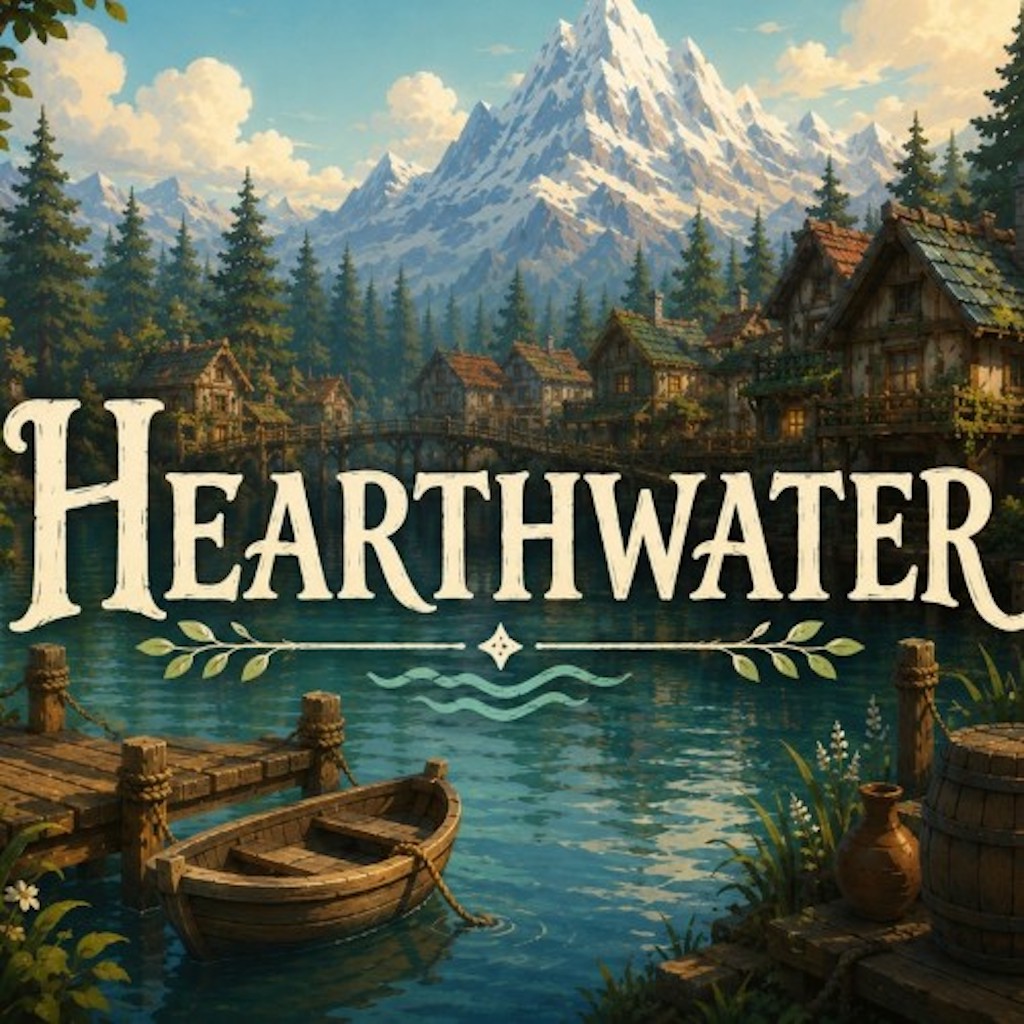
There is something wonderfully appealing about a game that asks absolutely nothing of you. No enemy is waiting around the next corner, there is no countdown urging you to hurry, and there is no complicated checklist demanding that you become an expert before you can properly enjoy yourself. Hearthwater is built around a much simpler idea: give the player a beautiful place to wander and let them decide what happens next. In a medium that can sometimes feel obsessed with bigger, louder and more demanding experiences, that simplicity is surprisingly refreshing.
Developed and published by Downmeadowstreet, Hearthwater is a cosy exploration game set in a peaceful seaside village. It follows the same relaxed philosophy as other walking and exploration experiences, but its coastal setting gives it a distinct personality. Beaches, quiet streets, woodland paths, hills and hidden corners create a small world that feels designed for wandering rather than conquering. There is no grand adventure waiting to be completed, because the adventure is simply taking the time to see what is around the next corner.
Welcome to Hearthwater
The first few minutes with Hearthwater immediately establish what sort of experience this is going to be. You arrive in a pleasant coastal environment, free to head wherever your curiosity takes you. There are no instructions telling you to hurry towards a particular destination, and no quest marker constantly pulls your attention away from the scenery. Instead, the game quietly encourages you to look around and discover the village for yourself.
That freedom is perhaps the most important part of the experience. You can stroll along the beach and enjoy the view, wander through the streets, or head towards the surrounding countryside to see what you can find. It sounds incredibly simple on paper, but there is something surprisingly satisfying about being allowed to explore without worrying about failure. The game gives you permission to slow down, and that makes even the smallest discoveries feel worthwhile.
The village itself is clearly designed to reward curiosity. There are landmarks to find, scenic viewpoints to discover, and hidden areas tucked away from the more obvious paths. You might initially walk past something without giving it much thought, only to notice it later when approaching the area from another direction. That encourages you to explore organically rather than simply following a predetermined route.
A Walk Without a Destination
What makes Hearthwater interesting is the complete absence of conventional pressure. There is no combat, no timer, and no punishment for wandering off in the wrong direction. You cannot really play the game badly, which is a lovely change of pace compared with experiences where every decision seems to carry consequences.
That does not mean the game is empty. Quite the opposite, because the lack of pressure allows the environment to become the main attraction. When you are not worrying about an enemy appearing behind you or an objective expiring, you have more time to appreciate the details around you. A quiet beach can become a destination in its own right rather than simply somewhere you pass through on the way to the next mission.
There is also something quite therapeutic about the pace. You can spend a few minutes wandering after a busy day and allow yourself to become absorbed in the scenery. The experience never demands that you optimise your time, which makes it particularly easy to relax into. Sometimes you can simply walk without any particular destination in mind and let the game decide what catches your eye.
The Beauty of the Coast
The seaside setting is arguably Hearthwater’s biggest asset. Beaches and coastal paths naturally lend themselves to this sort of experience, creating open spaces where the player can slow down and take in the surroundings. The combination of sand, water, village architecture and countryside provides enough visual variety to keep the journey interesting without making the world feel overwhelming.
The village itself has a pleasant sense of warmth. There is a feeling that this is somewhere people could actually live, rather than simply a collection of scenery designed to give the player something to look at. Quiet streets and little corners help create that impression, while the surrounding landscape provides a natural contrast when you decide to leave the built-up areas behind.
Then there are the viewpoints. These moments work particularly well because they provide a natural reward for exploration. Finding your way to a slightly elevated location and looking back across the village or towards the sea gives you the opportunity to appreciate the environment as a whole. It is a simple idea, but when the game is built around exploration, these visual rewards become surprisingly effective.
Discovering the Hidden Corners
The real challenge in Hearthwater is not survival. It is curiosity. If you want to discover everything the village has to offer, you need to be willing to explore beyond the most obvious routes and pay attention to where paths lead.
That can make the experience feel almost like taking a holiday somewhere unfamiliar. You arrive with no particular agenda and start walking, perhaps turning down a path simply because it looks interesting. Before long, you find a quiet spot you would never have seen if you had stuck rigidly to the main route. These moments are small, but they are exactly what give exploration games their charm.
The absence of traditional rewards also makes discovery feel more personal. You are not necessarily finding a powerful item or unlocking a new ability. Instead, you are finding a place you might not have seen otherwise. That may sound like a small reward, but it works because Hearthwater is not trying to turn exploration into a numbers game.
A Relaxing Atmosphere
The presentation plays a crucial role in making the experience work. Hearthwater has a soft, welcoming visual style that suits its peaceful philosophy perfectly. Nothing feels excessively harsh or designed to create tension, allowing the scenery to remain comfortable and inviting throughout your journey.
The audio is equally important. Gentle environmental sounds and the presence of the sea help create a sense of place, while the quieter musical elements complement the surroundings rather than overpower them. The result is an atmosphere that feels deliberately calming. It is the sort of game where you can imagine leaving the world behind for a little while and simply allowing yourself to become absorbed in the environment.
Sound is particularly effective when the player is not in combat. In an action game, music and effects are often there to increase adrenaline, but here they serve almost the opposite purpose. The soundscape gives you room to breathe. The sea, the surrounding environment and the gentle ambience all contribute to that feeling of being somewhere peaceful.
Is There Enough to Keep You Playing?
This is where Hearthwater will inevitably divide players. Its simplicity is both its greatest strength and its biggest limitation. If you need deep mechanics, character progression, puzzles, or a strong narrative to keep you invested, you may find yourself wondering what there is to do after you have explored most of the village.
There is no getting around the fact that this is a deliberately minimal experience. The game does not suddenly introduce a dramatic new mechanic halfway through to keep you hooked. It remains what it promises to be from beginning to end, and whether that is enough will depend entirely on what you want from a game.
Personally, I think there is value in that restraint. Not every game needs to justify its existence through endless progression systems. There is something refreshing about a title that knows its purpose and sticks to it. Hearthwater is essentially a digital stroll, and judging it for not being an RPG would be like criticising a walk on the beach because there were not enough boss battles.
A Little Escape From Everything
Perhaps the greatest compliment I can pay Hearthwater is that it understands its audience. This is not a game for players seeking challenge or adrenaline. It is for anyone who occasionally wants to sit down, pick up a controller, and have absolutely nothing stressful happen for a while.
There is something wonderfully old-fashioned about that idea. Games can be escapes, but we often think of escape in terms of becoming a hero, fighting enemies, or exploring enormous fantasy worlds. Hearthwater offers another kind of escape. It lets you become someone simply taking a quiet walk through a lovely coastal village.
That may sound insignificant, but sometimes that is exactly what we need. There are days when a complicated game feels like another responsibility, while something as gentle as Hearthwater can feel like a welcome breath of fresh air. It does not demand your attention. It simply gives you somewhere pleasant to spend it.
Final Verdict
Hearthwater is a charming, wonderfully peaceful exploration game that understands the appeal of slowing down. Its seaside setting is inviting, its hidden areas encourage genuine curiosity, and its complete lack of combat, timers and pressure makes it an ideal experience for anyone seeking something relaxing. There is no grand adventure here, but there does not need to be.
Its minimal approach will inevitably limit its appeal. Players seeking substantial gameplay systems, progression or narrative depth may find there is not enough beneath the surface to keep them occupied for long. For those willing to embrace the experience on its own terms, however, Hearthwater offers exactly what it promises: a quiet place to wander, explore and breathe.
Sometimes a game does not need to ask you to save the world. Sometimes it is enough to give you a beautiful beach, a quiet path and nowhere you need to be.