There is something wonderfully nostalgic about watching a small aircraft barrel through a canyon as enemy fighters swarm from every direction, your guns blazing and your squadmates shouting encouragement over the radio. It is the sort of scene that instantly transports you back to a time when arcade flight games were built around spectacle, personality and the simple joy of chasing a higher score. Wild Blue Skies understands that appeal almost instinctively. Now that the game has officially launched, rather than lingering in that strange pre-release space where promise can sometimes mask shortcomings, it is possible to properly judge whether Chuhai Labs has delivered the old-school rail-shooter revival it set out to create.
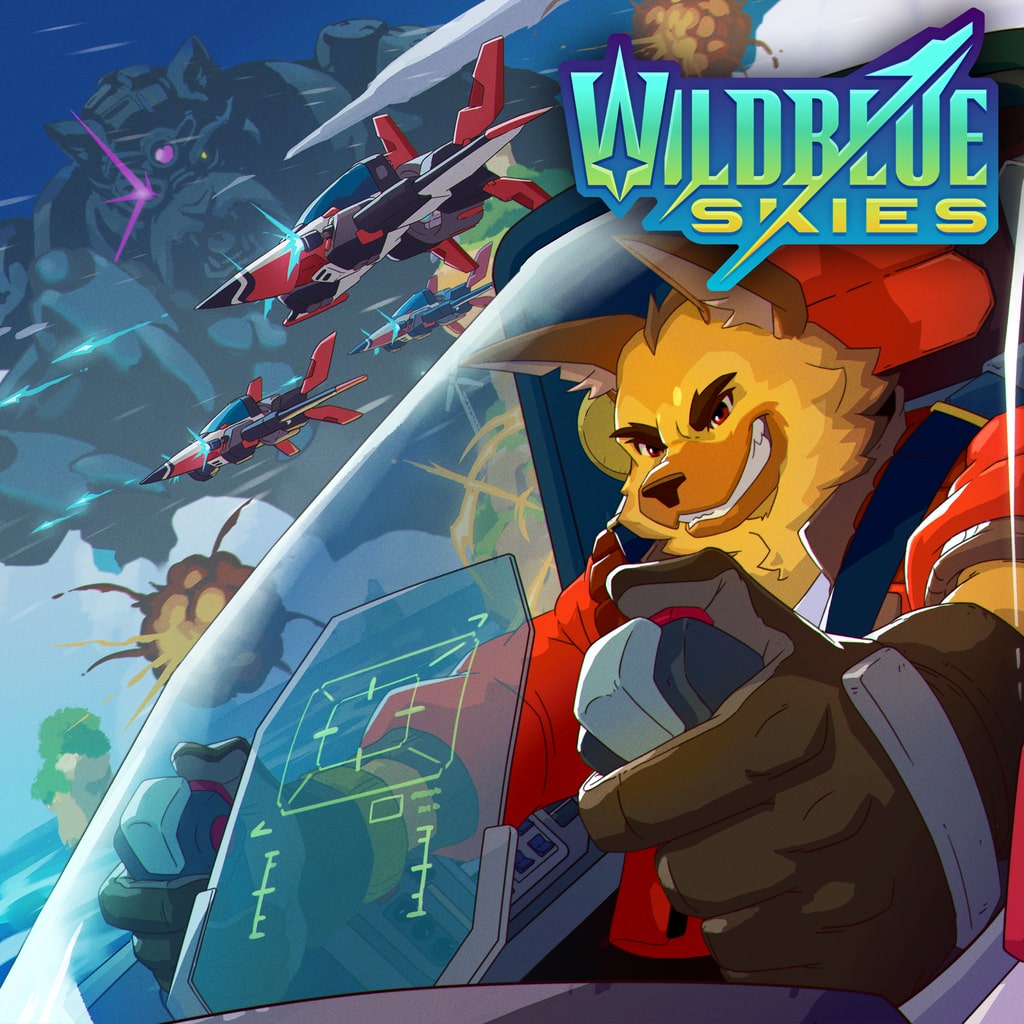
The answer is, for the most part, yes. Wild Blue Skies is an unapologetically nostalgic arcade shooter that wears its influences proudly, but there is enough charm, colour and personality here to make it more than a simple exercise in nostalgia. You take control of Bowie Stray, a pilot working alongside the Blue Bombers as they take to the skies to push back the forces of Grimclaw. The story is deliberately straightforward, the characters are colourful and the action rarely stays still for long. It is not trying to reinvent the rail shooter, and that confidence works in its favour.
Back in the Cockpit
The first thing that stands out about Wild Blue Skies is how quickly it gets to the point. There is no enormous skill tree, sprawling open world or complicated aircraft management system waiting to bury you beneath menus. You climb into the cockpit, follow the predetermined flight path and start shooting anything that looks remotely hostile. It is wonderfully uncomplicated, but beneath that simplicity lies a score-chasing system that gradually reveals itself as the real reason you will want to keep coming back.
The controls are deliberately accessible, making the game welcoming even if your previous experience with rail shooters is limited to occasional arcade sessions. Movement feels responsive enough to dodge incoming fire, weave around environmental hazards and position yourself for the best possible shots. There is also a satisfying rhythm to the action as enemies appear in formations, vulnerable points become visible and the game encourages you to think about accuracy rather than simply holding down the trigger. The difference between merely surviving a mission and finishing it with an impressive score becomes increasingly apparent the more familiar you become with each route.
That distinction is important because Wild Blue Skies is at its best when you stop treating it like a traditional campaign and start treating each mission like a performance. You learn where enemies appear, memorise attack patterns, search for opportunities to rack up larger scores and experiment with alternative routes. A first run might simply be about staying alive, while subsequent attempts become increasingly focused on medals, secrets and squeezing every last point from the environment. That old arcade mentality is alive and well here.
The Sky Is the Playground
Visually, Wild Blue Skies is a lovely thing to look at. The colourful, anime-inspired presentation gives the game a personality that could easily have been lost beneath its obvious retro influences, while the various environments provide plenty of visual variety as you fly over oceans, deserts and more dangerous enclosed areas. Everything feels bright and deliberately exaggerated, which is exactly what you want from this sort of arcade adventure. There is a sense that every explosion, enemy formation and dramatic flyby has been designed to make you grin.
The handcrafted environments are particularly effective because they help prevent the on-rails format from feeling too restrictive. You might find yourself flying across an open expanse one moment, before being funnelled through a dangerous passage the next. The camera and flight path constantly create opportunities for spectacle, whether that means sweeping around an enormous structure or squeezing through a hazardous environment while enemy fire fills the screen. It gives the campaign a nice sense of momentum.
There is also a pleasing amount of character in the world itself. The Blue Bombers are not simply anonymous pilots communicating through sterile radio chatter. Bowie, Thorne, Chuck and Roe have their own personalities, and the banter between them adds a light-hearted quality that fits the game’s Saturday morning adventure atmosphere. It never takes itself too seriously, which helps Wild Blue Skies maintain that wonderfully cheesy charm associated with the arcade games and animated adventures it clearly loves.
Follow the Leader
The branching mission structure is another smart addition. Although the core rail-shooter formula remains intact, the ability to follow different paths gives you a reason to revisit missions rather than simply completing them once and moving on. Some routes contain secrets, alternative encounters or different challenges, adding a welcome layer of discovery to what could otherwise be a very linear experience.
This is also where the game’s arcade DNA becomes particularly apparent. You are encouraged to replay missions, improve your performance and uncover everything the game has hidden away. There is a satisfying relationship between knowledge and skill, because knowing what is coming does not automatically guarantee success. You still need to react quickly, aim accurately and understand when it is worth taking a risk for a better score.
The bosses and larger encounters provide welcome punctuation to the regular shooting galleries. They give you something substantial to focus on and break up the rhythm of smaller enemy encounters. While the game does not always push the formula as far as it perhaps could, these moments are generally enjoyable and reinforce the sense of playing through a lost arcade classic that somehow escaped from the 1990s.
A Little Too Familiar
If there is a significant weakness, it is that Wild Blue Skies sometimes struggles to distinguish itself from its inspirations. The affection for classic rail shooters is obvious, and there is nothing wrong with drawing on the greats, but at times the game feels more like a loving recreation than a bold reimagining of the formula. Players who have spent years hoping for a new experience in this genre may occasionally wish the developers had taken a few more risks.
That does not make the game bad. Far from it. It simply means the strongest parts of Wild Blue Skies are often the moments when its own personality shines through, rather than the sections that recall something played decades ago. The characters, colourful presentation, branching routes and playful atmosphere are where the game feels most at home.
There is also an inevitable question of longevity. Rail shooters are naturally compact experiences, and Wild Blue Skies is not pretending to be something it isn’t. Its replay value comes from mastery rather than endless content, which means players looking for a lengthy campaign may finish sooner than expected. For those willing to replay stages, chase medals and hunt down secrets, however, there is considerably more here than the initial playthrough might suggest.
The Sound of the Arcade
The audio presentation deserves a mention for its vital role in sustaining the game’s energy. The music, sound effects and constant radio chatter combine to create a wonderfully exaggerated arcade atmosphere. There is always something happening, whether it is an enemy screaming into the distance, an explosion erupting nearby, or a squadmate chiming in with another line of dialogue.
It is that combination of visual colour, energetic sound and constant movement that makes Wild Blue Skies so easy to enjoy. It feels like a game made by people who genuinely love the genre, rather than a product designed simply because retro shooters are fashionable again. There is enthusiasm behind it, and that enthusiasm comes through in the presentation.
Worth Taking to the Skies?
Now that Wild Blue Skies has officially landed, it is easier to see what Chuhai Labs was aiming for. This is not a grand reinvention of the rail shooter, nor does it need to be. Instead, it is a bright, energetic and affectionate celebration of a style of game that has been largely absent from modern platforms for far too long.
Its strongest qualities are its accessible controls, colourful presentation, entertaining characters and excellent score-chasing loop. The branching paths give the campaign welcome replay value, while the varied environments and enemy encounters keep the action moving. It occasionally leans too heavily on its influences, and players seeking a lengthy or mechanically revolutionary shooter may find its relatively focused design limiting. But those shortcomings are only difficult to ignore if you approach the game expecting something it never promised to be.
Wild Blue Skies is at its best when you stop worrying about whether it is the next great evolution of the genre and simply enjoy the ride. There is something wonderfully uncomplicated about blasting through the skies with a group of likeable pilots, hearing the music swell as another enemy formation appears and immediately thinking about how much better you could do on the next run. In an era when games often seem determined to become bigger and more complicated, that simplicity feels refreshing.
Chuhai Labs has delivered a game with genuine heart, and that matters. Wild Blue Skies remembers why these games were so much fun in the first place. It wants you to smile, shoot things, discover another route and then have another go because you know you can squeeze a few more points from the stage. It may not completely escape the shadow of the classics that inspired it, but when it spreads its wings and embraces its own colourful personality, it soars.
Final Verdict
Wild Blue Skies is a spirited, beautifully nostalgic return to arcade flight combat. It does not hide its influences or disguise where its heart lies, instead embracing the colourful characters, explosive set pieces and score-chasing gameplay that made classic rail shooters so memorable. Some players may find the formula a little familiar and the overall experience more compact than modern blockbusters, but there is a real warmth here that makes the journey worthwhile.
For anyone who still remembers sitting in front of a CRT television, trying to survive another impossible mission, Wild Blue Skies feels like finding an old favourite waiting for you in a new arcade. It is colourful, charming, energetic and, most importantly, fun. A very welcome flight back to the golden age of arcade shooters.