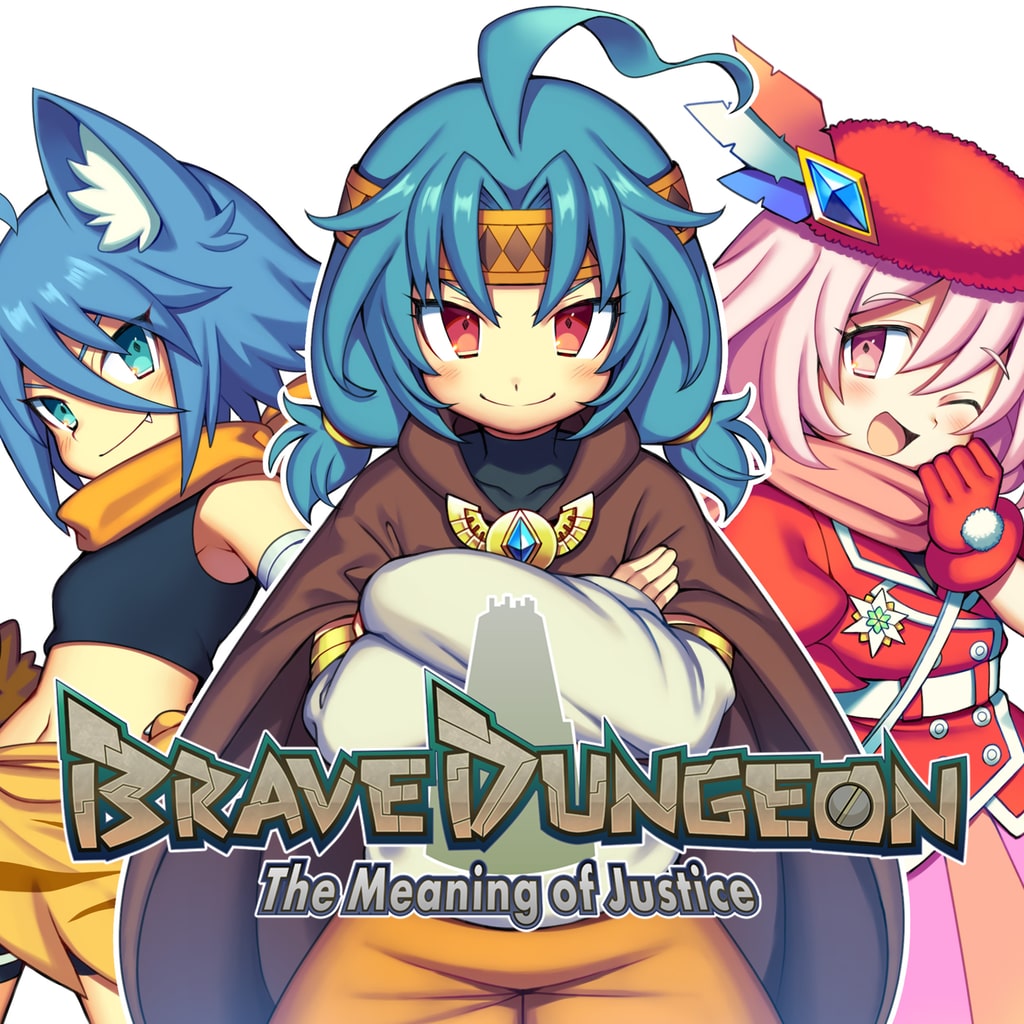
There is something reassuring about a good old-fashioned dungeon crawler. While modern RPGs often seem determined to become bigger, louder and more complicated, there is still a special pleasure in being handed a party, a handful of abilities and a dangerous maze to explore, then being told to figure things out for yourself. Brave Dungeon: The Meaning of Justice understands that appeal, but rather than simply polishing the formula established by its predecessor, it takes a rather more interesting approach. By splitting its adventure between three protagonists, each with their own style of play, INSIDE SYSTEM has created a sequel that feels considerably broader without losing the charm of its retro-inspired roots.
For newcomers, Brave Dungeon is a spin-off from The Legend of Dark Witch, a series that has quietly built a dedicated following since the original game launched in 2014. The first Brave Dungeon went on to find its own audience, selling more than 100,000 copies worldwide, and The Meaning of Justice builds directly upon that foundation. You are not simply stepping into another linear adventure here. Instead, three characters face very different challenges, and each route offers its own rules, objectives and personality.
That structure is arguably the game’s greatest strength. Just as one storyline begins to settle into a familiar rhythm, another protagonist changes the pace and asks you to approach progression from a completely different angle. It gives the adventure a pleasantly varied rhythm that keeps the dungeon crawling from becoming too predictable.
Three Heroes, Three Adventures
The central idea behind The Meaning of Justice is beautifully straightforward. Rather than forcing every character into the same RPG progression, the game gives Al, Klinsy and Papelne their own campaigns.
Al’s story is closest to what you would traditionally expect from a dungeon crawler. You explore the Forest of Miracles, push deeper into increasingly dangerous areas and search for a way out while dealing with the mysterious GrassKeys and the enormous IvyDoors that block your progress. It is the most immediately recognisable of the three adventures, making it a comfortable starting point for anyone who simply wants to explore, fight and build a party.
Klinsy’s adventure is a different beast altogether. Her journey takes place across three library towers known as the Unopened Archives, where knowledge itself becomes part of the challenge. The presence of Sealing Traps means that exploration is not simply about finding the next staircase. You need to pay attention, consider what the environment is asking of you and approach the archives with a little more caution.
Then there is Papelne, whose campaign could almost be mistaken for an entirely different game. She finds herself standing in an empty plain and sets about creating a settlement from scratch. Gathering resources, crafting items, constructing facilities and decorating the town give her storyline an economic and creative flavour that the other campaigns simply do not have.
The Forest of Miracles
Al’s route offers the strongest traditional dungeon-crawling experience, and it is easy to see why this structure remains so appealing. The Forest of Miracles is full of locked paths, hidden resources, and areas that gradually become accessible as you expand your capabilities.
The GrassKeys are particularly effective because they create a sense of limited opportunity. You cannot simply open everything immediately, so exploration involves deciding where to spend your resources.
Syega pieces add another layer to the process. Collecting them allows you to create Seama Items, which in turn expand the areas available for exploration. This creates a satisfying loop in which exploration feeds progression and progression opens up more exploration.
That familiar Metroidvania-like rhythm works particularly well within the dungeon-crawler framework. Every new ability or resource can make you look back at previously inaccessible areas with fresh eyes.
Klinsy’s Unopened Archives
Klinsy’s campaign is perhaps the most distinctive of the three. The Unopened Archives provide a setting that feels appropriately mysterious, but the real draw is how the game uses its library towers to introduce a more thoughtful progression.
The Sealing Traps force you to consider your surroundings rather than simply charging from one encounter to the next. There is a nice sense of anticipation when entering a new section, because you never quite know whether you are about to find a valuable resource, a useful piece of information, or something designed specifically to punish careless exploration.
It also suits Klinsy as a protagonist. Her story feels more intellectual and investigative, which helps prevent the three campaigns from becoming superficial variations on the same dungeon.
The result is an adventure that rewards curiosity. You are encouraged to explore carefully and think about what the game presents, rather than simply treating every room as another combat arena.
Building Papelne’s World
Papelne’s campaign is where The Meaning of Justice really shows its willingness to experiment. Starting with nothing more than an empty plain, you gradually build a functioning settlement by gathering materials and using them to craft tools, facilities and decorative objects.
There is undeniable satisfaction in watching an empty space become a place that feels lived in. The process gives resource gathering a genuine purpose, while the freedom to decorate the settlement adds a more personal touch to the adventure.
It is also a welcome change of pace. After spending time exploring dangerous environments and worrying about enemies, focusing on construction and development gives the overall experience some breathing room.
More importantly, it makes Papelne feel like her own character rather than simply another member of a larger RPG cast. Her campaign has its own identity, and that is exactly what this three-story structure needs.
Tactical Turn Based Combat
Despite the variety between the campaigns, combat remains one of the game’s foundations. The Meaning of Justice uses turn-based battles built around speed-based turn order, party composition and careful management of skills.
That emphasis on speed adds a little more urgency than the traditional approach to turn-based combat. Knowing which character is likely to act first can influence how you approach an encounter, particularly when facing tougher opponents.
Class changes and stat distribution also give you room to shape your party around your preferred strategy. You can experiment with different roles and adjust your characters as the difficulty increases.
The Revenge Magic system is another welcome return. Saving up that potential and unleashing it at the right moment can turn an otherwise dangerous encounter around, particularly during boss fights where one well-timed attack can make a huge difference.
Building the Right Party
Party construction is where the RPG mechanics become particularly satisfying. There is enough flexibility to make experimentation worthwhile without drowning the player in endless menus and statistics.
Changing classes allows characters to evolve in different directions, while resource management adds another reason to explore thoroughly. The deeper you venture into the dungeons, the more important it becomes to understand what your party actually needs.
It is not necessarily about creating the theoretically perfect team. Much of the enjoyment comes from finding a combination that suits the way you like to play.
That makes the progression feel personal. Your party becomes something you have built rather than simply a collection of predetermined characters.
A Retro Heart
Visually, The Meaning of Justice wears its retro influences proudly. This is not an RPG trying to hide its heritage behind photorealistic environments or enormous cinematic set pieces.
Instead, it embraces a colourful, deliberately old-school presentation that sits comfortably alongside the earlier games in the franchise. There is a warmth to that approach. The characters have personality, the environments have distinct identities, and the overall presentation feels designed for readability rather than spectacle.
That simplicity works particularly well for a dungeon crawler. You can quickly understand what you are looking at, where you need to go, and what might be important without the screen becoming overwhelmed by visual noise.
Bringing Everything Together
The most interesting aspect of The Meaning of Justice is how its three campaigns eventually come together. Each storyline initially feels like its own little adventure, with its own systems and priorities, yet there is a larger purpose behind the separation.
Completing the three routes unlocks a final chapter in which the different parties converge. This gives the structure a sense of payoff that would otherwise be missing.
This is important because three separate campaigns could easily have felt disconnected. Instead, the game gradually reveals why these perspectives matter. The final convergence gives the adventure a stronger sense of progression and makes the hours spent with each protagonist feel worthwhile.
Does It Stay Fresh?
The three-part campaign structure does an impressive job of keeping the experience moving. Whenever one style of gameplay starts to feel familiar, the next protagonist offers something different.
There are still moments when the dungeon crawling can feel repetitive, particularly for players who prefer a faster pace or more dramatic storytelling. This is still fundamentally a retro-inspired RPG, and its systems are deliberately built around repetition, exploration and gradual character growth.
But that repetition rarely dominates for too long. The shift between Al, Klinsy and Papelne gives the adventure enough variety to maintain momentum. It feels like a game that understands its audience. It is not trying to turn dungeon crawling into something it is not.
Final Verdict
Brave Dungeon: The Meaning of Justice is a charming and surprisingly ambitious sequel that recognises the strengths of its predecessor while finding room to experiment. Its three protagonists offer three distinct ways to experience the world, with Al delivering classic dungeon exploration, Klinsy offering a more puzzle-focused adventure, and Papelne bringing crafting and settlement building into the mix.
The turn-based combat remains satisfyingly strategic, particularly when class changes, speed-based turn order, and Revenge Magic work together. There is enough character progression to make party building rewarding without burying the experience in unnecessary complexity.
What makes the game stand out, though, is its willingness to let each protagonist have a genuine identity. These are not three interchangeable campaigns wearing different costumes. They each have their own mechanics, rhythm, and personality, and that variety gives the entire adventure a stronger sense of purpose.
It is not the most visually spectacular RPG you will play, nor is it trying to be. Its appeal comes from exploration, experimentation, and the simple pleasure of watching a small party grow stronger as the dangers around them become increasingly demanding.
For fans of The Legend of Dark Witch and the original Brave Dungeon, this is a worthy continuation. For newcomers, it offers a welcoming entry point into a charming little RPG universe that deserves more attention. Brave Dungeon: The Meaning of Justice proves that sometimes the best adventures are the ones that know exactly what they want to be.