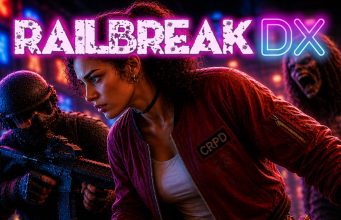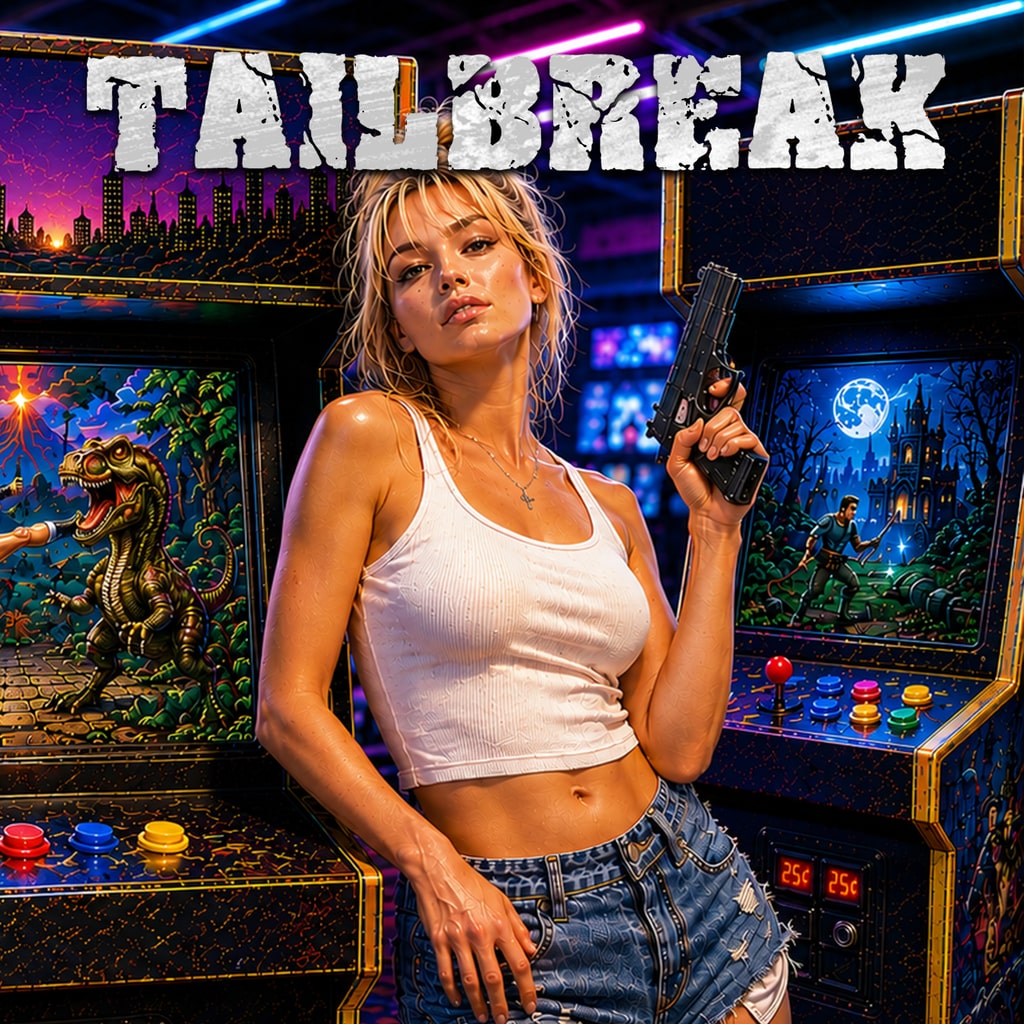
There is something wonderfully stupid about a game where dinosaurs and zombies can both decide you are today’s lunch. Tailbreak understands this immediately and, rather than trying to make its premise respectable, embraces every ridiculous inch of it. Developed and published by Dead Drop Studios, this arcade on rails shooter is a follow-up to Railbreak and a retelling of DINOBREAK, throwing players into the chaos of Cypress Ridge as they blast their way through prehistoric predators, undead hordes and enough B-movie nonsense to make a VHS collector proud. Beneath the camp and carnage, however, lies a surprisingly thoughtful arcade shooter that understands the importance of weapon management, replayability and simply making shooting things feel fantastic.
The premise is gloriously uncomplicated. You are dropped into a city overrun by dinosaurs and must survive six-story acts while playing as Alex and Rin, two heroines whose desperate attempt to stay alive is accompanied by the sort of hysterical banter that would feel completely at home in a late-night creature feature. The camera follows a predetermined route through each environment, leaving you free to concentrate on identifying threats, choosing targets and making every bullet count. It is a formula that has been around for decades, but Tailbreak demonstrates why the on rails shooter still has plenty of life left in it.
Welcome to Cypress Ridge
The first few minutes tell you almost everything you need to know about Tailbreak. The screen fills with movement. Something enormous roars in the distance, and suddenly a dinosaur charges directly towards you. Your handgun is not particularly glamorous, but it is reliable, and that matters because the game wastes little time giving you reasons to shoot.
The environments offer plenty of variety as you move through restaurants, streets, industrial areas and darker subterranean locations. Cypress Ridge feels appropriately desolate, with the destruction around you providing a convincing backdrop for the ridiculous creatures currently trying to eat you. The contrast between detailed environments and completely absurd enemies gives Tailbreak much of its personality.
This is not survival horror in the slow, creeping sense. It is survival horror through sheer momentum. The game wants you moving, shooting and reacting before you have time to think too much about what is happening.
The Arcade Spirit Lives
At its heart, Tailbreak is an old-school arcade shooter powered by modern technology. The camera moves automatically, enemies appear in carefully constructed sequences, and success depends on your ability to identify threats quickly. It is a simple formula, but simplicity is not necessarily a weakness.
In fact, it is one of the game’s greatest strengths. There is something immediately satisfying about watching a raptor leap into view and knowing you have only a second or two to put it down. A well-placed burst feels rewarding, while missing a target can have consequences that snowball surprisingly quickly.
The result is an experience that is easy to understand but considerably harder to master. You can pick it up and play without reading a manual, yet chasing higher scores requires considerably more attention.
Two Items, Difficult Decisions
One of the smartest additions is the new item system. You can pick up ammunition, healing items and other useful equipment, but you can carry only two at a time. That limitation sounds minor until you are staring at a grenade while already carrying something you know you might desperately need later.
Do you take the extra firepower? Do you keep your healing item? Do you gamble on surviving without it?
These decisions give the otherwise straightforward shooting a little more depth. You cannot simply collect everything and become an unstoppable walking arsenal. You have to make choices, and sometimes those choices are dictated by whatever terrifying creature is charging at you.
That sense of limited resources fits the survival horror atmosphere nicely. Even though Tailbreak is deliberately loud and ridiculous, there is still a satisfying tension in knowing that your next mistake could leave you vulnerable.
Guns, Grenades and Dinosaurs
Your starting handgun is only the beginning. As you progress, you gain access to additional weapons and sub-weapons, each offering different ways to deal with the game’s increasingly aggressive enemies. The trick is learning when to use them rather than simply firing everything the moment it becomes available.
Sub-weapon ammunition needs careful management. Waste your stronger attacks early, and you may regret it when something considerably nastier arrives later. The best arcade shooters have always understood this principle, and Tailbreak makes good use of it.
Arrange Mode takes the weapon system further by letting players select handguns with different effects and upgrade their sub-weapons. This gives repeated runs a stronger sense of progression and experimentation. Instead of simply replaying the same campaign, you can start thinking about which weapon combinations suit your play style.
Dinosaur Meets Zombie
The ability to mix dinosaurs and zombies is exactly the kind of ridiculous idea that makes Tailbreak so enjoyable. In the standard story mode, the focus is on its dinosaur apocalypse, but the other modes let you introduce undead enemies into the chaos.
It should not work as well as it does. Watching the battlefield become a mix of prehistoric predators and shambling corpses creates wonderfully unpredictable encounters. You might be preparing to deal with a group of zombies only to find a dinosaur suddenly charging into their midst. It turns the already frantic combat into something even more chaotic. The best part is that the game never seems embarrassed by its own ridiculousness. It knows exactly what it is doing.
A Proper B Movie
The six-act story is fully voiced, and the dialogue is deliberately cheesy. Alex and Rin are not delivering Shakespeare, nor should they be. Their exchanges are designed to make you smile even as everything around them collapses into dinosaur-infested madness.
That tone is crucial because Tailbreak could easily have become exhausting if it took itself too seriously. Instead, the dialogue provides breathing space between the action and reinforces the game’s arcade horror identity. It feels as though the developers genuinely understand the appeal of bad monster movies.
There is a warmth to the silliness, too. The characters are not merely there to deliver exposition. Their personalities and banter make the journey feel more like an adventure with friends than a grim march through an apocalypse.
Unreal Engine Makes a Difference
For a game built around arcade action, Tailbreak is surprisingly attractive. Unreal Engine 5.7 brings Cypress Ridge to life with more sophisticated lighting and detailed environments, and the results are particularly effective in darker locations.
The lighting gives some areas a genuinely threatening atmosphere. Restaurants, streets and underground spaces can look dramatically different depending on how the environment is lit, while the contrast between darkness and sudden flashes of gunfire adds plenty of visual energy.
It is an interesting blend of old and new. The gameplay belongs firmly to the arcade era, but the technology behind the presentation allows the world to look considerably more modern than the games that inspired it.
Six Acts of Chaos
The campaign’s six acts provide a solid framework for the experience, though the real longevity comes from replaying them. On a first run, much of your attention is spent simply surviving. Once you understand enemy placements and environmental cues, however, your priorities begin to shift.
Suddenly you are thinking about score multipliers. You are looking for better ways to deal with groups of enemies. You are trying to conserve ammunition and maximise your damage.
That transformation is important because arcade shooters are rarely about seeing the ending once. They are about becoming better at the game. Tailbreak understands that and provides enough additional systems to encourage repeated runs.
Mutation Matrix
The Mutation Matrix is perhaps the most interesting feature for players who want unpredictability. By randomising encounters and items, it ensures that subsequent playthroughs do not necessarily unfold as expected.
This can make a familiar level feel surprisingly fresh. You may know the general route, but the weapons and threats you encounter can force you to adjust your approach. That unpredictability gives the game something beyond simple memorisation.
It also makes the system particularly well suited to arcade players. Once you have mastered the conventional campaign, the Mutation Matrix gives you a reason to return and see what chaos the next run brings.
Playing Together
The entire experience can be enjoyed solo or with another player, and local co-op is where Tailbreak arguably makes the most sense. There is something inherently social about an arcade shooter. One player spots a target while the other handles threats from another direction, creating moments of frantic communication.
Co-op also adds another layer to resource management. You have to consider who needs the next useful item and who is best placed to handle the next wave of enemies. It turns what can already be an intense experience into something wonderfully chaotic.
The additional modes also provide plenty of reasons to keep playing once the story is complete. Score Attack is perfect for competitive players, while Arrange Mode and Mutation Matrix offer different ways to approach the same core mechanics.
The Art of the Arcade
One of the most appealing things about Tailbreak is its confident embrace of its influences. It does not try to disguise itself as something more sophisticated than it is. The game wants you to sit down, grab the controls and blast dinosaurs. That honesty is refreshing.
Modern games sometimes become so obsessed with progression systems, open worlds and enormous amounts of content that they forget how satisfying a focused experience can be. Tailbreak does not need a hundred-hour campaign. It needs good enemy encounters, satisfying weapons and enough variety to make another run worthwhile. Fortunately, it has all three.
Where It Stumbles
The arcade structure will inevitably feel restrictive to players who prefer more freedom. You are following a predetermined route, and there is no escaping the fact that the camera controls the journey. That is fundamental to the genre, but it can make the experience feel less interactive than in a conventional survival horror game.
There are also moments when the sheer number of enemies can overwhelm the more tactical elements. When everything is moving at once, precision can occasionally give way to frantic button-pressing. For some players, that will be part of the fun, while others may wish the game gave them slightly more breathing room.
The campaign itself is relatively straightforward. Much of the replay value comes from mastering the existing content rather than discovering an entirely new adventure. That is perfectly acceptable for an arcade shooter, but it is worth remembering before expecting a traditional horror campaign.
Final Verdict
Tailbreak is exactly the sort of game that knows how ridiculous it is and becomes better for it. Dinosaurs, zombies, arcade shooting and cheesy B- movie dialogue should not necessarily make for a cohesive experience, yet Dead Drop Studios brings these ingredients together with surprising confidence.
The new item system adds welcome decision- making to the shooting, while weapon variety and Arrange Mode give experienced players plenty to experiment with. The Mutation Matrix is another excellent addition, as it prevents repeated runs from becoming entirely predictable. Add co- op, Score Attack and the ability to mix dinosaurs with zombies, and there is considerably more here than a simple six- act campaign.
The Unreal Engine 5. 5. 5.7 presentation is another pleasant surprise. Cypress Ridge looks suitably grim and desolate, with lighting doing a great deal to enhance environments that could otherwise have felt like simple shooting galleries. At the same time, the deliberately cheesy story and voice acting ensure that the game never loses its sense of fun.
There are limitations. The on- rails structure will not appeal to everyone, and the campaign can feel relatively straightforward once you have seen it. Some encounters also become so frantic that careful weapon management occasionally gives way to pure survival instinct. But perhaps that is the point.
Tailbreak is not trying to reinvent the arcade shooter. It is trying to remind us why the genre was so much fun in the first place. It wants you to grab a weapon, watch a dinosaur charge towards you and experience that split second when your brain has to decide exactly where to shoot. Then it wants you to do it again. And again.
With its ridiculous premise, satisfying gunplay, smart resource management and excellent replay potential, Tailbreak is a wonderfully chaotic love letter to the light- gun shooters of yesterday, given a modern visual makeover and an appropriately prehistoric twist.
If you have ever wanted to fight your way through a dinosaur apocalypse while occasionally wondering whether the next corridor is going to contain a zombie, Tailbreak is more than happy to make that particular dream come true.