Some games ask you to work together. Others demand it. Brave Escape firmly belongs in the second category, building its entire identity around cooperation, a quality very few platformers attempt. There is no lone hero saving the day here, no option to simply carry an inexperienced partner through difficult sections, and certainly no room for selfish play. Every leap, every climb, and every puzzle depends on two people thinking as one.
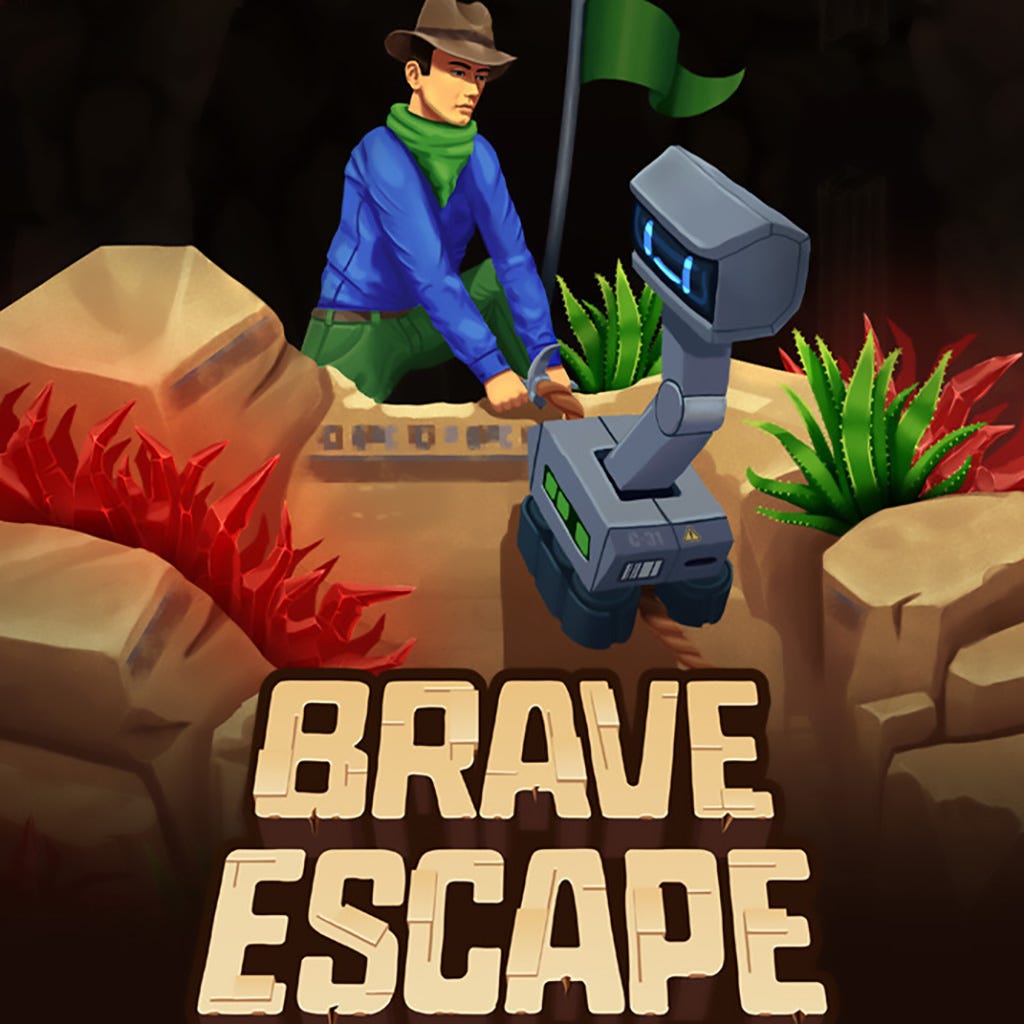
Developed by Hit Start Studios, Brave Escape follows Colin and his robotic companion, Floyd, as they venture through a sprawling network of dangerous underground caverns in search of freedom. It sounds like a straightforward adventure, but the journey quickly becomes a demanding test of communication, trust, and precision. Whether you’re playing with a lifelong friend, a sibling, or someone you’ve only just met online, success depends on your ability to work together constantly.
Cooperative platformers have become increasingly popular over the past decade, but many still allow one player to dominate while the other offers occasional assistance. Brave Escape takes a bolder approach, designing every challenge around equal participation. Neither Colin nor Floyd can escape alone, and that philosophy runs through every aspect of the game.
The result is an experience that feels incredibly rewarding when everything clicks. At the same time, it can be wonderfully chaotic when communication breaks down. Like any memorable co-op game, some of the best stories are not scripted moments but the laughter and panic shared between players after yet another spectacular failure.
Gameplay
At its heart, Brave Escape is a precision platformer. Timing, movement, and confidence matter, but none of them mean much unless both players are perfectly in sync. From the opening levels, the game establishes a rhythm that encourages constant communication, asking players to coordinate jumps, operate mechanisms, and overcome hazards neither character could survive alone.
Colin and Floyd each bring their own unique abilities to the adventure. Colin specialises in physical traversal, using climbing ropes and grappling equipment to scale difficult terrain and create opportunities for his companion. Floyd, meanwhile, relies on mechanical gadgets and mobility enhancements that allow him to manipulate the environment in ways Colin cannot.
This asymmetrical design is where Brave Escape truly shines. Rather than simply controlling two characters with identical movesets, each player feels genuinely important. Every obstacle becomes a conversation. Who goes first? When should the rope be deployed? Is now the right time to activate the Wind Gun, or should Floyd wait another second?
These constant decisions keep the experience engaging throughout the campaign. Solving challenges rarely comes down to individual skill alone. Instead, success depends on understanding your partner’s intentions and reacting accordingly.
Movement itself feels excellent. Both characters respond immediately to player input, making failures feel like genuine mistakes rather than problems with the controls. Precision platformers live or die by responsiveness, and Brave Escape earns trust by making every jump feel reliable.
Built Around Cooperation
Many multiplayer games claim to encourage teamwork yet often allow players to split up and complete objectives independently. Brave Escape refuses to compromise its vision. Every area is carefully constructed around the idea that both players must remain involved at all times.
Environmental puzzles regularly combine platforming with gadget use. Floyd’s specialised tools vary by biome, introducing fresh mechanics throughout the adventure. In Glacial Falls, the Wind Gun alters movement and environmental hazards. Elsewhere, the Freeze Gun, Magnet Gun, Flashlight, and other gadgets completely reshape how players approach each level.
These additions prevent the gameplay from becoming repetitive. Every biome introduces something new without abandoning the core mechanics established in the opening stages. Rather than constantly introducing entirely new systems, the game builds naturally on familiar ideas, encouraging players to master existing abilities while adapting to fresh situations.
The seven distinct environments also give the campaign a welcome sense of progression. Each location introduces distinctive hazards, visual themes, and traversal challenges, ensuring the adventure continues to evolve rather than repeating the same ideas across dozens of levels.
Collectables and hidden secrets provide additional motivation to revisit completed stages. Completionists will enjoy experimenting with different strategies to uncover every hidden area, particularly once they become more comfortable with the game’s movement systems.
Two Difficulty Options That Actually Matter
One of the smartest design decisions in Brave Escape is the inclusion of two genuinely distinct difficulty settings. Standard Mode offers a more welcoming experience for players unfamiliar with demanding platformers. Hazard placement is slightly more forgiving, timings are less punishing, and mistakes rarely feel overwhelming. It lets newer players enjoy the cooperative mechanics without being immediately discouraged.
Brave Mode, however, lives up to its name. This is where the game fully embraces its precision platforming roots. Obstacles demand near-perfect execution, communication becomes essential, and every successful section feels genuinely earned.
Importantly, neither mode feels like an afterthought. Standard Mode is not simply an easier version with fewer enemies, while Brave Mode is not unfairly difficult for the sake of frustration. Both are carefully balanced for different audiences, allowing players to choose the experience that best matches their skill level. This flexibility makes the game surprisingly accessible despite its demanding reputation.
Playing Together Never Felt Easier
The technical features supporting multiplayer deserve recognition for removing many of the barriers that often prevent friends from playing together.
Cross-platform support ensures players are not restricted by hardware choices, while local couch co-op captures the timeless appeal of sitting beside someone and sharing the adventure on one screen. The inclusion of a Friend’s Pass is another welcome feature, allowing an online partner to join without purchasing a second copy.
It is an incredibly consumer-friendly decision that deserves praise. Cooperative games only succeed when players can find partners, and removing financial barriers makes it far easier to introduce friends to the experience.
Online performance remains consistently smooth, which is particularly important given the precision required in later levels. Timing-based platformers have little room for latency issues, and thankfully Brave Escape performs reliably throughout.
Presentation
Visually, Brave Escape adopts a colourful style that complements its adventurous tone. The environments are bright and varied, with each biome establishing its own identity through distinct colours, environmental details, and obstacle designs. While it may not push modern hardware to its limits, the art direction remains consistently appealing.
Character animation also deserves praise. Colin and Floyd move with enough personality to make them instantly likeable, and their contrasting designs reinforce the idea that each brings something different to the partnership.
The soundtrack is another highlight. Filled with energetic, synth-inspired compositions, the music keeps the adventure moving at a lively pace without becoming repetitive. During more intense platforming sections, the soundtrack naturally builds excitement, while quieter moments allow players to catch their breath before the next challenge.
Sound effects are equally effective, providing satisfying feedback for jumps, gadget use, and environmental interactions. Together with the responsive controls, they help make every successful sequence feel rewarding.
Where It Occasionally Stumbles
As enjoyable as Brave Escape is, its greatest strength can also be its biggest obstacle. Because the entire experience depends on cooperation, everything falls apart if one player loses focus or becomes significantly less skilled than the other.
There are moments when repeated failures can slow the pace, particularly in Brave Mode. Even experienced players may occasionally find themselves replaying the same section numerous times while waiting for both partners to achieve near-perfect execution.
For some players, that challenge will be the main attraction. Others may find the relentless focus on precision a little exhausting during longer sessions. Thankfully, Standard Mode offers a gentler alternative without sacrificing the game’s core identity.
Verdict
Brave Escape is one of the strongest examples of genuine co-op game design in recent years. Rather than simply allowing two players to share the same adventure, it builds every mechanic, puzzle, and platforming challenge around communication, trust, and teamwork. The result is a rewarding experience that constantly reminds players that success feels even sweeter when it is shared.
Its responsive controls, imaginative level design, clever asymmetric abilities, and thoughtful accessibility features make it easy to recommend to anyone seeking a memorable co-op adventure. While Brave Mode demands remarkable precision and patience, the inclusion of Standard Mode ensures that less experienced players can still enjoy the journey.
Like the best co-op games, Brave Escape creates memories far beyond its levels and collectibles. It creates stories of last-second rescues, perfectly timed jumps, hilarious mistakes, and celebrations after finally conquering a seemingly impossible challenge. Those shared moments are what make great multiplayer games special, and Brave Escape delivers them in abundance.