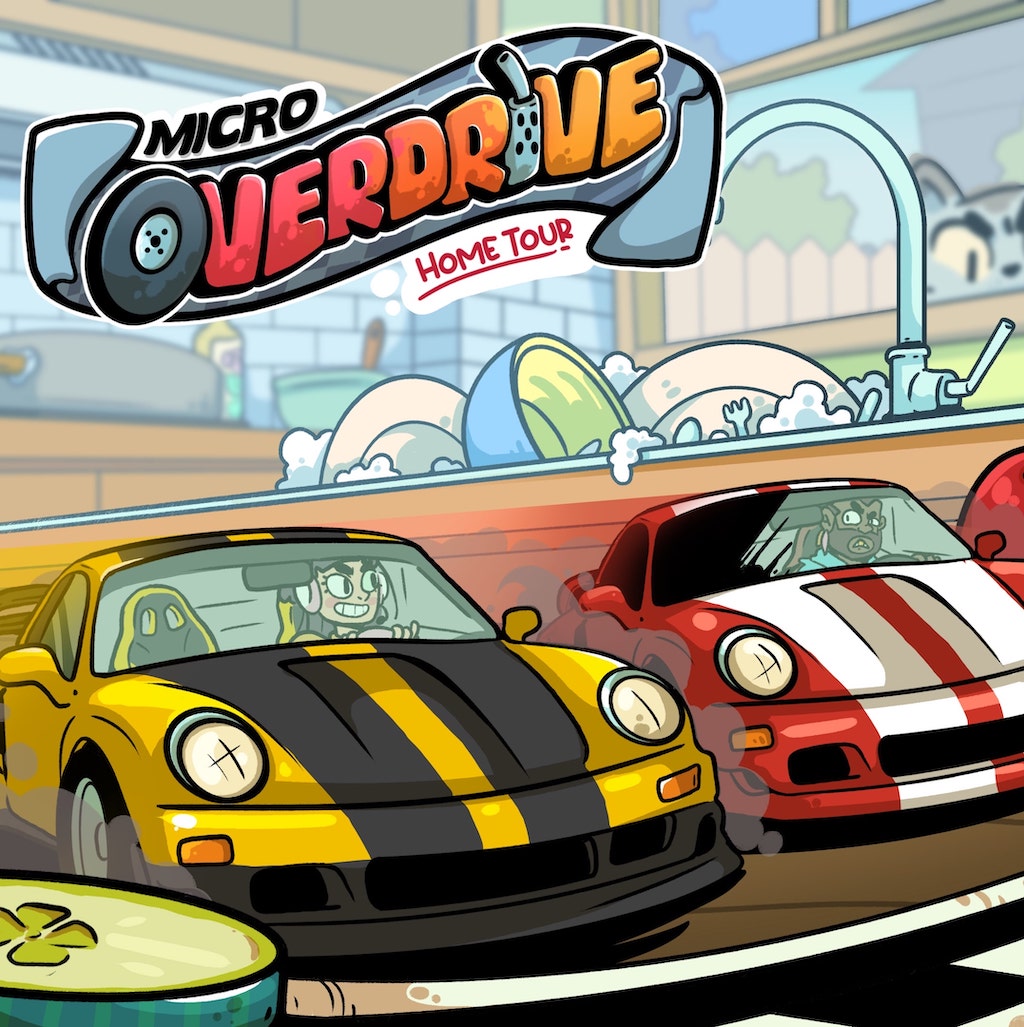
There is something timeless about miniature racing games. Long before sprawling open worlds and hyper-realistic driving simulators dominated the genre, there was a special kind of joy in guiding tiny vehicles across oversized environments, where a breakfast table could become a deadly circuit and a bathtub could transform into a motorsport arena. Micro Overdrive: Home Tour fully understands that appeal.
Developed by Lucky Raccoon Games, this top-down arcade racer wears its inspirations on its sleeve. The influence of classics like Micro Machines is impossible to miss, yet Micro Overdrive never feels like a simple imitation. Instead, it takes that familiar formula and injects it with enough charm, energy and modern polish to create an experience that feels nostalgic yet refreshingly accessible.
The result is a racing game that rarely takes itself seriously. It is colourful, chaotic and built around quick bursts of fun rather than endless progression systems. While it may not offer the depth or longevity of larger racing titles, it knows exactly what it wants to be, and for the most part, it succeeds.
Racing Through the Everyday
One of the game’s greatest strengths is its setting. Rather than placing players on traditional race tracks, Micro Overdrive transforms ordinary household locations into oversized racing playgrounds. Kitchens become dangerous obstacle courses. Workbenches become technical circuits. Children’s playrooms become labyrinths of toys and hazards that can disrupt even the most careful racing line.
The concept works because the environments are instantly recognisable. Everyone knows what a kitchen looks like, but seeing it from the perspective of a tiny toy car creates a sense of wonder that never entirely wears off. Suddenly, a spilled drink becomes a hazardous corner. A rolling marble becomes an unexpected obstacle. A fork left on a table can alter the flow of an entire race.
Each location has its own identity and challenges. Tracks rarely feel interchangeable because environmental hazards actively shape how races unfold. Some circuits reward aggression and confidence, while others demand patience and precision. Learning each layout becomes part of the fun, especially when unexpected hazards appear in later laps.
The final-lap twists deserve particular praise. Many tracks introduce additional dangers as the race reaches its climax. A harmless kitchen appliance might suddenly activate, or environmental hazards may become more aggressive. These moments create dramatic finishes that can completely alter the outcome of a race within seconds.
Pure Arcade Racing
Micro Overdrive wastes little time getting players into the action. From the moment you begin racing, the controls feel responsive and easy to understand. Steering is sharp, acceleration is immediate, and drifting around corners quickly becomes second nature.
This simplicity is one of the game’s biggest strengths. There are no complicated simulation mechanics to learn, and no intimidating vehicle-tuning systems stand in the way. Instead, success comes from mastering track layouts, maintaining momentum, and making quick decisions under pressure.
The handling strikes an effective balance between accessibility and skill. New players can jump in and enjoy themselves almost immediately, while experienced racers will find opportunities to shave precious seconds from lap times by taking cleaner lines and cornering more efficiently.
The races themselves are deliberately short, often lasting less than two minutes. This creates a wonderfully addictive rhythm. Losing a race never feels frustrating because another attempt is only moments away. The game constantly encourages that familiar “just one more race” mentality that defines the best arcade experiences. Even after several hours, it remains difficult to quit after a single event. The pacing keeps everything moving without overstaying its welcome.
Home Tour Mode
For solo players, Home Tour is the primary attraction. This structured championship mode challenges players to progress through a series of increasingly demanding events while managing a limited number of lives.
It is a straightforward concept, but it provides enough structure to keep races meaningful. Strong performances help secure progression, while mistakes carry consequences that add a welcome layer of tension.
The issue is that Home Tour never becomes particularly demanding. Skilled players will likely work through much of the content without significant resistance. The AI opponents perform adequately, but they rarely display the aggression or unpredictability needed to create memorable rivalries.
There are moments when the competition becomes exciting, particularly on hazard-heavy tracks, but much of the challenge comes from the environment itself rather than from the racers sharing the circuit.
That does not make the mode bad. It remains enjoyable throughout, but players hoping for a deeply competitive single-player experience may find themselves wanting more.
Multiplayer Is Where It Shines
Like many arcade racers before it, Micro Overdrive truly comes alive when played with friends. Local multiplayer turns every race into a wonderfully chaotic battle filled with laughter, accidental collisions and dramatic comebacks. The simple controls ensure that even inexperienced players can remain competitive, while the unpredictable track hazards create moments tailor-made for couch gaming sessions.
The household environments work particularly well in multiplayer because everyone understands the visual language immediately. There is no need to explain what a rolling toy or a swinging kitchen utensil might do. Players recognise the danger instantly, often moments before it ruins their carefully planned race.
Narrow sections become battlegrounds as racers fight for position, while final-lap hazards frequently create dramatic last-second victories. These moments generate the kind of spontaneous excitement that multiplayer arcade games thrive on.
It is difficult to imagine anyone playing Micro Overdrive with a group of friends without having a good time. The game’s light-hearted nature makes it incredibly easy to enjoy in social settings.
Presentation and Atmosphere
Visually, Micro Overdrive embraces a colourful, inviting art style that perfectly complements its playful premise. The oversized environments are packed with personality, offering enough detail to make each room feel distinct without overwhelming the player.
The miniature scale is particularly effective. Everyday objects become landmarks, obstacles and set dressing all at once. Racing past enormous pencils, towering cereal boxes and giant bathroom accessories beautifully reinforces the toy-car fantasy.
Character designs and vehicle models lean into a cartoon-inspired aesthetic that keeps the tone light and welcoming. Nothing feels overly serious, and that is exactly the right approach for this type of game.
The soundtrack maintains the same energetic spirit. Upbeat music accompanies races without becoming distracting, while sound effects provide satisfying feedback during collisions, drifts and environmental interactions. Together, they create an atmosphere that feels cheerful and consistently entertaining.
A Little Too Small
The biggest issue facing Micro Overdrive is longevity. While the core gameplay remains enjoyable, there simply is not enough of it. The single-player content can be completed relatively quickly, and once the championships are finished, there are few reasons to return unless multiplayer is available. Additional tracks, tournament variations or more challenging AI would have significantly increased the game’s lifespan.
The strong foundation is already in place. The handling feels excellent, the environments are creative, and the overall presentation is charming. It simply feels like a game that could have benefited from a little more content to fully realise its potential.
For some players, this will not matter. Arcade games are often designed for short sessions rather than massive campaigns. Still, it is hard not to imagine how much stronger the package could have been with a few more circuits and gameplay modes.
Final Verdict
Micro Overdrive: Home Tour understands exactly what makes arcade racing enjoyable. It delivers fast-paced races, responsive controls, creative environments, and a constant sense of momentum that keeps players coming back for another attempt. The household-themed tracks are imaginative, the hazards create memorable moments, and the multiplayer component provides plenty of laughs.
Its limitations are equally clear. The single-player campaign lacks substantial challenge, AI opponents rarely push players to their limits, and the overall content feels a little thin. Yet even with those shortcomings, the game remains consistently fun.
This is the kind of racer that prioritises enjoyment over complexity. It does not chase realism or endless progression systems. Instead, it focuses on delivering immediate entertainment, and in that regard, it succeeds admirably.
For fans of classic top-down racers and anyone looking for a fun local multiplayer experience, Micro Overdrive: Home Tour offers plenty of reasons to climb behind the wheel.