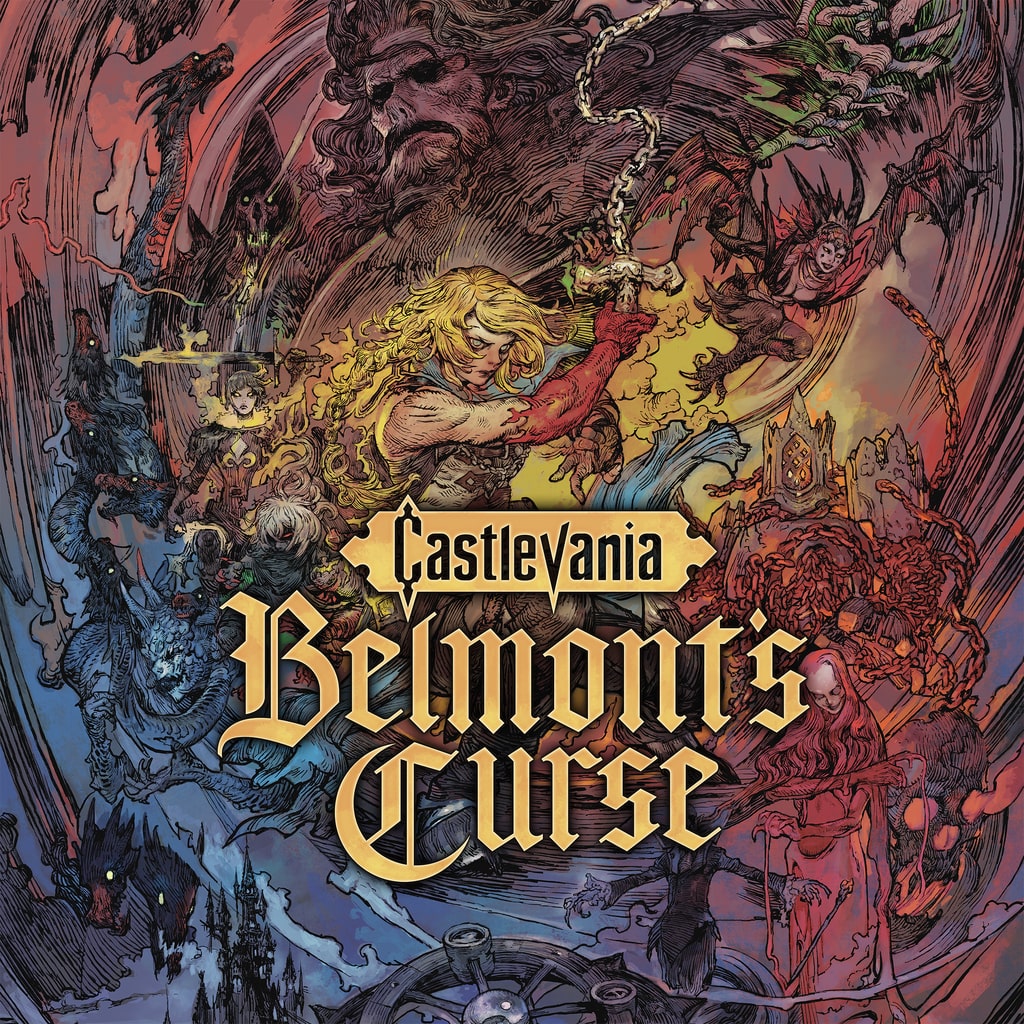
Castlevania: Belmont’s Curse wastes no time reminding you that legacy is both a weapon and a burden. Set in 1499 Paris, a city choked by flame and superstition, this new entry from Evil Empire and Konami feels dragged from the series’ gothic past and sharpened into something faster, louder, and more physically expressive. The result is a side-scrolling action-exploration game that respects its lineage yet refuses to sit still long enough to be trapped by it. You are no longer simply surviving in Dracula’s shadow; you are sprinting through it, whip in hand, with the confidence that the bloodline was always going to catch up.
You play as Rose Belmont, daughter of Trevor, stepping into a world already collapsing under the weight of prophecy and ash. Paris is not just a backdrop but an active wound, with burning rooftops, collapsing cathedrals, and twisted remnants of history itself clawing their way into the present. The narrative quickly establishes that something deeper than a simple demonic outbreak is at play, pulling Rose into a conspiracy that feels almost theological in scale. It is familiar Castlevania territory, but filtered through a sharper, more kinetic lens that constantly pushes you forward.
Whip First, Questions Later
The most immediate shift in Belmont’s Curse is how it treats movement. The Vampire Killer whip is no longer just a weapon; it is a traversal system that turns every environment into a potential route. Swinging across broken arches or launching yourself from gothic spires feels fluid, recalling Super Castlevania IV but with far more modern elasticity. There is a rhythm to it that rewards confidence, and hesitation will often see you fall into danger faster than you can recover.
Combat follows the same philosophy. Encounters are fast, deliberate, and built around momentum rather than static positioning. Enemies do not wait politely for your input, and Rose is designed to meet them halfway with aggressive spacing, aerial pressure, and whip-driven control of the battlefield. It is a system that encourages improvisation, where a single swing can transition from traversal to crowd control in the same breath. The game does not want you to stand your ground; it wants you to carve your own path through chaos.
The Arcana of Defeat
The Arcana system is where Belmont’s Curse begins to show its more experimental side. Defeating bosses does not simply mark progression; it turns those encounters into usable power through tarot-like cards that carry their essence. These Arcana abilities range from devastating screen-clearing attacks to subtle passive shifts that alter how Rose interacts with the world. This mechanic gives weight to every major fight, because victory does not just move you forward; it permanently reshapes how you fight.
What makes this system compelling is how it ties into build identity. You are not just collecting abilities; you are curating a deck of consequences, each reflecting how you have chosen to engage with the game’s challenges. A fight against a towering, corrupted historical figure does not end when their health bar disappears; it lingers as a tool you can choose to wield or ignore. That sense of continuity between boss design and player expression gives the progression a satisfying, almost ritualistic rhythm.
A Familiar Curse in a New Frame
Despite its mechanical evolution, Belmont’s Curse never forgets what makes Castlevania feel like Castlevania. Hidden walls, secret chambers, and environmental storytelling remain, but they are now woven into a faster, more expressive structure. The world encourages constant movement, yet rewards those who slow down just enough to notice cracks in the architecture or suspiciously placed ruins. Even healing items tucked behind destructible surfaces feel like small nods to tradition rather than relics of it.
Visually, the game takes a surprising turn. Instead of leaning into muted gothic decay, it embraces a more vivid palette, with deep reds, electric spell effects, and sharply animated silhouettes giving the action a comic-book intensity. It still feels dark, but not in the suffocating way of earlier entries. This is a world that is burning rather than buried, and that distinction changes everything about how it is experienced moment to moment.
Bosses, Bloodlines, and Familiar Faces Rewritten
The boss roster continues the series’ tradition of mythologising history through distortion. Classic figures like Death and Medusa return, but they are joined by reinterpretations of real-world icons such as Joan of Arc, recast through the lens of corruption and divine manipulation. These encounters are not merely mechanical tests; they are thematic confrontations that blur the line between legend and monstrosity.
Each boss feels designed to justify the Arcana system’s existence, often leaving behind abilities that directly contrast with their fighting style. A slow, oppressive encounter might reward you with a burst-based Arcana that encourages aggression, while a fast, erratic fight might give you something defensive and controlling. The result is a loop in which narrative and mechanics constantly reinforce each other without ever feeling overly scripted.
Final Thoughts
Castlevania: Belmont’s Curse feels like a deliberate attempt to push the series forward without severing its roots. Evil Empire understands that the appeal of Castlevania is not just its gothic aesthetic or monster roster, but its sense of momentum built on dread. By turning traversal into a weapon and boss defeats into evolving power systems, the game builds a version of Castlevania that is more physical, more expressive, and arguably more confident than many of its predecessors.
There are moments when its speed may feel like it is pulling away from the series’ more methodical past, and purists may find themselves missing the slower, more oppressive pacing of earlier entries. But what replaces it is undeniably engaging, a gothic action game that treats movement as identity and combat as storytelling.