Survivor-style games now carry certain expectations. You start, navigate in circles, upgrade your skills, and soon the screen dissolves into a mesmerising storm of numbers and particles. Beatdown City Survivors defies that familiarity right away. From the first few minutes, it makes it clear that this city is not a passive backdrop but an active participant in your downfall or survival, depending on how well you read the chaos.
NuChallenger has built something that feels closer to a living demolition zone than a traditional arena. Streets crack with hazards, puddles become electrical traps, and abandoned vehicles sit like delayed explosions, waiting for the wrong touch. It is a design choice that fundamentally reshapes the genre loop. Instead of simply avoiding enemies while your build does the work, you constantly negotiate with the environment itself, deciding when to trigger destruction and when to leave a dangerous opportunity untouched.
Weapons, Weird Science, and Improvised Violence
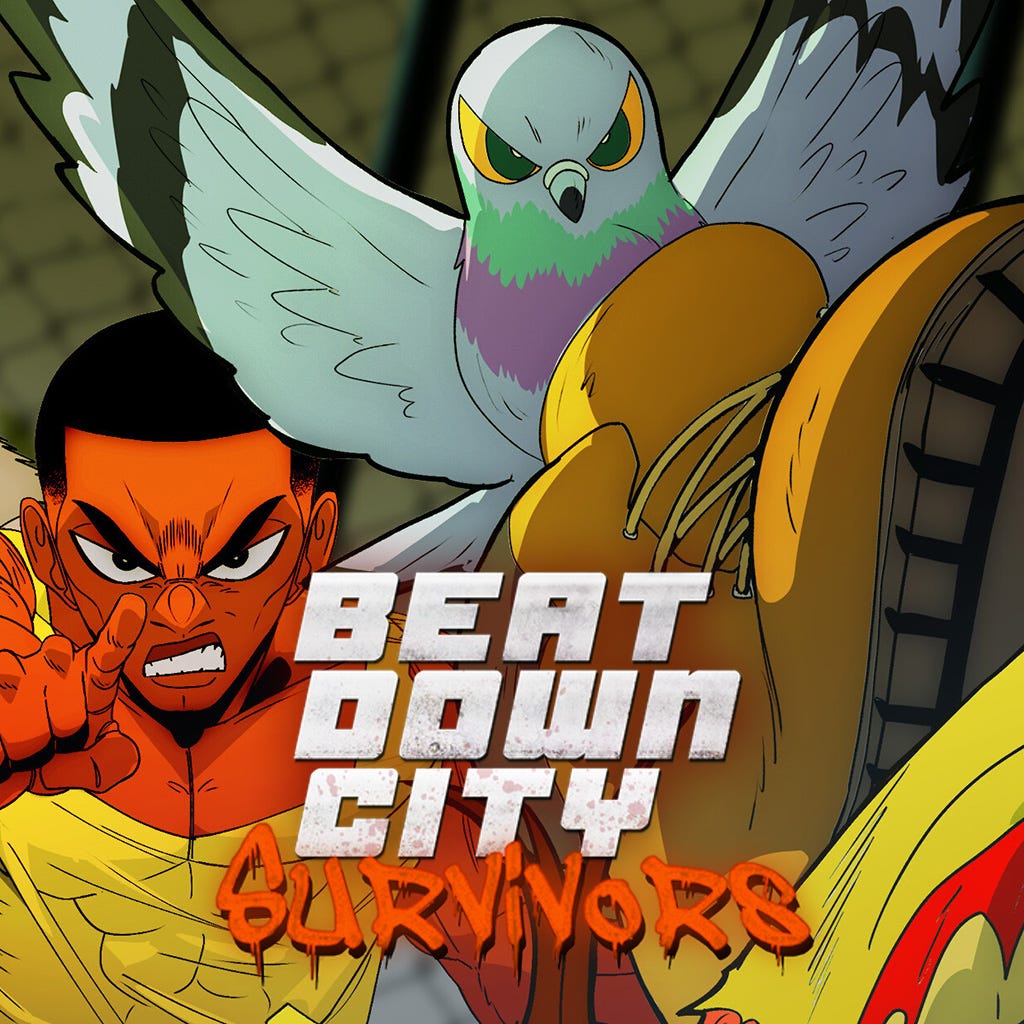
Where Beatdown City Survivors really starts to show its personality is in its weapon system. This is not a world of elegant swords or elemental spells. It is pipes, pigeons, boots, and whatever else you can duct tape into something vaguely functional and deeply absurd. The crafting system leans fully into improvisation, rewarding experimentation and constantly pushing you towards sillier, more powerful combinations.
There is a strange joy in watching a run evolve from basic street brawling into something completely unhinged. One moment you are punching through slow-moving zombies, and the next you are launching improvised contraptions that feel like they should not legally function in any physical reality. The game does not just allow chaos; it encourages it, then quietly asks you to keep up as it escalates beyond reason.
A Roster With Attitude
The playable cast adds another layer of identity, helping the game stand apart from genre peers. Instead of anonymous survivors, you get a lineup that feels pulled from a late-night animated series that never got properly cancelled. Martial artists, eccentric fighters, unexpected animals, and outright comedic inclusions, like a sneaker-wearing Shiba Inu, all exist in the same space without feeling out of place.
Each character changes how you approach movement and combat in subtle but meaningful ways. Some are fast and fragile; others are slow but capable of clearing entire sections of the screen with a single well-timed ability. This variety keeps runs from blending together, especially once you start unlocking deeper combinations of characters and weapon synergies.
When the Environment Becomes the Real Enemy
What truly defines Beatdown City Survivors is its aggressive use of stage design as a mechanic rather than as decoration. Subway tunnels introduce sudden lighting shifts that make visibility a risk factor. Traffic-heavy streets become timing puzzles where a single misstep can trigger chain reactions of explosions. Even the quieter zones carry the constant threat of escalation if you are not paying attention to your surroundings.
These systems create some of the most memorable moments in the game, particularly when everything aligns in your favour and a perfectly timed environmental trigger wipes out half the screen in one satisfying chain reaction. It is in these moments that the game feels less like a survivors-like and more like a tactical destruction sandbox that happens to contain monsters.
The Rough Edges Beneath the Chaos
For all its invention, Beatdown City Survivors is not without structural issues. The most noticeable friction point is its late-game difficulty curve, which can spike in ways that feel more abrupt than earned. Certain elite enemies introduce effects that can end runs suddenly, especially when your build leans too heavily into offence without the defensive tools needed to stabilise.
There is also a slight inconsistency in auto-attack targeting that can be frustrating in more chaotic encounters. Because attacks are tied to movement direction, there are moments when positioning and survival instinct clash with optimal damage output. When the screen becomes crowded, this system can feel less like a deliberate design choice and more like a limitation under pressure.
Style, Sound, and Personality Carry the Load
Even when systems strain under pressure, the presentation holds everything together. The pixel art style is expressive without becoming cluttered, and the animations deliver impact with surprising clarity, given how chaotic things can become. More importantly, the game has a strong sense of personality that runs through its writing, character design, and soundtrack.
There is a confidence in how it presents itself, as if the game knows exactly how strange it is and refuses to apologise for it. That attitude goes a long way to keeping the experience engaging, even during its more repetitive stretches. When the action hits its stride, it feels less like surviving and more like orchestrating destruction in real time.
Final Verdict
Beatdown City Survivors succeeds because it refuses to behave like a standard survivors game. Instead of passive progression and safe positioning, it builds a system where the environment, your weapons, and your decisions constantly collide in unpredictable ways. It is messy, loud, and occasionally unbalanced, but it is also one of the most creatively confident takes on the formula in recent memory.
The flaws are real, particularly in late-game balance and clarity under extreme conditions, but they rarely outweigh the energy of what is being achieved here. This is a game that thrives on momentum and personality rather than precision and perfection.