Simulation games have spent years proving that almost any profession can be compelling when viewed through the right lens. We’ve cleaned houses, restored power lines, unpacked moving boxes, and pressure-washed entire neighbourhoods. On paper, Tattoo Removal Simulator sounds like another entry in that ever-growing list of oddly specific occupations. Yet what makes Uraga’s debut stand out is its understanding that tattoos are rarely just images on skin. They are memories, decisions, mistakes, celebrations, and sometimes scars disguised as artwork.
Set in a modest clinic tucked away in a bustling city, Tattoo Removal Simulator places you in the role of a professional laser technician tasked with helping clients erase pieces of their past. It is an unusual premise, but one that immediately gives the game an emotional dimension many simulators never attempt. Rather than simply treating customers as walking objectives, the game often presents them as people carrying stories they are ready to leave behind. The result is a simulator that occasionally reaches beyond its mechanical foundations and becomes something surprisingly reflective.
Finding Comfort in Repetition
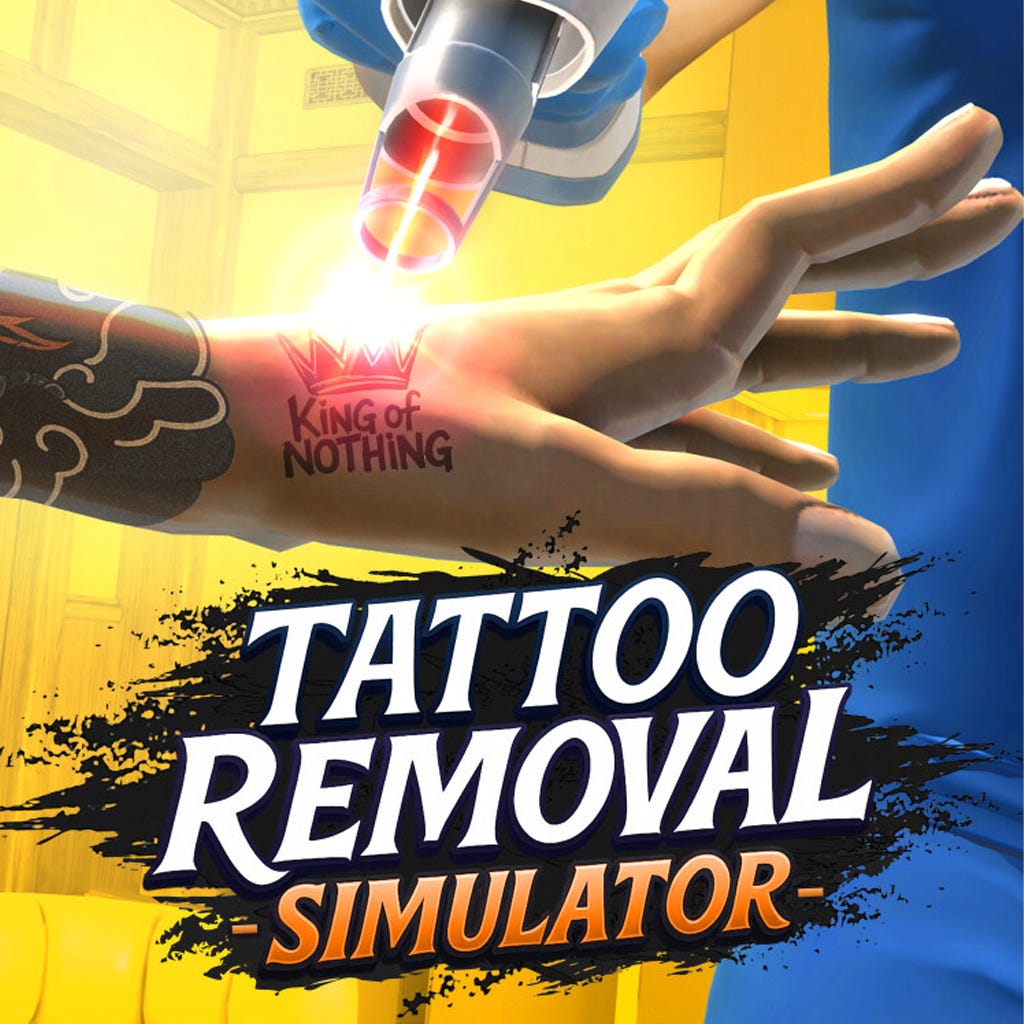
At its core, Tattoo Removal Simulator is about precision. Using various laser tools, players carefully trace over tattoos, gradually fading the ink layer by layer until clean skin emerges. The process is methodical and deliberate, demanding a steady hand and patience rather than speed.
There is undeniable satisfaction in watching a large tattoo slowly disappear under your careful work. The visual feedback is excellent, and the game understands the importance of making every movement feel meaningful. As with PowerWash Simulator, much of the appeal lies in transforming something cluttered into something clean. The difference here is that the transformation feels more personal.
The pace may prove divisive. Players seeking excitement, challenge, or constant progression may find the process repetitive after a few hours. Tattoo removal is, naturally, a slow process, and the game fully commits to that reality. There are no explosions, dramatic twists, or frantic time pressures. Instead, it asks players to settle into a rhythm and appreciate the gradual nature of the work. For some, that calm focus will be therapeutic. For others, it may simply feel monotonous.
The Stories Beneath the Ink
The game’s strongest feature is Story Mode. Here, Tattoo Removal Simulator shifts from a straightforward profession simulator to something more intimate. As sessions progress, clients share fragments of their lives, revealing why they chose their tattoos and why they now want them removed.
Some stories are humorous, centring on youthful mistakes and questionable life choices. Others explore heavier themes such as grief, heartbreak, identity, and personal reinvention. Not every narrative lands perfectly, and some characters feel more developed than others, but the writing is genuinely sincere.
What works particularly well is that the game never treats removal as a judgement. The tattoos themselves are not portrayed as mistakes that need correcting. Instead, they become symbols of different chapters in a person’s life. Sometimes people outgrow those chapters. Sometimes they need closure. Sometimes they simply want a fresh start. That perspective gives the game a surprising emotional maturity.
Building a Business
Career Mode introduces management elements that add structure to the experience. Starting with basic equipment and a modest studio, players gradually expand their business through successful treatments and positive customer feedback.
New tools unlock over time, offering greater efficiency and more advanced treatment options. The progression system is simple yet effective, giving players tangible goals beyond completing individual procedures. Watching your humble clinic evolve into a professional operation creates a welcome sense of ownership.
However, the management mechanics never become especially deep. Studio upgrades are functional rather than transformative, and the business side occasionally feels secondary to the removal process itself. Players hoping for a detailed tycoon experience may find the progression somewhat limited.
Still, the lighter management approach helps maintain the game’s relaxed atmosphere. Tattoo Removal Simulator is clearly more interested in mindfulness than spreadsheets.
A Surprisingly Effective VR Experience
One of the game’s biggest strengths is its optional VR support. While the standard PC version is perfectly enjoyable, virtual reality feels like the format the game was designed for from the start.
Physically guiding the laser tool across a client’s skin creates an immersion that traditional controls cannot fully replicate. Every movement feels deliberate. Every mistake feels personal. The sense of presence transforms what could have been a simple point-and-click activity into something genuinely engaging.
VR also enhances the game’s already impressive audio design. The crackle of the laser, the subtle environmental sounds of the clinic, and the quiet ambience of the treatment rooms combine to create a remarkably soothing atmosphere.
Even outside VR, the soundscape deserves praise. Few games this year have understood the power of audio as well as Tattoo Removal Simulator.
A Few Scars Remain
Despite its strengths, Tattoo Removal Simulator launches with rough edges that prevent it from fully realising its potential. Technical issues have been a recurring topic among early players. Save progression bugs and occasional upgrade resets can disrupt the experience, particularly during longer Career Mode sessions. While the developer has responded quickly with patches, these problems are difficult to ignore during a review period.
The clinic itself can also feel strangely lifeless. Outside of client interactions, there is little happening within the environment. Additional decorative options, interactive elements, or background activities could have made the studio feel more like a living workspace rather than a static backdrop.
There is also the simple reality that the game’s central mechanic must carry almost the entire experience. If you do not enjoy the process of carefully removing tattoos, there is little else here that will change your mind. The narrative elements add depth, but they cannot completely compensate for a gameplay loop that remains fundamentally repetitive.
Quietly Unique
What impresses me most about Tattoo Removal Simulator is its willingness to explore territory few games have considered. It would have been easy to build a straightforward cleaning simulator and leave it at that. Instead, Uraga seeks to examine why people choose to erase parts of their past and what that process means emotionally.
Not every idea is fully realised, and some systems could certainly benefit from greater depth and polish. Yet the experience has an authenticity that lingers. The game understands that healing is often slow, messy, and gradual. In many ways, the act of removing a tattoo becomes a metaphor for moving forward. That gives Tattoo Removal Simulator a surprising amount of heart beneath its clinical exterior.
Final Verdict
Tattoo Removal Simulator will not appeal to everyone. Its deliberate pacing, repetitive mechanics, and occasional technical hiccups make it a niche experience by design. Yet for players willing to embrace its slower rhythm, there is something quietly captivating.
The satisfying laser work, excellent sound design, thoughtful storytelling, and strong VR implementation combine to create an experience that feels genuinely different from most modern simulators. It does not try to overwhelm you with complexity or spectacle. Instead, it invites you to sit down, focus on the task at hand, and help people leave a little piece of the past behind. Sometimes that’s enough.