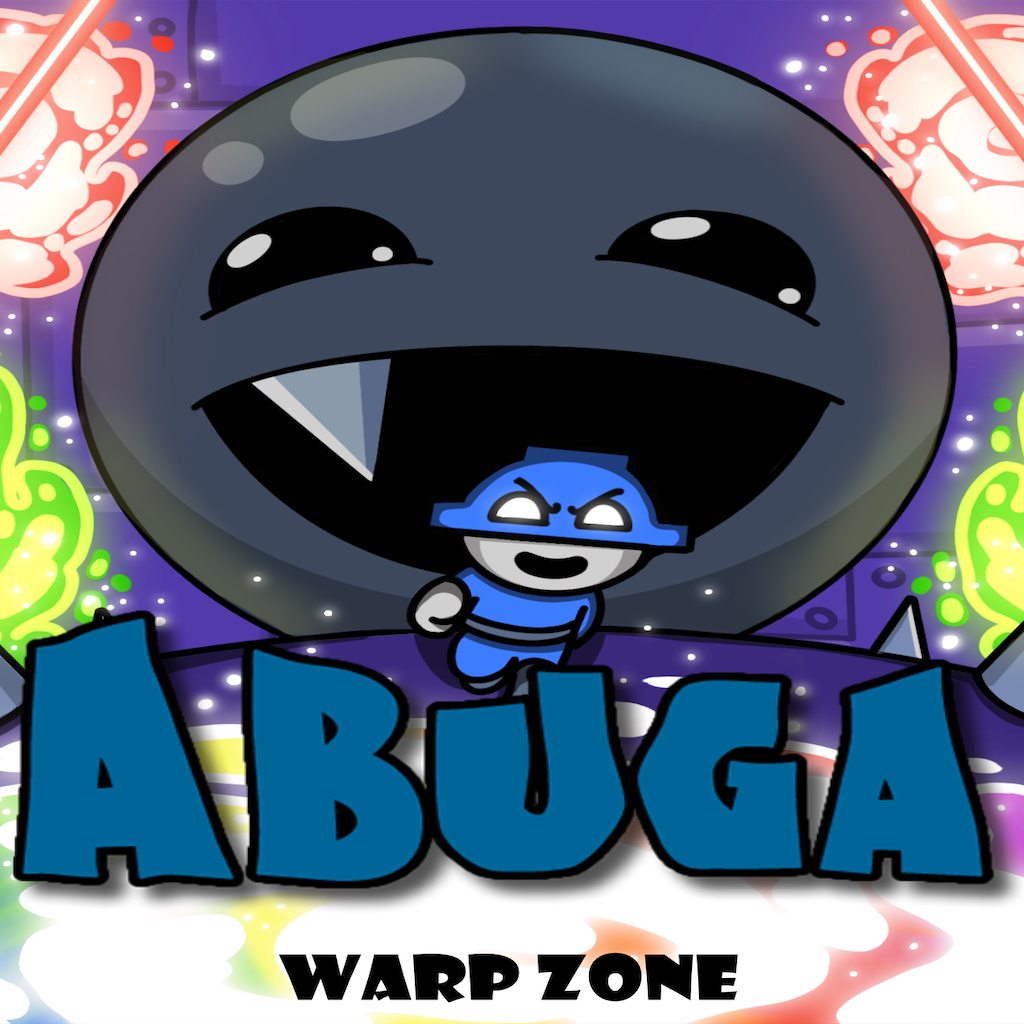
There is a very specific kind of platformer that does not ask you to relax. It asks you to focus. Fully. No distractions, no hesitation, just movement and instinct. Abuga Warp Zone firmly belongs to that category, but it wraps itself in a bright, whimsical layer of charm that you almost forget how demanding it can be until you are already deep inside its trap-filled corridors.
You play as Abuga, an ordinary figure dropped into the extraordinary Warp Zone, a strange dimension tucked inside a place called StrangePlace. It is the kind of setting that feels half dream, half experiment. Nothing behaves quite as you expect, and the only consistent guide is a floating orb companion who seems helpful at first, then increasingly uncertain as the journey continues. That shift in tone is where the game quietly starts to work on you.
Gameplay
At its core, Abuga Warp Zone is a precision platformer built around one central idea: warping. Instead of simply running and jumping through levels, you constantly interact with colour-coded portals that instantly shift your position. Some are safe, some are traps, and many depend entirely on timing that demands near-perfect rhythm.
The result is a gameplay loop that feels fast, sharp, and slightly unpredictable, keeping your attention locked in. Early levels ease you in gently, teaching you how portals behave and how momentum carries between transitions. But it does not take long before the game layers hazards on top of hazards, asking you to read environments in motion rather than at rest.
Spikes, collapsing platforms, shifting gravity zones, and fake-out portals become part of a constant mental checklist. The game is never unfair, but it is rarely forgiving. One mistake is usually enough to reset your attempt, and that design choice defines much of its personality.
What stands out most is how controlled everything feels despite the chaos. Abuga’s movement is tight and responsive. When you fail, it almost always feels like a timing issue, not the game’s systems. That clarity is what keeps repetition from becoming frustration.
There is also a subtle rhythm to progression. Levels rarely overstay their welcome, and new mechanics are introduced at a steady pace without overwhelming you with complexity. Just when you think you have mastered a concept, the Warp Zone shifts slightly and asks you to reconsider everything.
World and Presentation
The Warp Zone itself is one of those settings that feels deliberately unstable. Visually, it is vibrant and slightly surreal, filled with shifting geometry, glowing pathways, and abstract architecture that never fully settles into a single identity. It is playful, yet something uneasy lingers beneath, as though the space is aware it should not exist.
That tension is reinforced by the orb companion, who serves as both guide and comic relief. It offers tips, encouragement, and occasional sarcasm, often at the precise moment you begin to feel frustrated. At first, it sounds like a standard tutorial voice. Over time, its tone shifts in subtle ways, hinting that it might understand more about the Warp Zone than it lets on.
The writing does not push this mystery too aggressively. Instead, it lets it simmer in the background while you focus on platforming. That balance works well, especially in a genre where story often takes a back seat.
There is a moment, not far into the game, when you reach a fork in the path. This is where Abuga Warp Zone quietly changes its shape. The decision you make here leads to different routes and ultimately different endings. It is not a dramatic branching system in the traditional sense, but it is enough to make your choices feel meaningful in a way that most precision platformers do not attempt.
Difficulty and Flow
Make no mistake, this is a difficult game. Later stages demand near-flawless execution, particularly when multiple portal types overlap in rapid succession. The margin for error is razor-thin, and the game expects you to adapt quickly rather than hesitate.
And yet, it avoids feeling oppressive. Checkpoints are fairly placed, and restarts are immediate. You are rarely pulled out of the flow for long. This is crucial, because Abuga Warp Zone is at its best when you are fully immersed in repetition and refinement, slowly turning failure into muscle memory.
There is satisfaction in mastering a sequence that initially felt impossible. The game leans heavily on that feeling, and it delivers it consistently.
Narrative and Structure
The story is not front and centre, but it is more present than you might expect in a game of this type. The mystery of StrangePlace unfolds gradually through environmental cues, orb dialogue, and the branching paths you choose.
What begins as a simple escape story slowly shifts into something more ambiguous. You start to question the nature of the Warp Zone itself, the purpose of the trials, and even the reliability of your guide. None of this is spelled out in heavy exposition. Instead, it is implied through repetition, variation, and subtle shifts in tone.
The multiple endings reinforce this sense of uncertainty. There is no single definitive conclusion that feels entirely “correct,” which fits the game’s overall philosophy. It is less about resolution and more about interpretation.
Final Verdict
Abuga Warp Zone is a precision platformer that knows exactly what it wants to be. It is fast, demanding, and mechanically focused, yet it wraps that intensity in a layer of charm that makes the experience feel lighter than it is.
Its warping mechanic gives it a distinct identity in a crowded genre, and its branching structure adds just enough narrative weight to keep you curious between challenges. While its difficulty will not suit everyone and some players may find its later stages exhausting, it remains remarkably consistent in design and execution. This is a game about learning patterns, trusting your instincts, and accepting that failure is part of forward motion. When it clicks, it really clicks.