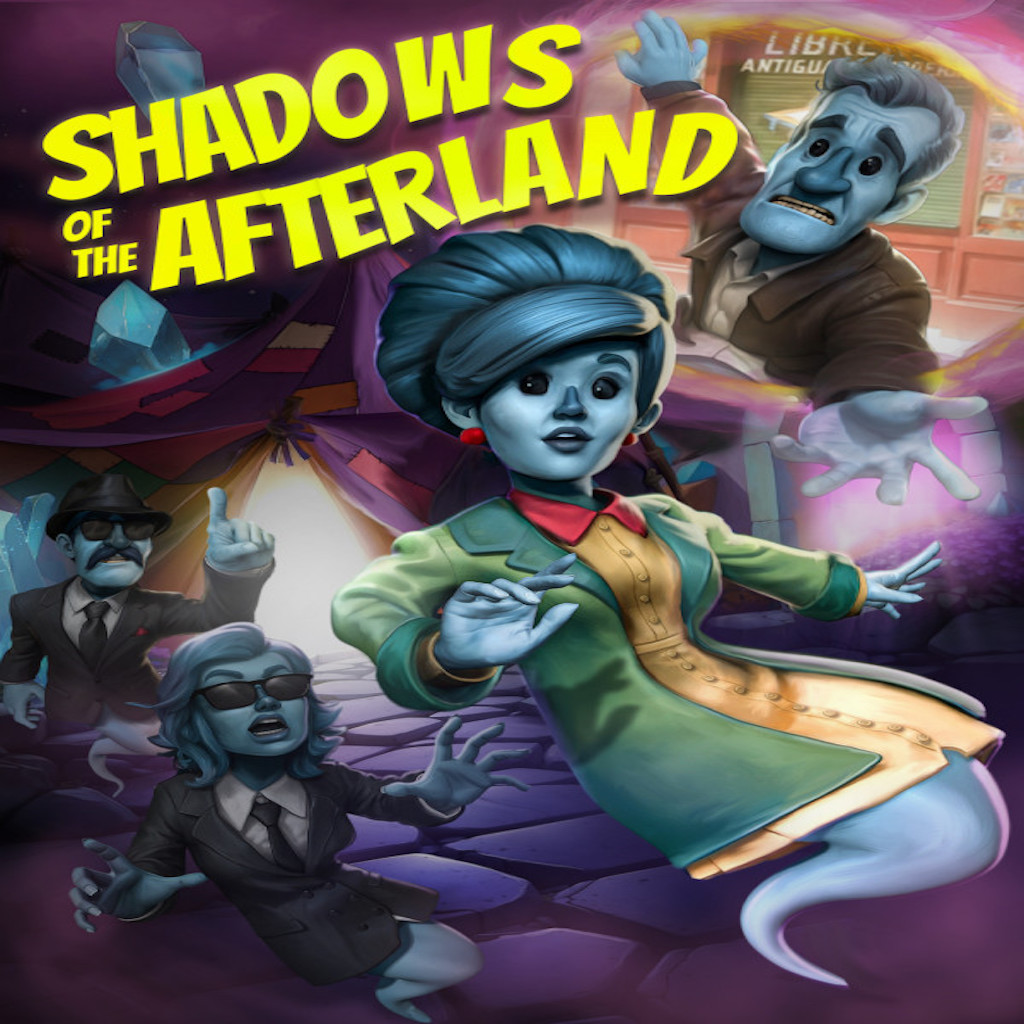
Developed and published by Aruma Studios, Shadows of the Afterland launched on PC in early 2026, then arrived on Nintendo Switch later that year. Set in Madrid in 1960, under the Francoist regime, the game blends historical grounding with supernatural absurdity in a way that feels surprisingly natural once it settles in.
The story begins at a zoo, where a mysterious incident leads to a death that should have been final. Instead, a soul finds itself suspended between worlds, carrying something impossible. The memories of Carolina, a pioneering police officer from a future that has not yet happened.
This contradiction becomes the engine of the entire narrative. You are not just solving a murder. You are untangling identity, time, and the uncomfortable overlap between who a person is and what a person remembers.
Gameplay
At its core, Shadows of the Afterland is a classic point-and-click adventure, carefully modernised in both interface and pacing. You explore environments, collect clues, solve environmental puzzles, and engage in dialogue-heavy investigation sequences that gradually advance the story.
The most distinctive mechanic is possession. As a spectral presence, you can inhabit living characters, temporarily seeing the world through their eyes and influencing events from within. This is not simply a gimmick. It underpins many of the game’s puzzles and narrative turns.
Possession is used to bypass obstacles, extract information, and manipulate conversations in ways that would otherwise be impossible. It adds a layer of systemic thinking to what could have been a purely linear adventure. You are constantly considering not just what needs to be done, but who needs to be used to do it.
Puzzle design is generally strong. Most challenges are logical, grounded in environmental observation or conversational deduction. There is a clear effort to avoid the kind of obscure logic that often defines older adventure games. When you fail, it usually feels like you missed something rather than the game unfairly withholding information.
That said, there is a noticeable amount of backtracking. Revisiting locations after acquiring new information is part of the structure, but it occasionally slows the pacing more than it needs to. The game is at its best when momentum is steady and investigation flows naturally between characters and environments.
Narrative and Setting
The narrative is where Shadows of the Afterland truly distinguishes itself. At first glance, it is a murder mystery. A death at a zoo, an investigation into what went wrong, and a search for truth in a world where answers are never straightforward. But it quickly becomes more layered.
Carolina’s identity is the central mystery, and the game is not interested in resolving it quickly. The idea that a soul can carry memories from a future self introduces a constant sense of instability. You are never fully sure whether what you uncover is fact, interpretation, or something in between.
The setting of 1960s Madrid provides a grounded counterpoint to the supernatural elements. The political and social atmosphere is present in the background, shaping the tone without overwhelming the narrative. It gives weight to the world without turning the story into a historical lecture.
By contrast, the afterlife is far more playful. It is structured, populated, and oddly bureaucratic in places. Spirits have personalities, agendas, and routines. It feels less like an abstract void and more like a strange parallel society operating under its own rules.
This contrast between grounded reality and imaginative afterlife design creates a rhythm that keeps the narrative engaging. You move between worlds that feel fundamentally different yet emotionally connected.
Characters and Writing
Much of the game’s emotional strength comes from its character writing. Carolina herself is an intriguing contradiction. She is both investigator and anomaly, trying to make sense of events while also being shaped by them. Her perspective shifts as the story unfolds, and the writing keeps her grounded even as her situation becomes increasingly surreal.
César, the enigmatic former ghost agent who accompanies you, is another highlight. He is cautious, occasionally guarded, and gradually becomes more invested in your journey. His dynamic with Carolina forms the emotional core of the experience, balancing mystery with reluctant trust.
Supporting spirits in the afterlife are often eccentric, sometimes humorous, yet rarely feel out of place. Their dialogue has a lightness that prevents the tone from becoming too heavy, even when the underlying themes lean towards identity, death, and loss.
Voice acting is consistently strong, adding texture to conversations and helping characters feel present even in quieter moments.
Presentation
Visually, Shadows of the Afterland leans into detailed pixel art and expressive animation. Environments are carefully constructed, with enough detail to make each location feel distinct without overwhelming the screen.
The afterlife sections are particularly striking, often more colourful and stylised than the grounded Madrid environments. This contrast reinforces the game’s thematic divide between reality and transition.
Sound design supports the atmosphere without drawing attention away from it. Ambient effects are subtle yet effective, and the original soundtrack adds emotional weight to key narrative moments. Everything is designed to support mood rather than spectacle, and it succeeds in maintaining a consistent tone throughout.
Pacing and Structure
The game’s structure is relatively compact, typically lasting around four to five hours. This brevity works in its favour. The narrative does not overstay its welcome, and each chapter feels purposeful.
However, the pacing is not always even. Investigation sections can slow as you search for missing interactions or revisit previously explored spaces. While this is typical of the genre, it occasionally disrupts narrative momentum. Even so, the overall structure remains tight enough that the experience feels focused rather than padded.
Final Verdict
Shadows of the Afterland is a thoughtful and well-crafted take on the point-and-click adventure genre. It respects tradition while introducing enough mechanical and narrative innovation to feel contemporary.
Its possession system adds genuine depth to puzzle-solving, while its dual-world structure gives the story emotional and thematic range. The writing is strong, the characters are memorable, and the setting is handled with care and restraint.
It is not without imperfections. Occasional backtracking and uneven pacing slightly disrupt its flow, and some narrative threads feel less developed than others. But these issues never fully undermine what the game does well. At its best, it feels like a quiet conversation between worlds, identities, and timelines, held together by curiosity and uncertainty.