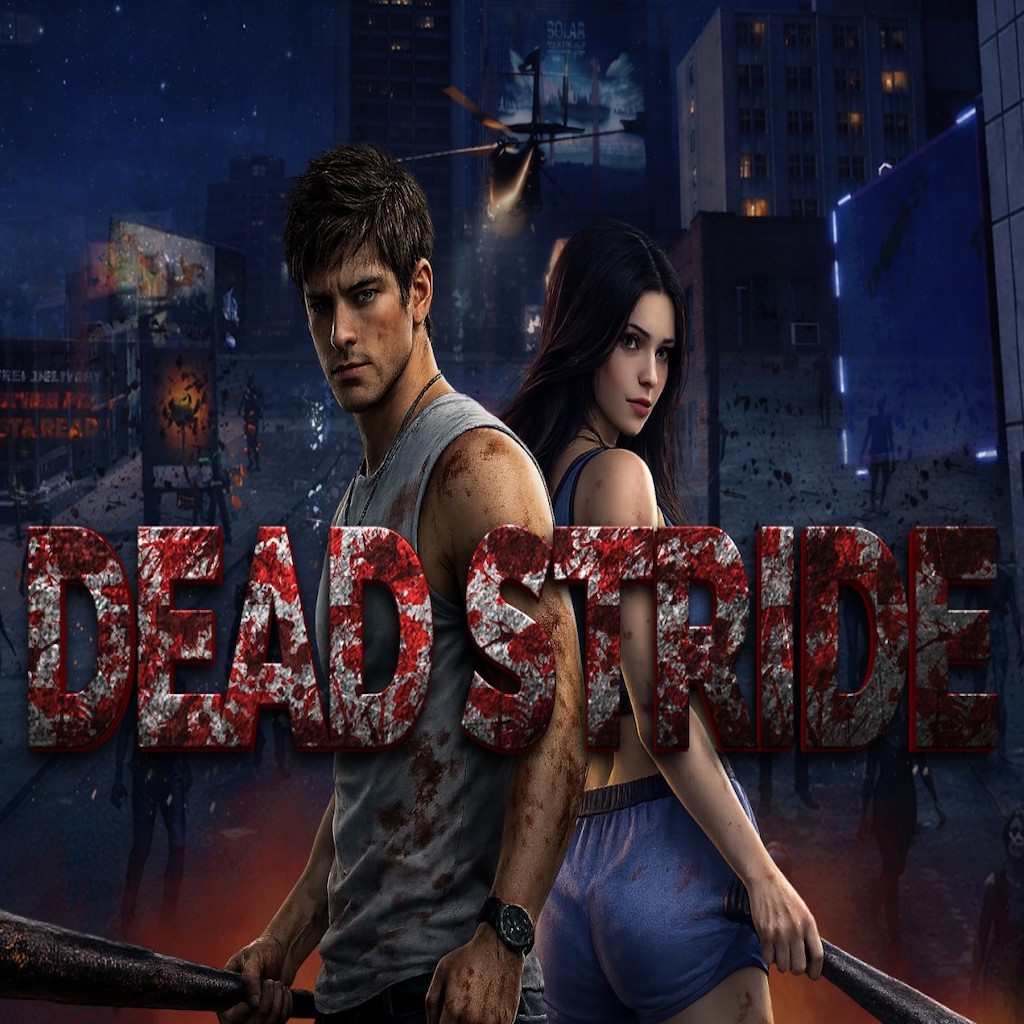
Developed and published by TROOOZE, Dead Stride launched in April 2026 on the Nintendo Switch and Nintendo Switch 2 as a cinematic, stage-based zombie action game. It drops players into a city that has collapsed overnight, overrun by the infected and stripped of any semblance of safety or order.
You play as Kaito, a former track star built for speed, and Akane, an elite bodyguard trained for close-quarters survival. Their goal is simple on paper but exhausting to execute: fight through collapsing urban environments and reach an evacuation helicopter before the city is completely consumed.
From the opening cinematic to its final moments, Dead Stride presents itself as a complete, self-contained survival story. There is no sprawling open world here, no crafting labyrinth or endless scavenging loop. Instead, it commits fully to a linear, stage-based structure that pushes you forward whether you are ready or not.
Gameplay
Dead Stride is built on immediacy. You begin with almost nothing, just a baseball bat and the kind of desperation that makes even the smallest corridor feel like a death sentence. From there, the game steadily hands you new weapons, situational upgrades, and just enough breathing room to make the next wave feel possible.
Combat is fast and reactive, centred on positioning and timing rather than deep resource management. Enemies rarely afford you the luxury of hesitation. They flood spaces quickly, forcing you to keep moving, keep swinging, and keep reassessing your options in real time.
The tag-team system between Kaito and Akane is the game’s central mechanic. Kaito is built for agility, quick dodges, and rapid traversal through crowded spaces. Akane, by contrast, is slower but far more deliberate, excelling in controlled engagements where precision matters more than speed.
Swapping between them is not just a stylistic choice. It becomes essential to survival. Certain encounters demand Kaito’s mobility to thin out groups or reposition, while others require Akane’s steadier hand to hold a line or break through tougher infected variants.
Weapons are scattered throughout each stage, often hidden in side rooms or tucked behind environmental hazards. Finding them adds a small but meaningful layer of exploration to otherwise linear levels. One moment you are scraping by with melee tools; the next you are holding a firearm that completely changes the rhythm of an encounter.
There is a satisfying escalation built into each stage. Early sections feel desperate and fragile. Later ones turn into controlled chaos, where you are less reacting to the undead and more carving deliberate paths through them.
However, the simplicity of the structure cuts both ways. While the lack of complex systems keeps the pace tight, it also limits long-term depth. Once you understand the rhythm of combat and character swapping, repetition begins to surface more clearly in extended sessions.
Structure and Pacing
Dead Stride is unapologetically linear. Each stage is a self-contained sprint through a different part of the collapsing city, from cramped subway tunnels to shattered office blocks and overrun streets.
This structure works in the game’s favour more often than not. Its pacing is clear, keeping momentum high. You are never wandering, never second-guessing your objective. The path forward is always clear, even when the situation is not.
That said, it can also make the experience feel transient. There is little room for deviation or experimentation outside combat encounters. Once a stage is complete, it is done, and you move on without lingering consequences or evolving systems.
The story attempts to provide emotional grounding for this constant forward motion. Kaito and Akane’s journey is framed as both a physical escape and a psychological endurance test, though the narrative occasionally struggles to rise above its genre framework. It hits familiar beats of sacrifice, resilience, and survival, but rarely lingers long enough for them to fully land.
Presentation and Tone
Where Dead Stride succeeds most consistently is in its tone. It fully embraces its identity as a cinematic, arcade-style survival experience. A clear “B-movie” energy runs through every encounter, from the exaggerated zombie waves to the dramatic framing of its cutscenes.
The opening cinematic sets the tone effectively: a city collapsing overnight, panic spreading down every street, and the slow realisation that escape is not just difficult but already slipping away. The ending, too, commits to its emotional framing, even if it does not always have the narrative weight to support it.
Visually, the game leans into clean, readable environments. Even when chaos fills the screen, you rarely lose track of your position or objectives. That clarity is essential given the speed of encounters.
Sound design does a lot of heavy lifting here as well. The constant pressure of distant groans, sudden breaks in silence, and sharp audio cues for enemy movement all contribute to a sense of unease that never lets go.
Critical Analysis
Dead Stride is not trying to reinvent zombie-survival design. It is trying to streamline it. By stripping away resource complexity and open-ended exploration, it focuses entirely on momentum and encounter design.
That focus is both its strength and its limitation. On the one hand, it creates an experience that is easy to pick up and hard to put down in short bursts. On the other, it leaves little room for long-term systems to evolve or surprise the player beyond its established rhythm.
The dual-character system adds enough variation to keep encounters interesting, and the weapon progression provides steady escalation, but neither element is deep enough to sustain extended play on its own.
What remains is a tightly paced, occasionally repetitive, but consistently energetic action game that knows exactly what it wants to be.
Final Verdict
Dead Stride succeeds as a focused, cinematic survival experience that prioritises momentum over complexity. It does not aim for depth in the traditional sense, but instead delivers a lean, structured campaign built on urgency and constant forward motion.
There is a certain honesty to that approach. It understands its scope and sticks to it, even when that limits its long-term staying power. Kaito and Akane’s journey may not linger in memory for its narrative ambition, but it leaves an impression through its pacing and clarity of design.
For players seeking a short, high-intensity survival-action experience that can be completed in focused sessions, Dead Stride delivers exactly that. For those seeking deeper systems or extended replayability, it may feel as if it ends just as it starts to find its rhythm.