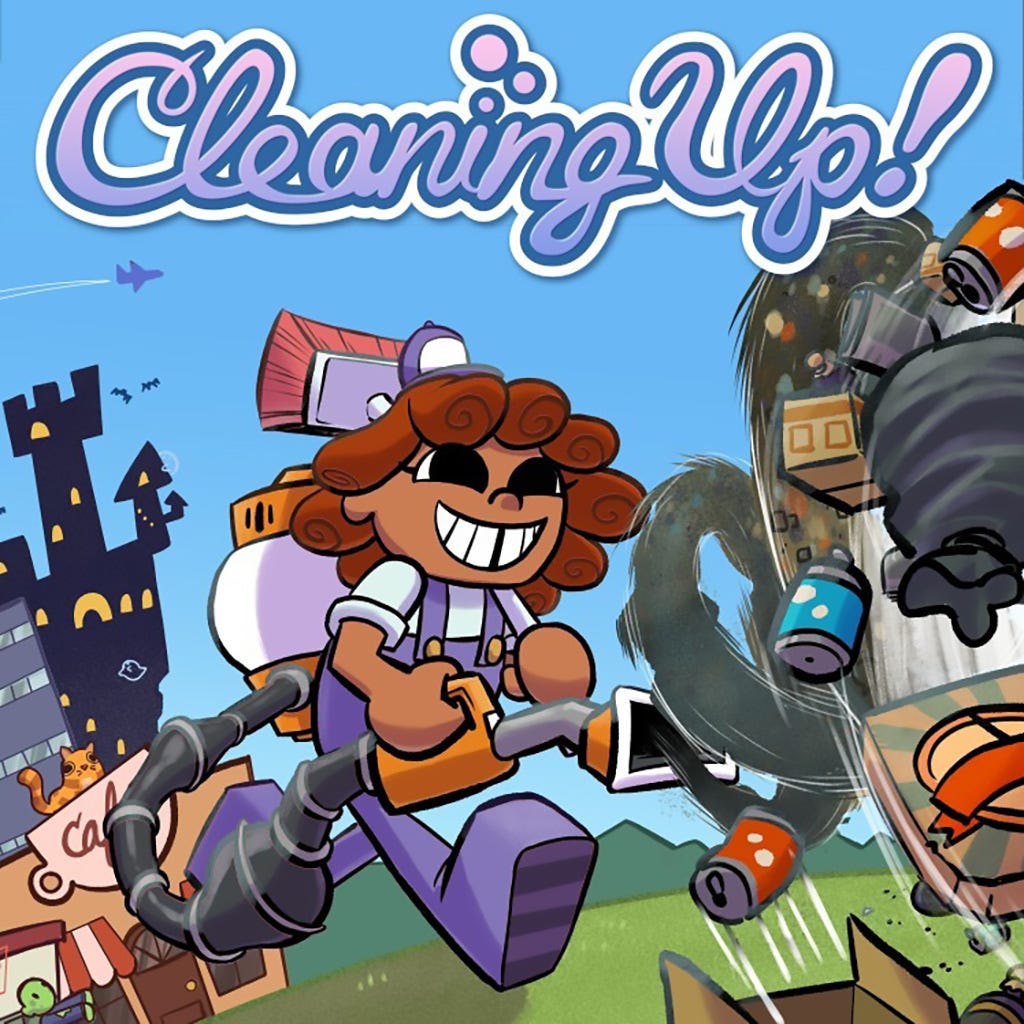
There are games that ask you to save the world, and then there are games that ask you to tidy it. Cleaning Up!, developed by Unbound Creations the studio behind chaotic comedy hits such as Just Crow Things and Rain on Your Parade, fits into the latter. But don’t let its simple premise fool you: under the mops, vacuums, and satisfying piles of dust, it offers one of the most unexpectedly soothing simulation experiences of the year.
Released on April 15, 2026, on PC and consoles, Cleaning Up! doesn’t try to throw a bunch of systems at you or create stress. Instead, it embraces one clear wish: transforming chaos into order, one swipe of a virtual mop at a time.
And somehow, it feels truly good.
“Cleaning Up! understands that satisfaction doesn’t always come from complexity—it comes from watching disorder quietly disappear.”
A World Built on Mess
At its heart, Cleaning Up! positions you as a “Cleaning Gig Worker,” tackling odd jobs in increasingly strange environments. One moment, you’re tidying up a cluttered apartment buried under years of neglect; the next, you’re exorcising dust and debris from a haunted mansion; later, you’re brushing sand off ancient temple floors in pursuit of hidden treasures.
The variety of settings is one of the game’s biggest strengths. Each place feels unique, not just visually but also in how you interact with it. Haunted mansions introduce environmental hazards like roaming ghosts that can disrupt your cleaning rhythm. Ancient temples come with light puzzles, revealing hidden paths beneath layers of grime. Even standard residential tasks grow more challenging as your tools improve.
Though supernatural elements and puzzles add twists, the core of the game remains simple: clean, upgrade, repeat.
The Joy of Digital Tidying
Where Cleaning Up! truly shines is in its gameplay, which captures every moment. The act of cleaning, often seen as mundane, becomes almost mesmerising here.
Vacuuming through clutter gives instant, satisfying visual results. Mopping leaves surfaces gleaming. Spraying away grime creates a quick sense of transformation. The feedback is immediate, responsive, and deliberately rewarding.
There’s a quiet artistry in how debris disappears. Big messes don’t just vanish, they break apart, scatter and dissolve in ways that make each action feel meaningful. It’s a design that gently nudges you to say, “Just one more room.”
Unlike more intense simulation games, Cleaning Up! avoids punishing timers or stressful resource worries. Instead, it offers a relaxed, low-pressure experience. Take your time, revisit with upgraded tools, and plan your cleaning routes at your own pace.
It’s the perfect comfort game, something to relax with, not to conquer.
Tools of the Trade
Progression in Cleaning Up! feels simple yet rewarding. As you go about completing jobs, you earn cash and prestige, which you can use to upgrade your gear. Vacuums get stronger, mops cover larger areas, sprayers become more efficient, and new gadgets add extra utility.
These upgrades don’t drastically change the gameplay, but they make your work more efficient in meaningful ways. Early on, you might be sweeping carefully around cluttered corners, while later you can breeze through entire rooms.
You can also customize your look with unlockable outfits, giving your cleaning persona a personal touch. It’s a small feature, but it adds to the playful feel of the game.
All together, it offers a steady, satisfying sense of progress without becoming complicated or overwhelming.
Level Design: From Mundane to Magical
One of the most charming aspects of Cleaning Up! is how it blends realism with a touch of absurdity. You’re cleaning familiar places like apartments, offices, garages while simultaneously encountering haunted mansions, cursed ruins, and settings straight out of fantasy stories.
This mix surprisingly works. The everyday environments offer a calming, methodical pace, while the more fantastical levels inject playful twists that keep the game interesting.
The haunted mansion stages, in particular, really stand out. Ghostly disturbances force you to adjust your cleaning approach, adding just enough suspense without disrupting the relaxed vibe. Meanwhile, the temple levels combine exploration with tidying, rewarding careful observation.
That said, not all environments hit the same note. Some later levels tend to repeat themselves, relying heavily on the core mechanics without much variation. While they don’t become frustrating, they can feel a bit stretched out.
Audio and Atmosphere
Sound design plays a vital role in drawing players in. The gentle hum of vacuums, the soft swish of mops, and the satisfying clink of debris being cleared create a tactile, immersive experience. Music remains subtle, often fading into the background so the cleaning sounds can shine. When it does come forward, it adopts calm, almost meditative rhythms that enhance the game’s cozy vibe.
Visually, the game features a bright, clear aesthetic. Cluttered yet never confusing, these environments make it easy to see your next target. The transformation from dirty to clean is visually striking, reinforcing the satisfying loop at the game’s heart.
Performance is smooth across all platforms. Even on the Nintendo Switch, it runs impressively well despite some minor visual compromises.
Where It Stumbles
Despite its charming appeal, Cleaning Up! has its shortcomings.
Its straightforward design, though deliberate, might not hold the interest for everyone during longer play sessions. The limited mechanical depth can lead to repetitive gameplay if played for extended periods. Although upgrades introduce some variety, they don’t fundamentally change the core experience.
Some players might also feel the game is too relaxed, lacking challenge or real consequences. Without much pressure to optimize or grow beyond personal satisfaction, it may not appeal to those craving a more structured progression.
Lastly, while the early levels boast environmental variety, later scenes sometimes recycle ideas without adding much new innovation.
Final Verdict
Cleaning Up! knows exactly what kind of game it wants to be and, more importantly, what it doesn’t try to be.
It’s not about complexity, tension, or deep storytelling. Instead, it taps into a simple, universal joy: the feeling of satisfaction from a tidy space. In doing so, it creates one of the most calming, genuinely soothing simulation experiences I’ve come across recently.
This isn’t a game that demands your full attention. It’s one that gently invites you to slow down and enjoy.