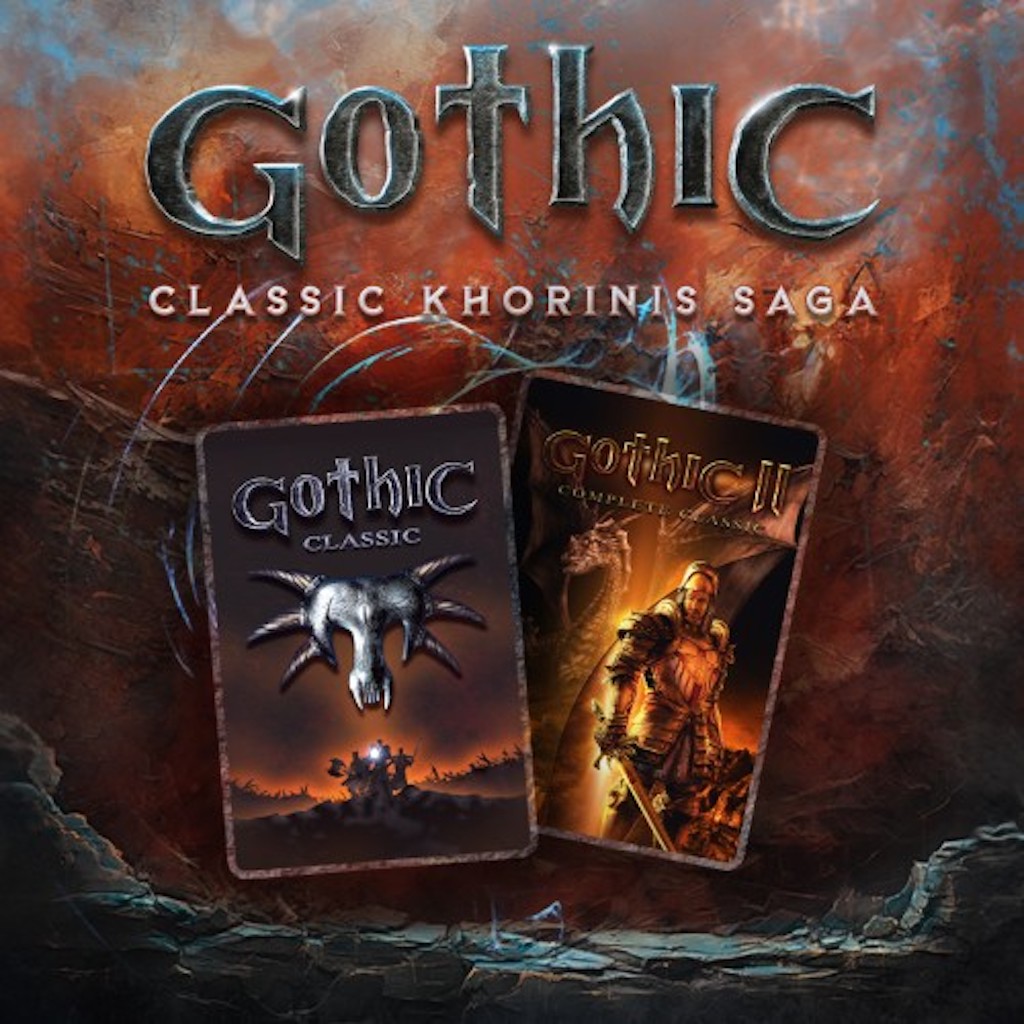
When THQ Nordic released Gothic Classic Khorinis Saga on the Nintendo Switch in April 2026, it quietly delivered one of the most substantial RPG bundles available on a handheld platform. This collection brings together Gothic Classic and Gothic II Complete Classic—two foundational entries in PC role-playing history—packaged as a combined saga following the journey of the legendary Nameless Hero through the brutal penal colony of Khorinis and beyond.
For long-time fans, this is a nostalgic return to one of the most influential Western RPG worlds ever created. For newcomers, it is a demanding yet deeply rewarding introduction to a series that helped define systemic open-world design long before it became an industry standard.
A World That Doesn’t Care About You
At the heart of the Gothic experience lies its defining philosophy: the world does not revolve around the player.
You are not a traditional chosen hero. You are a prisoner cast into a violent colony enclosed by a magical barrier, forced to survive by aligning with one of several factions, each with its own moral compromises and internal politics. That sense of harsh independence endures across both games in this bundle.
The colony itself—Khorinis and its surrounding regions—feels dense, reactive, and surprisingly consistent even decades after its original release. NPCs follow routines, factions clash, and progression is earned rather than handed out. The sequel expands this structure significantly, venturing into broader regions while maintaining the same grounded sense of consequence.
This is not a power fantasy in the modern sense. It is a slow ascent from vulnerability to competence, and sometimes back again when the world decides you have become too comfortable.
Two Games, One Long Journey
The first half of the bundle, Gothic Classic, is raw and unpolished by today’s standards—but that is part of its identity. The early hours are intentionally punishing. Combat is stiff, progression is slow, and survival depends heavily on observation and patience.
Joining a faction is not just a narrative choice; it fundamentally reshapes how the world interacts with you. Whether you side with the Old Camp, the New Camp, or the Swamp Camp, your identity is constantly redefined by reputation and necessity rather than by a predefined class fantasy.
Then comes Gothic II Complete Classic, which significantly refines the formula. Combat is smoother, progression is more structured, and the world noticeably larger. The inclusion of the Night of the Raven expansion deepens both narrative complexity and mechanical depth, adding new regions and significantly tougher questlines.
Together, these two games form a coherent arc of growth—not just for the Nameless Hero, but for the player’s understanding of how this world operates.
Systemic Design That Still Holds Up
What makes the Gothic series remarkable even today is its systemic consistency. Nearly every encounter feels simulated rather than scripted. NPCs respond to aggression, factions react to shifts in reputation, and exploration often leads to unintended consequences.
There is very little hand-holding. Quests are frequently vague, directions are minimal, and players are expected to pay attention rather than follow markers. In an era dominated by guided open-world design, this approach feels almost radical.
That said, it is also where the experience becomes divisive. Modern players accustomed to clarity and accessibility may find the lack of guidance frustrating rather than immersive. The game rarely adapts to your expectations—you must adapt to it.
Combat and Progression: A Product of Its Time
Combat in both titles remains one of the most dated elements of the package. Attacks are animation-driven, timing is rigid, and early encounters can feel unresponsive by modern RPG standards.
However, this system has a deliberate arc. Early combat is meant to feel awkward and dangerous. As your character improves, so does your control over fights. Mastery is not just statistical—it is mechanical familiarity earned through repetition.
Progression follows a similarly deliberate pace. Skill training, weapon proficiency, and faction alignment all require investment. There is no fast track to power, and that restraint gives weight to every improvement.
Still, this aspect will be the biggest barrier for new players. It is functional, but not fluid by modern expectations.
Switch Adaptation and Quality-of-Life Improvements
On the Nintendo Switch, the collection benefits from a series of modernised enhancements that make these otherwise PC-era titles more approachable.
The updated UI improves inventory navigation and quest tracking, while controller support feels surprisingly competent given the complexity of the original PC interface. Menus are still dense, but they are no longer unintelligible.
Performance is generally stable across both games, though occasional frame dips and minor texture pop-in remind you of their age. Load times are improved compared with the original PC builds, but they are still longer than those of contemporary RPGs.
Importantly, the core identity of the games has not been diluted. This is not a remake or reinterpretation—it is a preservation effort with light modernisation.
Narrative Strength: Humble but Effective
Narratively, the saga remains grounded in political conflict, survival, and personal ambition rather than a world-ending prophecy. The Nameless Hero is less a defined personality than a vessel for transformation, shaped by the factions and people he encounters.
The writing leans heavily on grounded dialogue and faction-based storytelling. Characters are often pragmatic rather than heroic, and moral choices tend to reflect survival rather than ideology.
Gothic II expands on this, introducing broader geopolitical tension and a stronger sense of external threat beyond the colony itself. While the narrative never reaches high cinematic spectacle, it excels in consistency and immersion.
Atmosphere and World Design
Perhaps the strongest aspect of the bundle is its atmosphere. Khorinis feels lived-in, dangerous, and unpredictable. Forests are dense and hostile, towns feel fragile, and even safe zones carry a sense of unease.
Sound design plays a subtle yet important role, with ambient wildlife, distant combat, and minimalist music reinforcing the sense of isolation. The world does not feel designed for the player—it existed before them and will continue after them.
This is where the Gothic series continues to stand apart from many modern RPGs. It is not about spectacle; it is about presence.
Final Verdict
Gothic Classic Khorinis Saga is not a modern RPG experience—it is a historical one, carefully preserved and lightly adapted for contemporary hardware. Its strengths lie in its systemic depth, atmospheric world-building, and uncompromising design philosophy. Its weaknesses are equally clear: dated combat, minimal guidance, and a steep learning curve that will not suit everyone.
But for those willing to meet it on its own terms, it remains one of the most distinctive RPG experiences ever made.