Rogue Doodle arrives as one of those deceptively simple platformers that immediately sells itself on style, then gradually reveals a surprisingly sharp gameplay core. Released on April 10, 2026, for PlayStation 4 and PlayStation 5, this CraePlay-developed and GGmuks-published title blends precision platforming with a light roguelite structure and a distinctive “ink-on-paper” visual identity. The result is a fast, readable, and consistently engaging arcade platformer that leans hard into the “one more run” philosophy—and mostly succeeds.
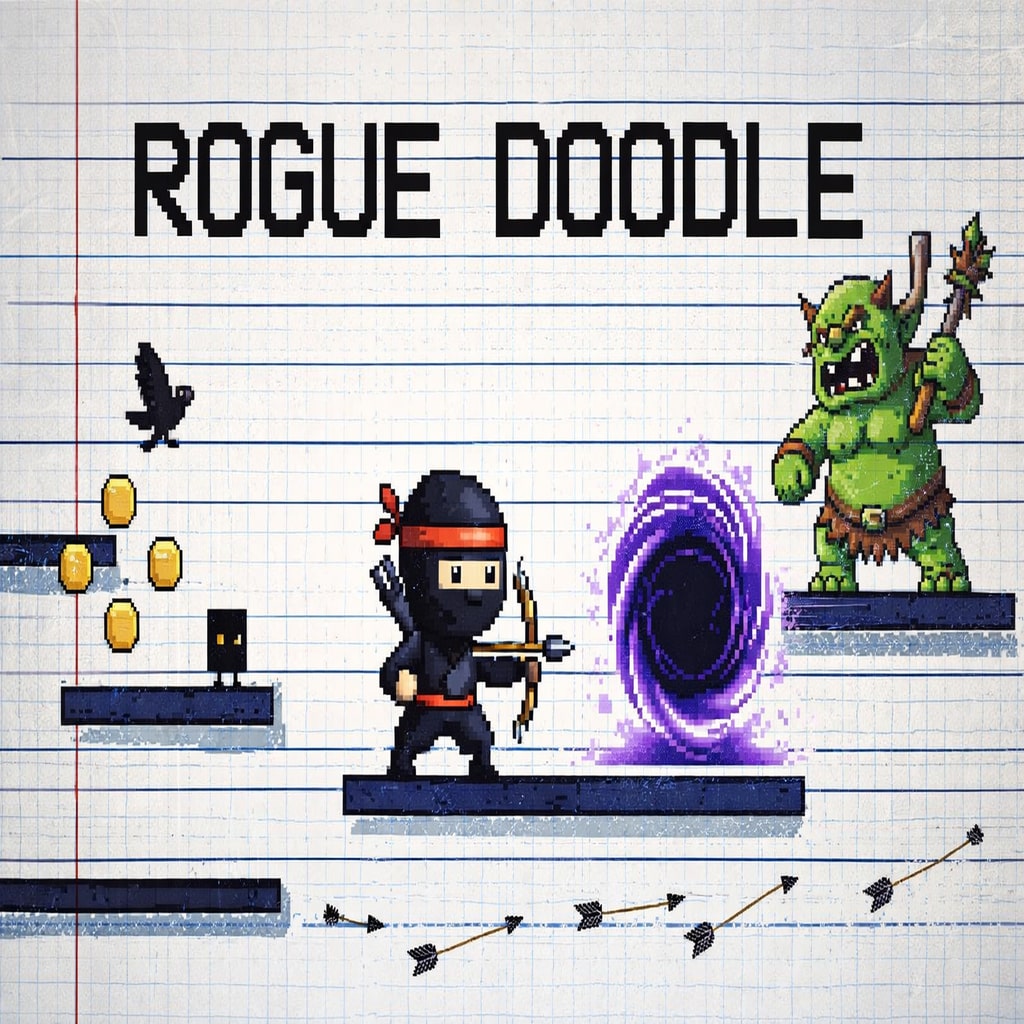
At its heart, Rogue Doodle is about momentum, spacing, and survival across fragile terrain. You play as a tiny ninja traversing a massive sheet of paper, where every platform feels as if it has been sketched in real time with deliberate fragility. Ink-thin ledges, jagged brushstroke hazards, and shifting doodled environments create a world that feels both playful and dangerous.
Gameplay – Precision on Paper
Rogue Doodle’s core gameplay loop centres on tight 2D platforming, with combat lightly layered on top. Movement is fast, responsive, and highly intentional. Your ninja can sprint, jump, wall-cling, and dash through tight gaps, and the controls are tuned for immediacy. There is very little delay between input and action, which is crucial in a game where even a fraction of a second can mean falling into the void of white space beneath the paper world.
The platforming is where Rogue Doodle shines brightest. Levels are constructed like sketchbook challenges—thin strokes of ink suspended in open space, requiring careful observation and confident execution. The “ink aesthetic” is not just visual flair; it directly informs gameplay readability. Safe surfaces, fragile platforms, and trap elements are clearly distinct, keeping the action readable even during high-speed sequences.
Failure comes often, but rarely feels unfair. When you miss a jump or get clipped by a hazard, it is usually because you pushed too aggressively or misread a timing window. The game encourages speed, but punishes recklessness just enough to maintain tension.
Combat – Minimal but Effective
Combat in Rogue Doodle is deliberately restrained. Your primary offensive tool is a bow, used to pick off enemies from a distance or to create space in tight platforming segments. This keeps combat from overpowering the platforming focus, instead integrating it as a situational tool rather than a dominant mechanic.
Enemies are designed more as movement obstacles than as full combat encounters. Some patrol narrow platforms, forcing timing-based shots, while others appear mid-jump or in areas where hesitation leads to failure. The bow feels responsive, with a satisfying arc and quick draw speed, but it is not meant to turn the game into a traditional action platformer.
This design choice works well for pacing. Rogue Doodle never slows down for long combat sequences, maintaining forward momentum even during enemy-heavy sections. However, players expecting deep combat systems or varied weaponry may find this aspect intentionally sparse.
Level Design – Controlled Chaos
Rogue Doodle’s level design centres on short, replayable runs that gradually escalate in complexity. Early stages focus on teaching movement fundamentals: jumping between thin platforms, timing dashes, and learning how enemies behave. Later stages introduce environmental hazards such as collapsing ink lines, shifting paper folds, and moving brushstroke traps that reshape the terrain mid-run.
The design philosophy here is clearly “learn through repetition.” Levels are short enough that failure never feels overly punishing, yet challenging enough that mastery requires multiple attempts. This creates a rhythm of quick retries and incremental improvement that suits the roguelite-inspired structure well.
One of the game’s strongest design elements is its use of negative space. The blank paper background is not just aesthetic—it reinforces spatial awareness. Every jump feels like a risk because failure means falling into emptiness rather than simply hitting a visible floor. This enhances tension without requiring overly complex mechanics.
However, some later levels begin to rely heavily on familiarity with patterns rather than adaptability. Once you learn certain sequences, replaying them becomes more about execution than decision-making. This slightly limits long-term variety, but does not significantly undermine the core experience.
Visual Style – Living Sketchbook
Rogue Doodle’s standout feature is its visual presentation. The entire game is styled as if it were drawn in real time on a massive sheet of paper. Platforms appear like brush strokes, enemies resemble animated doodles, and environmental effects look like ink bleeding through paper fibres.
This aesthetic is not merely decorative—it actively improves gameplay clarity. Hazardous elements are visually distinct from safe platforms, and motion is communicated through subtle ink deformation and line thickness. Even in fast-paced sequences, the visual language remains legible.
Animation is smooth and expressive without being overly complex. The ninja character feels weightless yet controlled, matching the game’s emphasis on precise movement. Enemy animations are simple yet effective, often exaggerated just enough to communicate intent.
The result is a game that feels cohesive, almost like playing inside an animated sketchbook that is constantly being rewritten as you progress.
Sound Design – Light but Purposeful
Audio design in Rogue Doodle is understated yet effective. Sound effects are crisp and responsive, with jumps, landings, and bow shots each providing clear auditory feedback. This reinforces timing during high-speed platforming sections.
The soundtrack leans towards minimalist percussion and light melodic loops, designed to maintain focus rather than dominate attention. During more intense sequences, the music subtly increases in tempo, reinforcing the sense of urgency without becoming distracting.
It is not particularly memorable in isolation, but it works well within the game’s pacing structure.
Replayability – Built for “One More Run”
Rogue Doodle is built around repeated attempts and incremental mastery. Runs are short, encouraging players to restart immediately after failure. This loop is addictive, especially in early play sessions when new mechanics are introduced regularly.
Additional modifiers and route variations unlock over time, giving players reasons to revisit earlier stages. However, the game’s roguelite elements are relatively light compared with more systemic entries in the genre. It is more about skill refinement than build experimentation.
For players who enjoy chasing perfection, speedrunning, or improving execution, Rogue Doodle offers strong replay value. For those seeking narrative depth or long-form progression systems, it may feel more limited.
Final Verdict
Rogue Doodle succeeds because it knows exactly what it wants to be: a fast, readable, precision platformer with a strong visual identity and tightly tuned controls. It does not overcomplicate its systems or try to stretch beyond its core loop. Instead, it refines a simple idea—platforming on fragile ink lines—and executes it with confidence.
While it occasionally leans too heavily on repetition in later stages and its combat remains intentionally minimal, these are small trade-offs in an otherwise polished experience. The visual presentation alone elevates it above many similar indie platformers, but it is the responsive movement and satisfying retry loop that keep it engaging.