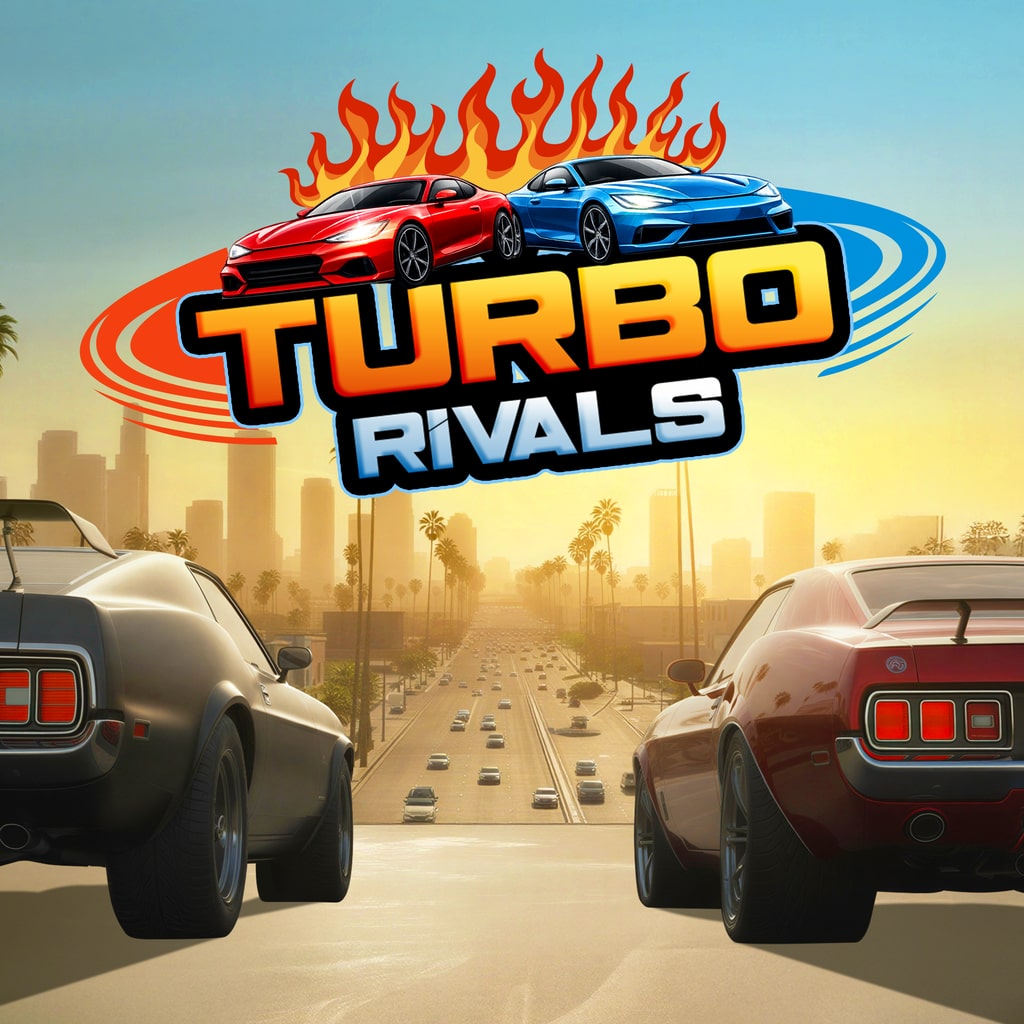
Released on April 9, 2026, Turbo Rivals from Yash Future Tech Solutions Pvt Ltd is a budget-friendly arcade racer with a clear focus: speed, spectacle, and the intoxicating thrill of perfectly executed drifts. Available on PC, PlayStation 5, and PlayStation 4, it positions itself as an accessible, high-energy alternative to more simulation-heavy racing titles, embracing a “pick up and play” philosophy while layering in just enough mechanical nuance to keep players engaged over time.
At first glance, it’s a familiar formula—global tracks, aggressive AI, and a career ladder to climb—but Turbo Rivals attempts to distinguish itself through its adaptive rival system and drift-to-boost gameplay loop. The question is whether these features meaningfully elevate the experience or simply dress up a fairly standard racer.
Core Gameplay: Drifting as a Language
At the heart of Turbo Rivals lies its defining mechanic: drifting is not just a tool but the game’s entire language. Every corner, every overtake, every victory hinges on your ability to slide through turns with precision and control.
Unlike more grounded racers, where drifting is situational, here it is constant. Players are encouraged—almost required—to initiate drifts through even gentle bends to build the all-important Turbo meter. This boost system serves as both reward and rhythm, creating a satisfying loop: drift cleanly, build boost, unleash speed, repeat.
What makes this system work is its accessibility. Drifting is easy to initiate, with forgiving handling that lets newcomers feel competent within minutes. Yet beneath that simplicity lies surprising depth. Perfecting entry angles, maintaining drift chains, and timing boost activation can significantly affect lap times.
However, this design also introduces a limitation. Because drifting is so central, races can begin to feel homogenised. There’s less emphasis on braking lines, traction management, or varied driving styles. Everything funnels back to one core skill, which—while satisfying—can eventually feel one-note.
Adaptive Rival AI: A Promising Idea
One of the game’s headline features is its “Adaptive Rival AI,” a system designed to learn from your driving habits and respond accordingly. In theory, this creates dynamic races in which opponents evolve alongside you, countering your strategies and forcing constant adaptation.
In practice, the results are mixed.
At its best, the system adds unpredictability. Rivals may become more aggressive if you favour risky overtakes, or tighten their lines if you consistently exploit certain corners. This gives the impression of racing against personalities rather than static opponents.
But the illusion doesn’t always hold. Over time, patterns emerge, and the AI can feel less like a learning entity and more like a rubber-banding system with extra flair. Difficulty spikes can occasionally feel artificial rather than earned, particularly in later Career events, where rivals seem to gain sudden bursts of speed regardless of player performance.
It’s an ambitious feature that adds flavour, but it doesn’t fully transform the racing experience as intended.
Track Design: Style Over Substance
Turbo Rivals boasts 12 global circuits, each with its own visual identity—from neon-drenched tunnels to molten volcanic landscapes and icy mountain passes. Visually, the variety is commendable, and the game does a solid job of making each location feel distinct.
Track layouts, however, are more inconsistent.
Many circuits centre on long, sweeping corners designed to facilitate extended drifts. While this complements the core mechanics, it can also lead to repetition. There are fewer tight, technical sections that demand precise control or strategic thinking, limiting the diversity of racing scenarios.
That said, some tracks do stand out. The more complex layouts—particularly those with elevation changes or environmental hazards—offer moments of genuine excitement. Narrow passes and sudden turns can disrupt your rhythm, forcing quick adjustments and rewarding adaptability.
Ultimately, the tracks serve the gameplay well enough, but they rarely surprise.
Progression and Career Mode
Career Mode forms the backbone of Turbo Rivals, guiding players through a series of events across its global circuits. The structure is straightforward: win races, earn rewards, unlock new challenges.
There’s a certain charm to its simplicity. The lack of convoluted systems or excessive menus keeps the focus squarely on racing. You’re rarely more than a few button presses away from the next event, which suits the game’s arcade sensibilities.
However, this simplicity also means progression can feel thin. There’s little narrative framing or meaningful milestones. Unlocks are functional rather than exciting, and the absence of deeper customisation or upgrade systems limits long-term engagement.
The result is a Career Mode that is enjoyable in short bursts but struggles to maintain momentum over extended play sessions.
Controls and Performance
On a mechanical level, Turbo Rivals performs reliably. Controls are responsive, with a clear emphasis on fluidity and immediacy. The handling model prioritises fun over realism and delivers a consistently smooth experience.
On PlayStation 5, the inclusion of DualSense features adds a subtle layer of immersion. Adaptive triggers simulate resistance during acceleration and braking, while haptic feedback provides tactile cues during drifts and collisions. These additions are not transformative, but they enhance the driving feel in a way that complements the game’s arcade nature.
Performance is stable across platforms, with minimal technical issues. Frame rates hold steady, and load times are short, ensuring the pacing remains uninterrupted.
Visuals and Audio
Visually, Turbo Rivals leans into a vibrant, stylised aesthetic. Bright colours, glowing effects, and exaggerated environments create a sense of energy that suits the game’s high-speed focus. It’s not cutting-edge, but it is cohesive and appealing.
Car models are functional rather than detailed, and environmental assets occasionally lack refinement. Still, the overall presentation is lively enough to carry the experience.
The audio design follows a similar pattern. Engine sounds are serviceable, if not particularly distinctive, while the soundtrack offers a steady stream of upbeat tracks that reinforce the game’s pace. It’s effective, though rarely memorable.
Replayability and Longevity
Replay value in Turbo Rivals largely depends on how much you enjoy its core loop. For players who find satisfaction in perfecting drift lines and shaving seconds off lap times, there’s plenty to keep them engaged.
The Adaptive AI adds some variety, and Free Mode allows for quick, no-pressure races. However, the limited number of tracks and the lack of additional modes—such as online multiplayer or deeper customisation—restrict the game’s long-term appeal.
This is very much a “jump in, have fun, move on” kind of experience rather than a title designed for months of dedication.
Final Verdict
Turbo Rivals is a confident, if somewhat limited, arcade racer that knows exactly what it wants to be. Its drift-focused gameplay is immediately enjoyable, offering a satisfying sense of flow that makes each race feel fast, fluid, and engaging.
Yet, for all its strengths, it rarely pushes beyond its core concept. The Adaptive Rival AI is an interesting idea that doesn’t fully deliver on its promise. Track design leans heavily on repetition, and progression lacks the depth needed to sustain long-term interest.
What remains is a polished, accessible racer that excels in short bursts but struggles to leave a lasting impression.