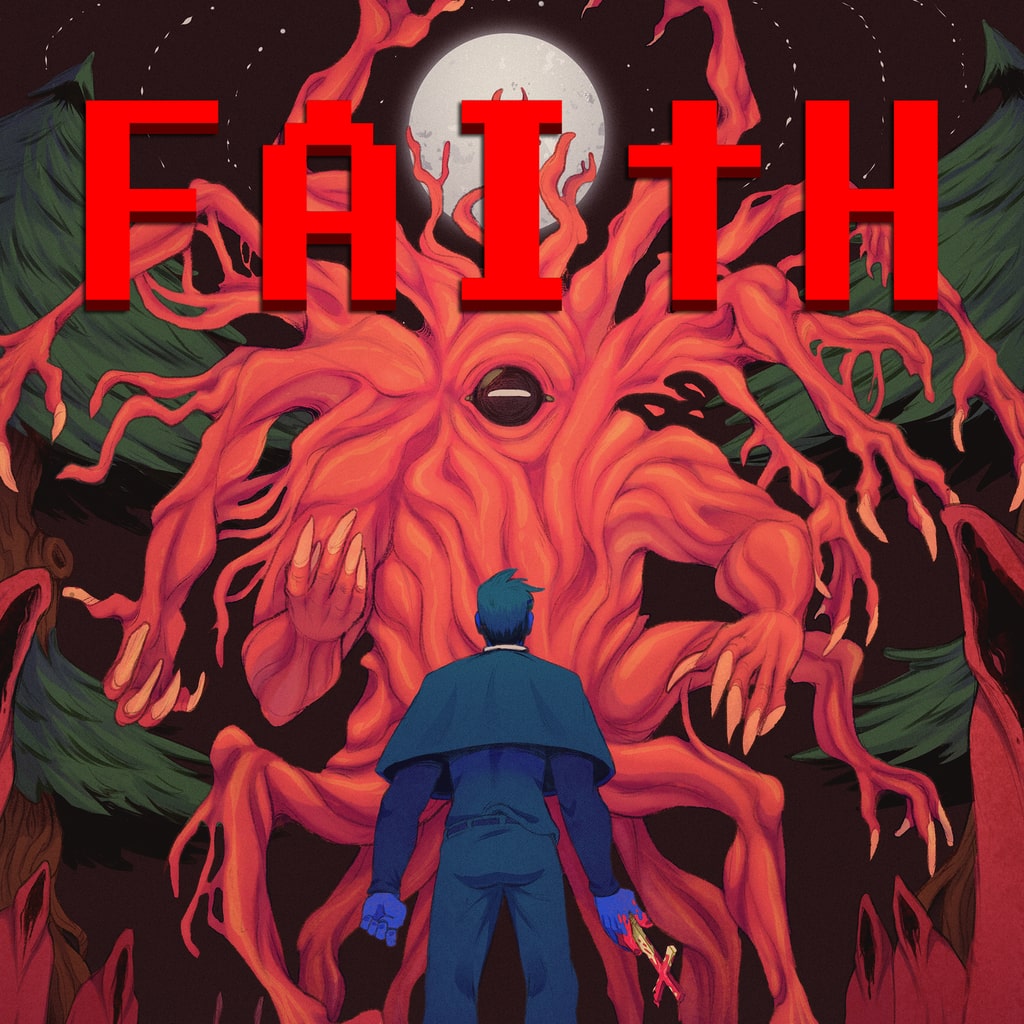
Horror has become increasingly fixated on realism. Bigger budgets often translate into more detailed monsters, cinematic lighting, and elaborate set pieces designed to overwhelm the senses. FAITH: The Unholy Trinity takes the opposite approach. It strips horror back to its bare essentials, presenting a world that looks as though it has escaped from an old home computer, yet somehow manages to be more unsettling than many modern blockbusters.
Originally released episodically before being collected into a single package, Airdorf Games’ cult classic finally arrives on PlayStation in its definitive form. Rather than relying on spectacle, it builds dread through imagination, uncertainty, and an atmosphere that rarely loosens its grip. It asks players to meet it halfway, filling the gaps left by its deliberately primitive presentation. That trust is rewarded with one of the most memorable horror experiences available today.
Three Stories, One Descent into Madness
The collection follows Father John Ward, a young Catholic priest haunted by the aftermath of a failed exorcism in rural Connecticut during the height of America’s Satanic Panic in the mid-1980s. A year after the tragedy at the Martin family home, John returns, hoping to confront unfinished business. Instead, he is drawn into something far larger than a single possession.
Each chapter broadens the story’s scope while preserving a deeply personal perspective. Haunted forests, abandoned churches, forgotten clinics, and hidden cult sanctuaries slowly reveal fragments of a disturbing conspiracy centred on faith, obsession, and corruption. The writing never rushes to explain itself, opting instead to drip-feed clues through notes, conversations, environmental details, and unsettling discoveries that reward careful observation.
What makes the narrative so effective is its confidence in ambiguity. Questions linger long after each chapter ends, and the game rarely offers easy answers. The result is a story that grows more disturbing the longer you think about it, inviting players to interpret events for themselves rather than spelling everything out.
Simplicity Creates Tension
Mechanically, FAITH couldn’t be more straightforward. John explores each environment from a top-down perspective, armed with little more than a crucifix. That single tool becomes both your shield and your weapon, allowing you to repel demons, cleanse cursed objects, and perform exorcisms.
The brilliance lies in how vulnerable the system makes you feel. Raising the crucifix slows John dramatically, forcing you to commit to every confrontation. You cannot simply rush through danger or overpower your enemies. Instead, every encounter becomes a careful dance of positioning, patience, and nerve, where standing your ground often feels as terrifying as retreating.
As the trilogy progresses, new mechanics gradually appear without overwhelming the core formula. Puzzle-solving grows more intricate, stealth sections increase the pressure, and enemy behaviour becomes increasingly unpredictable. Despite these additions, the game remains remarkably focused, never losing sight of the tension created by its minimalist design.
The multiple endings found throughout all three chapters also encourage repeat playthroughs. Hidden encounters, secret puzzles, and optional discoveries reward curiosity, making each revisit feel worthwhile rather than repetitive. Some of the game’s most memorable moments are tucked away behind clever secrets that many players may never discover on a first run.
When Pixels Become Nightmares
The first thing many players notice about FAITH is its intentionally crude presentation. Tiny sprites, sparse environments, and chunky animations immediately evoke memories of early home computers and primitive console games. At first glance, it almost feels harmless, but that illusion never lasts.
The visual design weaponises your imagination. With characters and monsters lacking detailed features, your mind instinctively fills the gaps. Every shadow becomes suspicious, every empty room carries hidden menace, and every flickering sprite seems capable of transforming into something far more horrifying.
Then the game shatters its own visual language. Without warning, key moments transition into rotoscoped animation sequences that feel grotesquely lifelike compared with everything around them. Their jerky movement, distorted faces, and uncanny realism arrive with shocking force, creating some of the most unforgettable scenes in modern horror. They never lose their impact because the game uses them sparingly, ensuring every appearance feels earned rather than expected.
The contrast between retro simplicity and disturbing realism becomes one of FAITH’s defining strengths. Few horror games understand the power of restraint this well.
Silence is the Real Monster
If the visuals set the mood, the audio is what truly burrows beneath your skin. Long stretches of exploration unfold in near silence, allowing every footstep and environmental sound to take on enormous significance. That absence of music creates an uncomfortable stillness that keeps you waiting for something terrible to happen.
When the soundscape finally erupts, it does so with remarkable precision. Distorted electronic voices, harsh bursts of static, mechanical speech synthesis, and unsettling ambient drones create an atmosphere unlike anything else in horror gaming. The famous text-to-speech dialogue has become iconic for good reason. Its emotionless delivery somehow feels more disturbing than conventional voice acting ever could.
The soundtrack itself remains subtle throughout much of the experience, emerging only when absolutely necessary. Rather than guiding your emotions, it amplifies whatever fear already exists, making every encounter feel even more oppressive. Long after finishing the game, certain sounds linger in your memory far more vividly than individual scenes.
A Deliberately Unforgiving Journey
FAITH never fully modernises its retro roots, which means embracing certain frustrations alongside its strengths. Movement is rigid, with John limited to the cardinal directions. During several boss encounters, this can make precise dodging feel awkward, especially when enemies unleash fast projectiles in confined spaces. The deliberate stiffness occasionally results in deaths that feel more mechanical than fair, particularly in later chapters.
Instant-death mechanics also demand patience. Learning boss patterns often involves repeated failures before success finally arrives. Players accustomed to generous checkpoints or forgiving combat systems may find these sequences unnecessarily harsh.
The game’s cryptic puzzles similarly refuse to hold your hand. Progress sometimes depends on careful experimentation or close attention to subtle environmental clues. For some players, that mystery will feel rewarding. Others may occasionally find themselves reaching for a guide.
Fortunately, these frustrations rarely overshadow the experience as a whole. They instead reinforce the feeling that FAITH belongs to a different era of game design, where persistence was part of the challenge rather than an inconvenience to be removed.
Final Verdict
FAITH: The Unholy Trinity proves that technical simplicity and artistic ambition are not opposites. Airdorf Games has crafted an unforgettable psychological horror experience that shows how atmosphere, pacing, and imagination can be far more frightening than photorealistic visuals ever could.
Its three interconnected chapters weave together an intelligent story of guilt, religion, obsession, and human vulnerability, supported by exceptional sound design and some of the most effective visual contrasts in modern horror. While its intentionally retro controls, demanding combat encounters, and occasionally obscure progression can frustrate, those rough edges feel part of the game’s carefully constructed identity rather than accidental flaws.
Years from now, players may struggle to remember every boss fight or puzzle solution, but they will almost certainly remember how FAITH made them feel. It is unsettling, oppressive, strangely beautiful, and utterly confident in its own vision. In a genre increasingly focused on bigger budgets and louder scares, FAITH quietly reminds us that sometimes the darkest nightmares are the ones our own imagination completes.