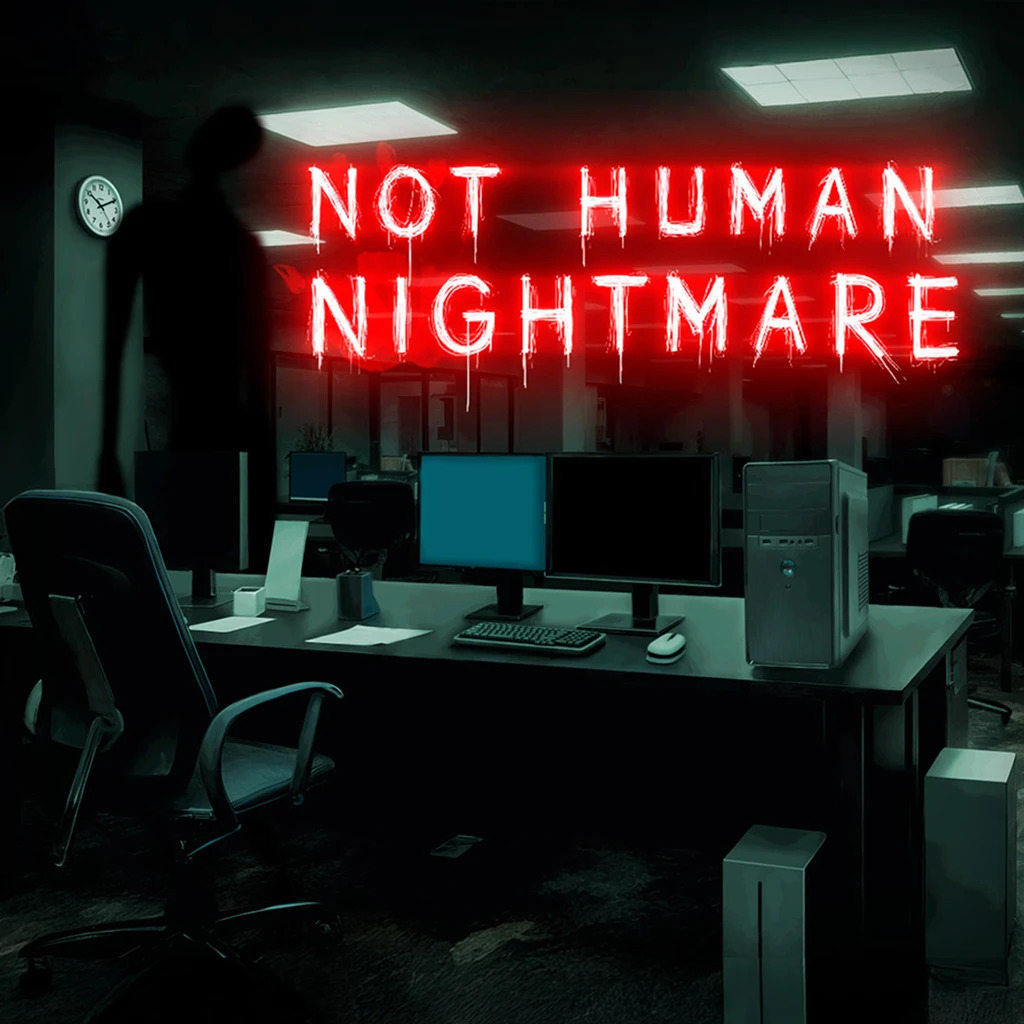
Released on April 2, 2026, for Nintendo Switch, Not Human Nightmare by CGI Lab is a sharply focused psychological horror adventure that pares the genre back to its most basic elements: space, silence, and uncertainty. There are no intricate combat systems, sprawling environments, or overly complex mechanics. Instead, it confines players to a single setting—a quiet office building during a late-night shift—and poses a deceptively simple question:
What happens when the familiar ceases to be trustworthy?
The answer, as it turns out, is both gripping and uneven.
The Horror of the Familiar
From the moment Not Human Nightmare begins, it relies heavily on a powerful tool: familiarity. The office setting is immediately recognisable—rows of desks, humming lights, narrow corridors, and sterile meeting rooms.
It is not inherently frightening.
That is precisely the point.
The game’s opening scenes are deliberately uneventful. You walk through the building, observe your surroundings, and settle into what feels like a routine night shift. There is a conscious lack of tension, aimed at grounding the player in a sense of normality.
Then, gradually, that normality starts to crack.
A chair is slightly out of place. A corridor feels longer than it should. A sound echoes from somewhere it logically shouldn’t. None of these changes are dramatic alone, but combined, they begin to shake your trust in the environment.
This is where Not Human Nightmare is at its most effective. It doesn’t depend on jump scares or obvious threats. Instead, it creates unease through subtle, almost invisible changes to a space you believe you understand.
Psychological Horror Over Traditional Gameplay
Unlike many horror titles, Not Human Nightmare does not focus on combat or survival mechanics. There are no weapons, no health bars, and no direct confrontation systems.
Instead, the gameplay centres on exploration and observation.
You move through the office, noticing changes, interacting with objects, and trying to make sense of what is happening. The horror comes not from what you fight, but from what you perceive—or think you perceive.
This design philosophy places a strong emphasis on player attention. The game rewards those who notice small details and question inconsistencies. It encourages you to second-guess your own memory of the environment.
However, this approach also has limitations. Without traditional gameplay systems to provide structure, the experience relies almost entirely on atmosphere and pacing. If the pacing falters, the game can feel aimless rather than unsettling.
The Unseen Presence
Central to the game’s tension is the suggestion that you are not alone in the building.
Not Human Nightmare never fully reveals its threat in a conventional way. Instead, it relies on implication, sound design, and environmental changes to hint at something watching—or perhaps something that has already replaced what was there before.
This ambiguity is one of the game’s most effective features. By choosing not to clearly define its antagonist, it allows the player’s imagination to fill in the gaps.
Is something following you?
Is the building itself changing?
Or is the protagonist losing their grip on reality?
The game offers no immediate answers, and that uncertainty is where its psychological horror flourishes.
Sound Design: Silence as a Weapon
If there is one area where Not Human Nightmare consistently excels, it is sound design.
Silence is employed not as absence, but as presence. The gentle hum of fluorescent lights, distant mechanical noises, and occasional unidentifiable sounds form an auditory landscape that feels alive—even when nothing visibly occurs.
Moments of near-total silence are especially effective. They generate tension not through noise, but through anticipation. The player becomes highly alert to every small sound, heightening the psychological impact of even minor audio cues.
When the game does introduce louder sounds, they are used sparingly and with intent, often signalling that something has changed—whether you notice it or not.
Visual Design and Environmental Shifts
Visually, Not Human Nightmare adopts a minimalist style. The office environment is deliberately plain, with muted colours and repetitive layouts that emphasise the sense of monotony.
This simplicity becomes a strength as the game advances. Subtle visual shifts—such as lighting changes, object placement, and architectural inconsistencies—stand out more against the otherwise uniform background.
Corridors stretch unnaturally. Rooms appear where none existed before. Familiar spaces feel wrong in ways that are hard to explain.
Nevertheless, the game’s visual limitations are also evident. Asset repetition is noticeable, and environmental variety is constrained by the single-location setting. While this supports the thematic focus, it can also create moments where the experience feels visually stagnant.
Pacing: A Delicate Balance
The pacing of Not Human Nightmare is both its greatest strength and its most notable weakness.
In its best moments, the slow build of tension is highly effective. The gradual rise from normality to unease and then to outright psychological discomfort is carefully crafted and genuinely engaging.
However, this slow pace can also work against the game. There are stretches where progress feels ambiguous, and the absence of clear objectives can lead to aimless wandering.
For some players, this ambiguity will deepen immersion. For others, it may create a sense of lack of direction.
The game walks a delicate line between deliberate uncertainty and unintentional stagnation—and does not always maintain balance.
The Switch Experience
As a Nintendo Switch-exclusive title, Not Human Nightmare benefits from the platform’s portability. The game’s brief, self-contained sessions suit handheld play well, where the close proximity to the screen can heighten the sense of immersion.
However, noticeable technical limitations exist. Visual fidelity is modest, and performance can occasionally falter during more complex environmental transitions. These issues aren’t game-breaking, but they serve as reminders of the platform’s constraints.
A Horror Experience Defined by Restraint
What ultimately defines Not Human Nightmare is its restraint.
It does not try to overwhelm players with spectacle or constant threats. Instead, it aims to evoke a particular emotional state: unease rooted in uncertainty.
This makes it a more niche experience than many mainstream horror titles. It is not intended to thrill in a conventional way. Instead, it seeks to unsettle—and it succeeds when players are willing to engage with its slower, more introspective approach.
However, that same restraint also limits its wider appeal. Without stronger gameplay systems or more varied content, the experience can feel insubstantial once its core ideas have been fully explored.
Final Verdict
Not Human Nightmare is a thoughtful, atmosphere-driven psychological horror experience that excels in creating tension through subtle environmental changes and masterful sound design. Its focus on perception and ambiguity distinguishes it from more conventional horror games.
However, its limited gameplay mechanics, uneven pacing, and restricted visual variety prevent it from reaching its full potential.
It is a haunting experience—but one that occasionally fades before it can fully take hold.