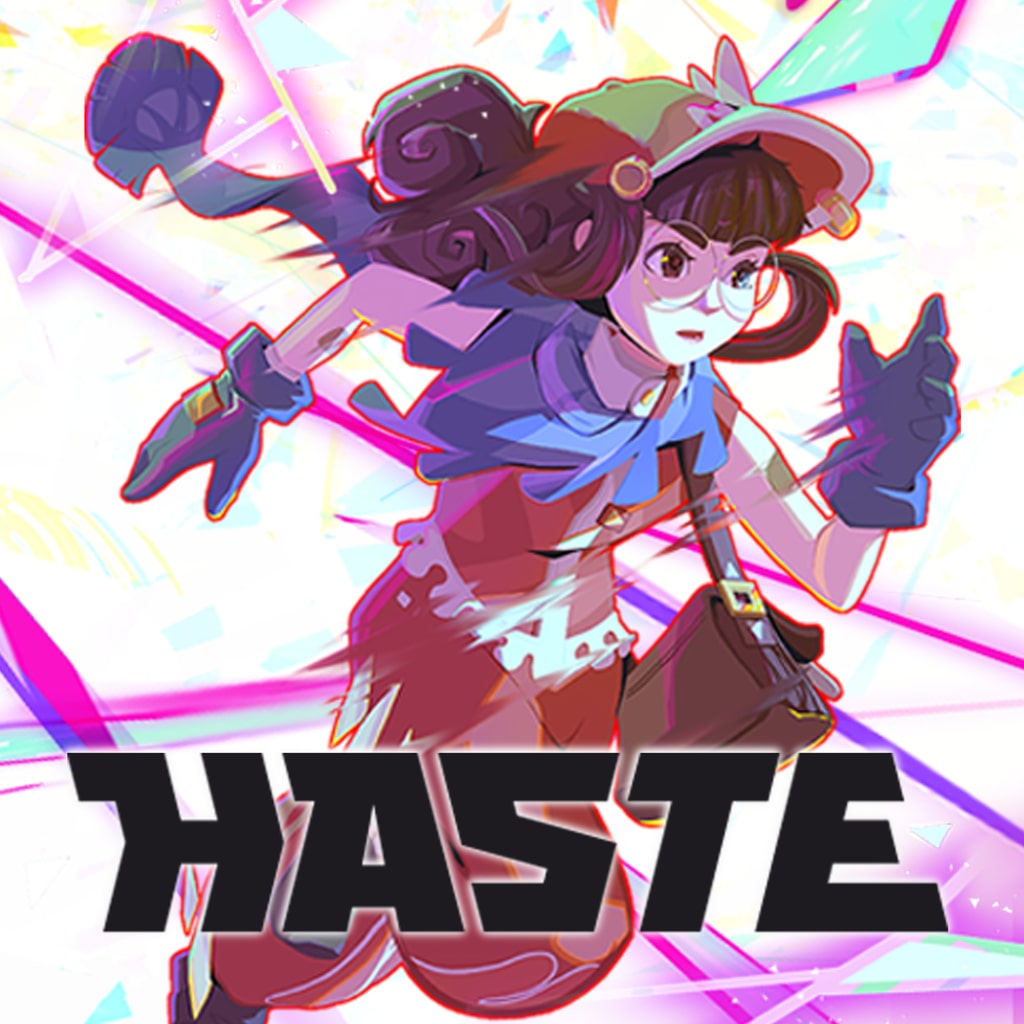
Following its PC debut in April 2025, Haste (HASTE: Broken Worlds) returns a year later to PlayStation 5, Xbox Series X|S, and Nintendo Switch 2, continuing Landfall Publishing’s now-expected tradition of chaotic April 1st releases. The same publisher also launched the viral co-op horror hit Content Warning on April 1st, a title we cover separately, and one that shares Haste’s experimental spirit and fondness for high-concept, streamable gameplay ideas.
At its core, Haste is simple in concept but intense in execution: you play as Zoe, a runner navigating a collapsing universe where entire realities disintegrate mid-sprint. The aim is not merely to reach the end of each level—it’s to outrun the apocalypse itself.
Across 10 procedurally generated “Shards,” players must keep momentum, adapt to changing terrain, and react to environmental collapse in real time. Every landing matters. Every misstep slows you down. And in Haste, speed is survival.
It is, quite literally, a game about not stopping.
Momentum as a Core Language
What immediately defines Haste is its obsession with momentum.
Unlike traditional platformers or runners where movement is divided into separate actions, Haste treats motion as a continuous flow state. Zoe is never truly stationary for long. Even brief hesitation feels threatening, as the world itself seems designed to punish hesitation.
Jumping, sliding, wall-running, and aerial adjustments all contribute to a single system: maintaining forward velocity. The game rewards precision not just in execution but also in timing. A perfect landing preserves flow. A mistimed one breaks it.
When everything aligns, Haste feels extraordinary. You are not merely controlling a character—you are guiding movement through chaos.
It’s one of those rare games where improvement is immediately obvious. The more you understand its rhythm, the faster and more fluid your runs become.
The Shards: Beautiful, Unstable Worlds
The 10 Shards that compose Haste’s campaign are procedurally generated variations of collapsing realities, each with unique visual and mechanical characteristics.
One moment, you might be sprinting across fractured crystalline landscapes suspended in void-like space. The next, you’re racing through broken industrial megastructures as entire sections crumble behind you.
Despite the procedural generation, each Shard retains a strong thematic identity. This is essential, as it prevents the game from feeling visually repetitive.
However, procedural design is a double-edged sword. While it boosts replayability and unpredictability, it can also cause occasional inconsistencies in level flow. Some runs feel perfectly tuned for momentum, while others introduce awkward terrain transitions that disrupt rhythm.
Zoe and the Silence of Collapse
Narratively, Haste is understated yet intriguing.
Zoe is not a heavily characterised protagonist in the traditional sense. Instead, she functions more as a lens through which the collapse of reality is experienced. As players progress, fragments of the story emerge—encounters with strange characters, environmental storytelling, and hints about what caused the universe to fracture.
There is a sense of mystery woven throughout the experience, though the game rarely stops to explain itself in detail. This ambiguity works in its favour, reinforcing the feeling that you are traversing something larger and more incomprehensible than yourself.
The focus remains firmly on motion, not exposition.
Controls and Flow State Design
Controls in Haste are responsive and precisely tuned, which is vital for a game centred on accuracy in movement.
Zoe reacts swiftly to inputs, and the game’s physics system accommodates quick adjustments without feeling excessively floaty or stiff. Achieving this balance is challenging, and Haste generally manages to maintain it.
Most impressively, the game fosters a sense of “flow state” play. When everything aligns—timing of inputs, understanding the terrain, managing momentum—the experience becomes almost hypnotic.
It’s the type of game where failure rarely feels like chance. Instead, it feels like a disruption in rhythm. Learning to restore that rhythm is where much of the game’s depth resides.
Items, Abilities, and Controlled Chaos
To support its movement system, Haste introduces various items and abilities scattered throughout runs.
These tools add variety without overwhelming the core design. Some offer temporary speed boosts, others enable recovery from mistakes or allow for creative traversal.
Importantly, they do not replace skill—they enhance it. A well-timed ability can save a run, but it cannot carry one alone.
This ensures that the game remains fundamentally about movement mastery, rather than item dependence.
The Challenge of Procedural Momentum
While Haste’s procedural structure boosts its replayability, it also brings one of its main weaknesses: inconsistency.
Since levels are generated dynamically, not every run offers the same pacing or flow. Some sections feel perfectly tailored for speed, with smooth chains of jumps and boosts. Others feature awkward gaps or unpredictable geometry that cause hesitation.
In a game so reliant on momentum, even minor disruptions can significantly impact enjoyment.
This doesn’t spoil the experience, but it does lead to variability in quality between runs.
Audio-Visual Identity: Speed Made Visible
Visually, Haste prioritises clarity over clutter.
The environments are designed to communicate movement clearly, enabling players to read terrain at high speed. Despite the chaos of collapsing worlds, the game maintains strong visual readability—a vital element in preventing frustration.
Effects such as trailing motion blur, environmental disintegration, and dynamic lighting enhance the sense of speed and urgency.
The soundtrack complements this perfectly, featuring energetic, pulsing compositions that escalate alongside player momentum. When a run reaches peak flow, audio and visuals unite to generate a heightened sense of intensity.
Replayability and Long-Term Appeal
Haste is designed for replayability.
Procedural generation ensures that no two runs are exactly the same, and the focus on mastery encourages players to continually improve their skills. Leaderboards, challenge modes, and personal progress all help maintain long-term interest.
However, the game may lack significant structural variety beyond the core loop, which could limit its appeal for players looking for narrative depth or mechanical expansion over time.
This is a game that flourishes through repetition – but it’s repetition of mastery, not content variety.
Strengths and Weaknesses
Pros
- Exceptional momentum-based movement system
- Highly responsive and satisfying controls
- Strong sense of speed and flow state gameplay
- Visually readable procedural environments
- Excellent replayability for skill-focused players
Cons
- Procedural generation can disrupt pacing
- Occasional inconsistency in level design quality
- Limited narrative depth and character development
- Repetition may not appeal to all players
Final Verdict
Haste (HASTE: Broken Worlds) is an exciting and finely crafted expression of movement within gameplay.
It captures the sensation of speed and collapse in a way that feels both mechanical and emotional, encouraging players to embrace rhythm, precision, and adaptability. When it succeeds—and it often does—it provides some of the most exhilarating motion-based gameplay seen recently.
However, its dependence on procedural structure means that not every moment hits with the same impact. Some runs soar; others falter.
Nonetheless, for players who appreciate flow state gameplay, mastery, and kinetic intensity, Haste offers an experience that is hard to rival.
It’s not merely about running fast—it’s about learning how to move as the world crumbles around you.