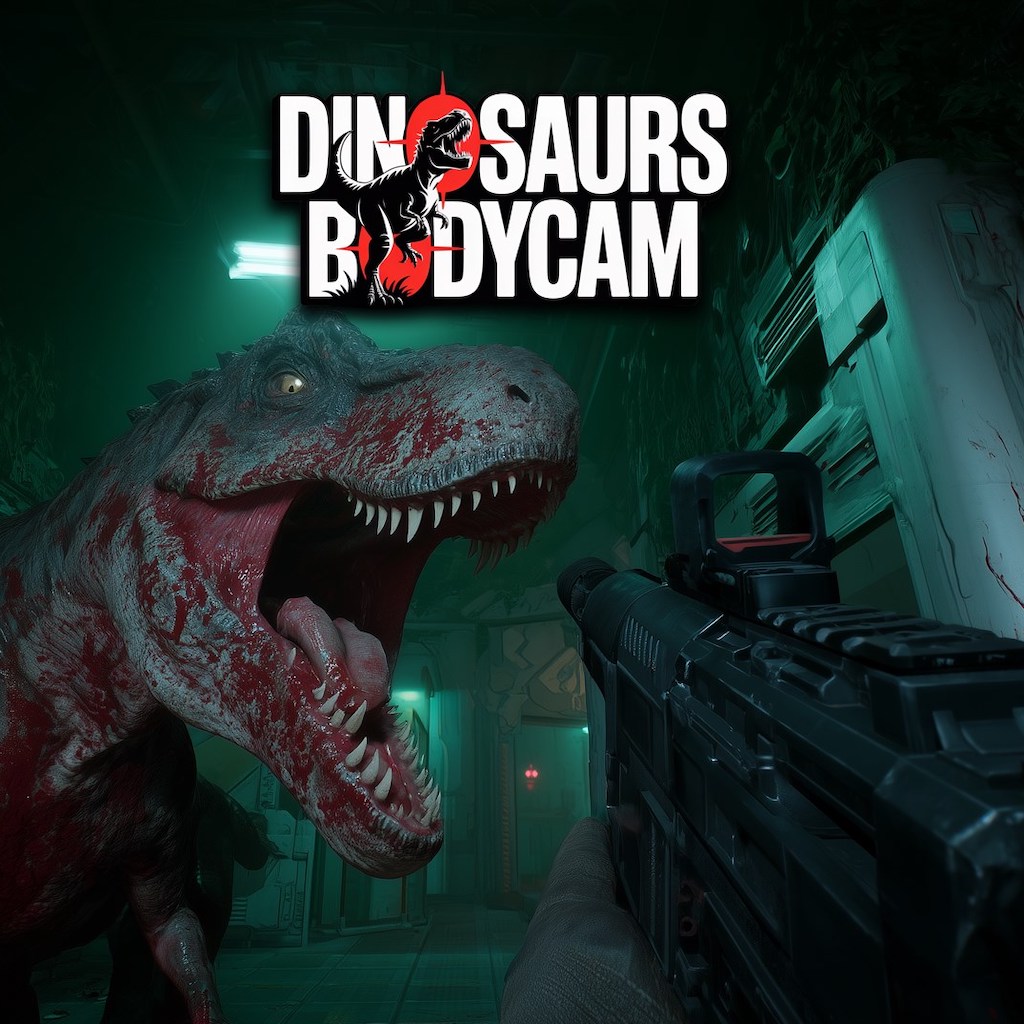
There is a very specific modern horror subgenre that has begun to take shape over the last few years: the “bodycam horror” experience. Born from viral Unreal Engine 5 tech demos and low-light realism showcases, it replaces traditional cinematic framing with shaky, first-person surveillance footage, aiming to blur the line between game and recovered evidence. Dinosaurs Bodycam, developed and published by GamePoc LTD, adopts that aesthetic and applies it to one of horror’s oldest fantasies: being hunted by dinosaurs.
The result is a game that is visually striking, mechanically ambitious, and often genuinely tense—but also uneven, occasionally exhausting, and heavily reliant on its presentation to keep players engaged.
A Horror Experience Filmed in Panic
From the moment Dinosaurs Bodycam begins, it fully commits to its concept. You are not a traditional protagonist—you are an operator in tactical gear, with your perspective filtered through a chest-mounted camera that distorts, shakes, and reacts to every movement. The interface is diegetic; the visuals are grainy and unstable, and visibility is often hindered by environmental effects, motion blur, or equipment failure.
This is not a game designed to make you feel in control. It aims to make you feel documented.
The premise is simple: an elite response team is sent to investigate a remote research facility that has gone quiet. What they discover are genetically enhanced dinosaurs—aggressive, adaptable, and relentlessly hostile. The facility itself is a labyrinth of collapsed corridors, overgrown jungle encroachment, and dimly lit industrial interiors.
There is no comfort zone. Only increasing exposure.
The Bodycam Aesthetic as Gameplay Identity
The defining feature of the game is its bodycam presentation. Unlike traditional first-person horror games, where clarity is often maintained for gameplay readability, Dinosaurs Bodycam deliberately avoids visual clarity.
Lighting is overexposed at times and nearly black in others. Motion blur is continuous. Camera sway responds to breathing, sprinting, and panic. Even when standing still, stability is not guaranteed, as micro-adjustments and hand jitter are simulated.
This creates an experience that feels authentic to surveillance footage—but can also be occasionally frustrating from a gameplay perspective. Enemies may be hard to track in chaotic encounters, and navigating the environment sometimes becomes a process of trial and error rather than careful observation.
However, when it works, it is truly effective. Spotting a dinosaur moving in the distance through grain and distortion evokes a primal unease that clearer visuals often fail to replicate.
The game shines when you are unsure about what you are seeing.
Dinosaurs Designed for Adaptation and Fear
The main antagonists are not fixed monsters. The genetically enhanced dinosaurs in Dinosaurs Bodycam are designed to adapt to player behaviour. If you rely heavily on hiding, they become more investigative. If you use loud weapons often, they become more aggressive and direct.
This adaptive AI system is one of the game’s strongest mechanics. It ensures that survival depends not just on reaction but on recognising patterns. Over time, players must actively change their behaviour to avoid becoming predictable prey.
As a result, encounters are rarely the same. A safe route in one mission may turn dangerous in the next. This unpredictability highlights the game’s core theme: you are not hunting the environment—you are being studied by it.
However, the system isn’t always transparent. It can be difficult to understand why certain behaviours cause escalation, and sometimes the difficulty curve feels inconsistent rather than intelligently reactive.
The Microphone Mechanic: Silence as Survival
One of the most distinctive—and controversial—features is the microphone detection system. Dinosaurs can react to real-world noise captured through your microphone, meaning that player silence becomes a mechanical survival tool.
In theory, this is a brilliant immersion feature. It transforms the player’s physical environment into part of the game world. A cough, a whispered comment, or background noise can potentially attract attention in-game, creating genuine tension during quiet sequences.
In practice, its effectiveness relies heavily on the player’s setup. Not all environments are equally suitable, and sensitivity calibration can vary. When it works, it significantly enhances immersion. When it fails, it can feel arbitrary.
Still, it reinforces the game’s commitment to breaking the barrier between player and experience. You are not just controlling fear—you are actively participating in it.
Tactical Survival and Resource Pressure
Beyond its presentation and gimmicks, Dinosaurs Bodycam is a survival horror game with limited resources. Ammunition is scarce, equipment is prone to malfunction, and direct confrontation is rarely advisable.
Combat exists, but it is deliberately unreliable as a primary solution. Weapons can jam, recoil is exaggerated by panic states, and visibility often makes precise aiming difficult. As a result, stealth and avoidance are generally more effective strategies.
The dynamic fear system further complicates encounters. As terror builds, your aim destabilises, stamina drains faster, and perception becomes unreliable. This creates a feedback loop where panic directly reduces your ability to respond effectively, which in turn increases panic.
It is a system designed to simulate psychological collapse under pressure, and it is effective—if sometimes punishing.
Audio Design and Environmental Tension
Sound design is arguably the most vital element of the experience. Dino roars echo through structures, footsteps resonate unpredictably across terrain, and environmental audio cues often serve as the only reliable warning of nearby threats.
The game employs sound not just for atmosphere but also for navigation. Learning to interpret audio layers becomes crucial for survival. Silence, in particular, is rarely reassuring — it is often a prelude to danger.
The bodycam perspective intensifies this, as sound often precedes visual confirmation, forcing players to react to incomplete information.
Performance and Presentation Stability
On Xbox Series X|S, the game performs adequately, though not perfectly. Frame pacing is usually steady, but intense scenes with multiple dinosaurs and environmental effects can cause slight dips.
More noticeable is the deliberate instability of the visual system. It can be hard to tell between performance problems and design choices, as the bodycam style deliberately blurs that line.
This is both a strength and a weakness. It boosts immersion but sometimes reduces technical clarity.
Final Verdict
Dinosaurs Bodycam is a bold and often effective experiment in immersive horror presentation. Its bodycam aesthetic is more than just visual style—it is a fundamental part of gameplay that influences how players perceive and interact with the environment. Coupled with adaptive dinosaur AI and microphone-based detection, it offers a uniquely tense survival experience.
However, its dependence on visual distortion and mechanical opacity can sometimes limit player agency. Not every moment of confusion feels purposeful, and not every system clearly communicates itself.
Nevertheless, when it works well, it provides a rare form of horror: not the fear of monsters, but the dread of not fully understanding what is happening until it is already too late.