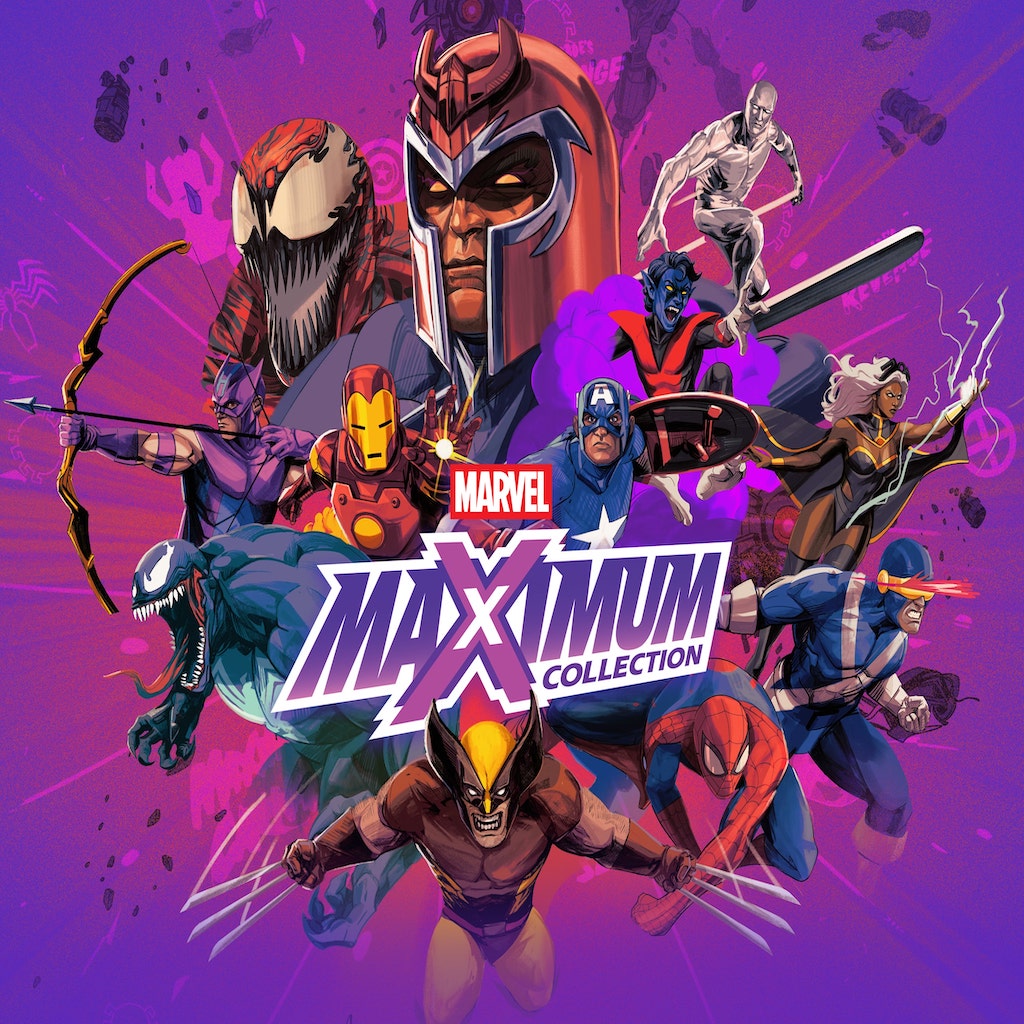
There’s a special reverence needed when handling retro collections—especially those linked to a licence as culturally influential as Marvel. These aren’t just games; they’re artefacts from a very specific era, when arcade cabinets roared in neon-lit corners and licensed tie-ins depended on their ability to capture imagination rather than fidelity. MARVEL MaXimum Collection acts as both a museum and a playground, bringing together multiple versions of six classic titles into one expansive package. It’s an ambitious, sometimes uneven, but often deeply nostalgic tribute to Marvel’s pixelated history.
What makes this collection stand out at once is its focus on preservation over curation. Instead of choosing a “definitive” version of each game, it includes nearly every major iteration—arcade, 16-bit, 8-bit, and even portable versions in some cases. This approach creates a captivating, if occasionally chaotic, time capsule. You’re not just playing a version of Spider-Man/Venom: Maximum Carnage—you’re comparing how it felt across different hardware generations, design philosophies, and technical constraints.
And that’s where the magic begins.
A Cabinet of Curiosities
The undeniable highlight here is X-Men: The Arcade Game, which remains just as electrifying today as it was in the early ‘90s. The addition of six-player online multiplayer with rollback netcode is truly transformative. What was once a chaotic, quarter-munching co-op brawler is now a genuinely playable multiplayer experience. It’s loud, messy, and repetitive—but that’s precisely the point. The enjoyment comes from piling on-screen with Cyclops, Wolverine, Storm, and friends, unleashing colourful chaos together.
Elsewhere, the collection ranges between cult classics and curiosities. Captain America and The Avengers feels like a relic of arcade spectacle, full of oversized sprites and booming voice lines that are both charming and absurd. Meanwhile, Spider-Man/X-Men: Arcade’s Revenge offers a tougher experience—one that reflects the difficulty spikes and experimental level design of its era.
Then there’s Silver Surfer, a game notorious for its brutal difficulty. Even with modern aids like rewind and save states, it remains tough—but now, crucially, it’s also more accessible. The addition of these features doesn’t weaken the experience; it contextualises it. You’re no longer battling the game’s limitations—you’re engaging with its design.
Preservation Done Right (Mostly)
The modern enhancements are what give MARVEL MaXimum Collection much of its appeal. Rewind, save states, visual filters, and cheat toggles aren’t merely conveniences—they are vital tools that help these older titles feel alive in a contemporary setting. For newcomers, they soften the sharp edges of retro design. For veterans, they provide a way to revisit cherished (or feared) moments without frustration.
The display options are especially well managed. Whether you prefer sharp, clear pixels or CRT-style scanlines that mimic the glow of an old television, the game offers flexibility without overcomplicating things. The included music player and archive mode are equally welcome features, providing a deeper look into the history behind these titles. High-resolution scans of manuals and box art are more than simple bonuses—they serve as reminders of how these games were originally experienced.
That said, the “everything included” approach does have drawbacks. Not all versions of these games are equal, and some feel unnecessary. The differences between certain 16-bit ports can be so subtle that casual players might wonder why both are available. It’s a choice that prioritises completeness over ease of use—and while that is commendable, it can sometimes make the collection seem bloated.
The Highs of Heroism… and the Lows of the Era
Playing through MARVEL Maximum Collection offers as much a history lesson as entertainment. You observe the evolution of design trends, from arcade immediacy to more narrative-driven console experiences. But you also notice the limitations—repetition, uneven difficulty, and mechanics that haven’t aged well.
Beat-’em-ups like Maximum Carnage and Separation Anxiety still provide satisfying combat loops, supported by their iconic soundtracks and comic-inspired visuals. However, they can become repetitive over longer sessions. These titles were designed for shorter bursts, often driven by coins or weekend rentals—not extended gameplay.
Similarly, platformers like Arcade’s Revenge can feel punishing in ways modern players might find frustrating. Precision jumps, limited checkpoints, and obscure objectives are part of the experience—but they’re not always enjoyable by today’s standards.
Yet, for all these flaws, there’s an undeniable charm. These games proudly showcase their era, and the collection doesn’t try to smooth over their rough edges entirely. Instead, it presents them as they were—enhanced, but not rewritten.
Online and Community Potential
The inclusion of online multiplayer—especially for X-Men: The Arcade Game—is a significant highlight, but it also prompts an intriguing question: why stop there? Other titles in the collection could have benefited from similar features. Imagine playing Separation Anxiety with a friend online, or competing in score challenges across the entire library.
Currently, the online component feels more like a proof of concept than a fully developed feature set. It performs excellently where it’s present, but its absence elsewhere is quite noticeable.
A Love Letter with Rough Edges
Ultimately, MARVEL MaXimum Collection focuses more on preservation than perfection. It celebrates a time when superhero games were experimental, unpredictable, and often wildly inconsistent. By gathering these titles and adding thoughtful modern features, it enables both new and returning players to experience that era in a meaningful way.
It won’t appeal to everyone. Players expecting polished, modern gameplay may find the collection’s rough edges hard to overlook. However, for those willing to engage with it on its own terms, there’s a wealth of history, charm, and surprisingly enduring fun to discover.
Final Verdict
MARVEL Maximum Collection is an ambitious and affectionate tribute to Marvel’s gaming history—focusing on authenticity and preservation rather than refinement. It excels as a digital archive, providing a detailed, multi-layered view of how these characters were once animated with pixels and polygons. The inclusion of multiple versions, modern quality-of-life improvements, and notable features like online multiplayer for X-Men: The Arcade Game make it a compelling package, even if its broad scope can sometimes work against it.
At its best, it’s a joyful return to arcade chaos and comic book spectacle. At its weakest, it’s a reminder that not all classics age gracefully. But overall, it’s a collection that respects its origins while making enough concessions to modern sensibilities to keep it playable—and, importantly, enjoyable.
For long-standing fans, it’s a nostalgic treasure trove. For newcomers, it’s an invitation to explore a formative era of superhero gaming, flaws and all.