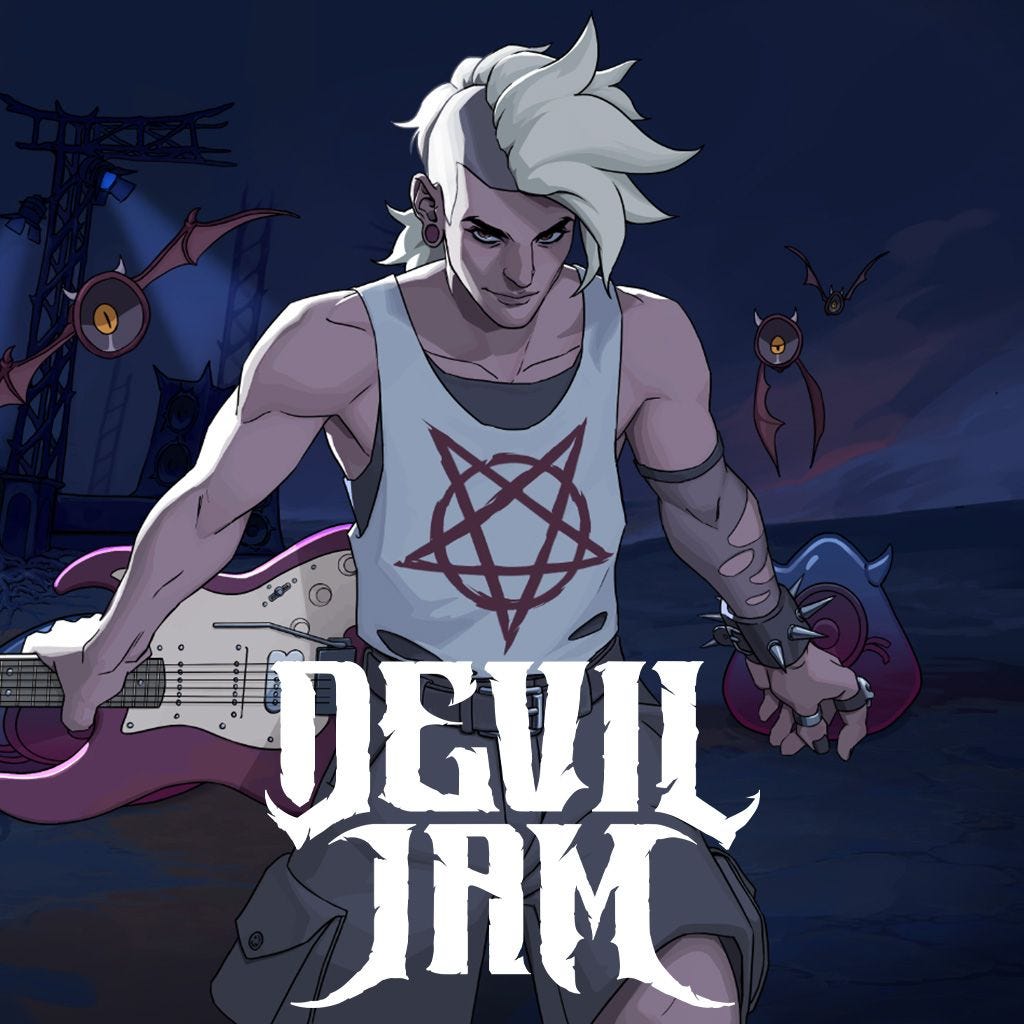
In a genre increasingly crowded with imitators, Devil Jam doesn’t just try to stand out — it screams for attention, guitar in hand, amps turned right up. On paper, it fits neatly into the “survivor-like” mould: auto-attacking combat, escalating waves, roguelite progression. But in execution, it’s something much more expressive—a chaotic blend of rhythm, positioning strategy, and heavy metal theatrics that manages to feel both familiar and refreshingly unpredictable.
Set in a hand-drawn vision of Hell, Devil Jam casts you as a musician bound by a demonic contract, forced to perform for an audience that would quite literally tear you apart. It’s an absurd premise, but one the game leans into with full confidence, creating an experience that thrives on excess, style, and mechanical experimentation.
A Genre Remix
At its core, Devil Jam shares similarities with games like Vampire Survivors—you move, your character attacks automatically, and survival depends on positioning, upgrades, and awareness. But where many games in the genre prioritise simplicity, Devil Jam introduces additional layers.
The most immediately noticeable twist is its rhythm-infused combat. While attacks are automatic, they’re linked to a musical cadence that subtly influences timing and flow. You’re not pressing buttons in time with a beat, but you are feeling it—combat has a pulse, and learning to move with that rhythm becomes key to surviving longer runs.
It’s a clever integration. Rather than turning the game into a strict rhythm challenge, it uses music as an underlying structure, enhancing the sense of momentum without overwhelming the player.
The 12-Slot System: Complexity with Purpose
If the rhythm element adds flavour, the 12-slot inventory system provides the game’s genuine depth. Unlike traditional roguelites where upgrades are simply stacked, Devil Jam introduces spatial strategy. Items aren’t just collected—they’re placed, and their position within your inventory grid influences how they interact.
Synergies emerge based on adjacency, alignment, and combination. A weapon placed next to certain modifiers might gain new properties; a poorly arranged setup could limit your effectiveness. It’s a system that rewards experimentation, encouraging players to think beyond raw power and consider how their build fits together.
This is where Devil Jam truly sets itself apart. Runs don’t just differ in what you acquire, but in how you assemble it. The result is a level of variety that keeps the gameplay loop engaging for much longer than many of its contemporaries.
However, this complexity comes at a cost. The game does little to explain its deeper systems, leaving players to figure things out through trial and error. For some, this will be part of the appeal. For others, it may feel unnecessarily opaque.
Combat: Chaos and Control
Moment-to-moment gameplay is swift, chaotic, and often intense. Enemies erupt from all angles—fans, rivals, and grotesque denizens of Hell—each contributing to the visual and mechanical disorder.
Yet beneath this chaos, there is an unexpected level of control. Movements respond well, and once you grasp your build, you can traverse even the most crowded arenas with confidence. It’s a fine balance, and Devil Jam generally maintains it well.
Boss battles punctuate the gameplay, bringing moments of heightened intensity. These fights are larger in scale and require heightened awareness, often introducing unique mechanics that challenge your understanding of combat and build optimisation.
The highlight, unsurprisingly, is Death himself—a dramatic encounter that captures the game’s blend of spectacle and difficulty.
A Visual Identity That Shreds
Visually, Devil Jam is a standout. Its hand-drawn art style brings Hell to life with a distinctive flair, combining exaggerated character designs with fluid animation and bold colour choices.
Everything feels animated in the truest sense—not just moving, but alive. Characters bounce, stretch, and react in ways that reinforce the game’s musical energy. Effects are loud and unapologetic, filling the screen with flashes of colour and motion.
This visual intensity enhances the experience, but it can also become overwhelming. In later stages, when enemy density and effects peak, it can be difficult to track everything happening on screen. It’s a trade-off between style and clarity, and one the game doesn’t always fully resolve.
Soundtrack: The Heart of the Experience
It would be impossible to discuss Devil Jam without mentioning its soundtrack. Rooted firmly in metal, it drives the entire experience, shaping both the tone and the pacing of gameplay.
Tracks evolve as runs progress, building intensity in tandem with the action. It’s not just background music; it’s the game’s heartbeat. The synergy between audio and gameplay is one of Devil Jam’s greatest achievements, elevating even routine encounters into something more engaging.
Progression and Replayability
As a roguelite, Devil Jam thrives on its replayability, and here it truly shines. Each run introduces fresh combinations, new challenges, and opportunities to improve your strategy.
Unlocks arrive gradually, granting access to new items, abilities, and characters. Progression feels purposeful without becoming too grind-heavy, balancing engagement with variety to maintain interest without becoming monotonous.
However, the early stages can seem somewhat limited. It takes time to unlock the full spectrum of options, and initial runs might not fully reveal the game’s potential.
Console Performance
On consoles, Devil Jam performs well across the board. Frame rates stay stable even during intense sequences, and controls respond smoothly to gamepads.
The Switch version, though slightly reduced visually, retains the core experience effectively, making it a solid choice for portable play.
Where It Falters
Despite its strengths, Devil Jam isn’t without flaws. The absence of clear tutorials for its more complicated systems can create a barrier to entry, especially for players unfamiliar with the genre.
Visual clutter, while part of the game’s character, can sometimes impede gameplay. And while the core loop is solid, some runs can feel overly reliant on RNG, particularly when hunting for specific synergies.
Final Verdict
Devil Jam is a bold, stylish evolution of the survivor-like formula, blending rhythm, strategy, and spectacle into a cohesive—if occasionally chaotic—experience. Its 12-slot inventory system adds a layer of depth rarely seen in the genre, while its audiovisual design ensures it leaves a lasting impression.
It’s not the most accessible game, nor the most polished in every respect. But it’s one of the most distinctive. In a space crowded with similar ideas, Devil Jam finds its own voice—and turns the volume all the way up.
For those willing to embrace its complexity and chaos, it’s an experience that’s as rewarding as it is relentless.