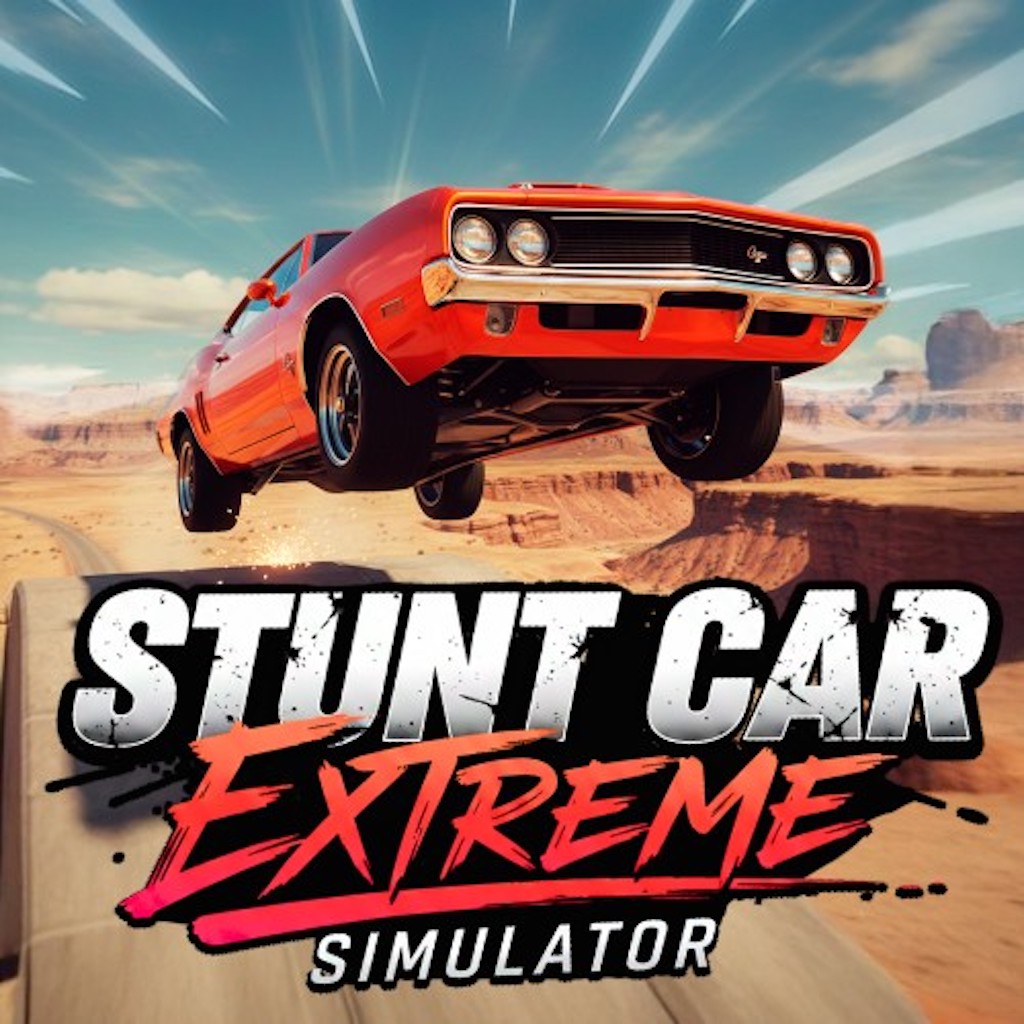
In recent years, the Nintendo eShop has quietly become home to a growing category of budget stunt-driving games — titles built less around competitive racing and more around spectacle. Inspired heavily by mobile-era “Mega Ramp” experiences, these games trade realism for outrageous physics challenges, towering sky tracks, and the simple joy of launching a car into impossible space.
Stunt Car Extreme Simulator, published by globalgamestudio and released on Nintendo Switch on February 20, 2026, firmly plants itself within that tradition. It’s not trying to compete with simulation giants or polished arcade racers. Instead, it aims to capture something far more specific: the thrill of barely landing a jump you absolutely should not have survived.
The result is a modest but occasionally addictive stunt playground — one that succeeds through simplicity even as its limitations remain clearly visible.
Welcome to the Mega Ramp
The core concept of Stunt Car Extreme Simulator is immediately understandable.
You are placed behind the wheel of increasingly powerful vehicles and tasked with completing obstacle-filled tracks suspended high above the ground. These courses resemble floating playgrounds of ramps, loops, rotating platforms, and narrow pathways that demand careful control rather than outright speed.
Unlike traditional racing games, there are no opponents. The challenge comes entirely from the environment.
Each level asks a deceptively simple question:
Can you reach the finish line without falling?
The answer is rarely achieved on the first attempt.
Tracks are constructed like physics puzzles. Clearing a gap may require accelerating just enough — too slow and you fall short, too fast and you overshoot the landing. Precision matters more than aggression, and learning each course becomes an exercise in trial and error.
This loop quickly defines the experience. Failure isn’t punishment; it’s expected.
Driving That Balances Arcade and Control
Despite including the word “Simulator” in its title, the driving model leans firmly toward arcade accessibility.
Controls are intentionally minimal:
- Accelerate
- Brake/Reverse
- Air tilt (adjust vehicle orientation mid-jump)
That’s it — and honestly, that’s enough.
The simplified input scheme works particularly well on the Nintendo Switch, making the game approachable for casual players or younger audiences. Vehicles respond quickly, and airborne adjustments provide just enough control to feel responsible for success or failure.
The physics sit in an interesting middle ground. Cars carry believable weight when landing, but exaggerated momentum ensures dramatic crashes and near-misses remain entertaining rather than frustrating.
It’s not realistic driving — but realism would arguably hurt the experience. The exaggerated handling keeps experimentation fun.
Trial, Error, Repeat — The Real Gameplay Loop
Progression revolves around mastering increasingly complex tracks.
Early levels function as tutorials, introducing ramps and simple jumps. Soon after, the game escalates into elaborate obstacle courses featuring:
- Moving platforms
- Vertical climbs
- Precision balance beams
- Looping structures
- Sudden drops requiring mid-air corrections
What keeps these challenges engaging is how failure becomes part of learning. You’ll restart frequently, adjusting speed or approach angles until everything clicks.
When you finally land a perfect jump after five failed attempts, the payoff feels earned — even if the mechanics themselves remain straightforward.
This creates a surprisingly satisfying rhythm: attempt, crash, retry, succeed.
Vehicle Variety Adds Personality
One of the game’s stronger features is its growing vehicle roster.
As players earn stars and rewards from completed stages, new vehicles unlock across several categories:
- Sleek supercars built for speed
- Classic muscle cars with heavier handling
- Monster trucks offering stability over precision
Each vehicle genuinely alters how levels feel. Heavier cars stick landings better but struggle with tight acceleration windows, while lighter cars excel at jumps but punish sloppy control.
This variety encourages revisiting earlier levels with different approaches — a welcome layer of replayability that helps extend the game’s lifespan beyond initial completion.
Customization and Progression
Between stages, players can access a garage system allowing cosmetic tweaks and performance adjustments.
Customization isn’t especially deep, but it provides enough progression incentive to keep players engaged. Improving acceleration or handling can turn previously frustrating courses into manageable challenges.
Importantly, upgrades never completely remove difficulty. Skill still matters more than stats — a smart design choice that prevents progression from trivializing later levels.
Presentation: Functional Over Flashy
Visually, Stunt Car Extreme Simulator is unmistakably a budget title.
Environments are bright and readable but simplistic, featuring clean textures and minimal environmental detail. Backgrounds often consist of skyboxes or distant terrain rather than fully realized worlds.
However, this simplicity serves a practical purpose: visibility. On narrow platforms suspended in midair, clarity matters more than realism.
Performance on Nintendo Switch remains stable for the most part, though occasional frame dips appear during complex physics interactions or high-speed crashes. Load times are short, making repeated retries painless — an essential feature given how often players restart levels.
Audio design is serviceable but forgettable. Engine sounds and menu music do their job without standing out, reinforcing the game’s focus on gameplay over presentation.
Accessibility and Pick-Up-and-Play Appeal
Perhaps the game’s biggest strength is how quickly it communicates itself.
Within minutes, players understand everything they need to know. There are no complicated menus, lengthy tutorials, or overwhelming mechanics.
This makes Stunt Car Extreme Simulator ideal for:
- Short handheld sessions
- Younger players
- Casual gaming breaks
- Achievement-focused experimentation
The game thrives in bite-sized bursts rather than long marathons.
Where the Wheels Come Off
Despite its fun core, several issues prevent the game from reaching greater heights.
Limited Variety Over Time
While tracks become harder, their visual themes rarely evolve. After several hours, environments begin to blur together.
Repetitive Structure
Every level ultimately revolves around the same goal: reach the end without falling. Without additional modes or challenges, longevity depends entirely on personal tolerance for repetition.
Budget Polish
Menus feel basic, animations lack refinement, and physics occasionally behave unpredictably — sometimes causing failures that feel slightly unfair.
None of these issues ruin the experience, but they reinforce the game’s modest scope.
The Budget Game Context
Like many eShop releases in this category, price matters.
At £4.49, expectations shift dramatically. Stunt Car Extreme Simulator isn’t competing with premium racers; it’s offering a lightweight, accessible stunt sandbox at impulse-buy pricing.
Judged within that framework, the game delivers reasonable value — especially for players who enjoy physics challenges and trial-based gameplay.
Final Verdict
Stunt Car Extreme Simulator doesn’t reinvent stunt driving, nor does it attempt to rival major racing franchises. Instead, it embraces its identity as a simple, physics-focused Mega Ramp experience built around experimentation and persistence.
Its accessible controls, satisfying trial-and-error progression, and varied vehicle handling create moments of genuine fun — particularly when you finally nail a jump that once seemed impossible.
While repetitive structure and budget presentation limit long-term appeal, the core gameplay loop remains entertaining in short sessions.
It’s a small game with small ambitions — but sometimes launching a car off a ridiculous ramp is all you need.