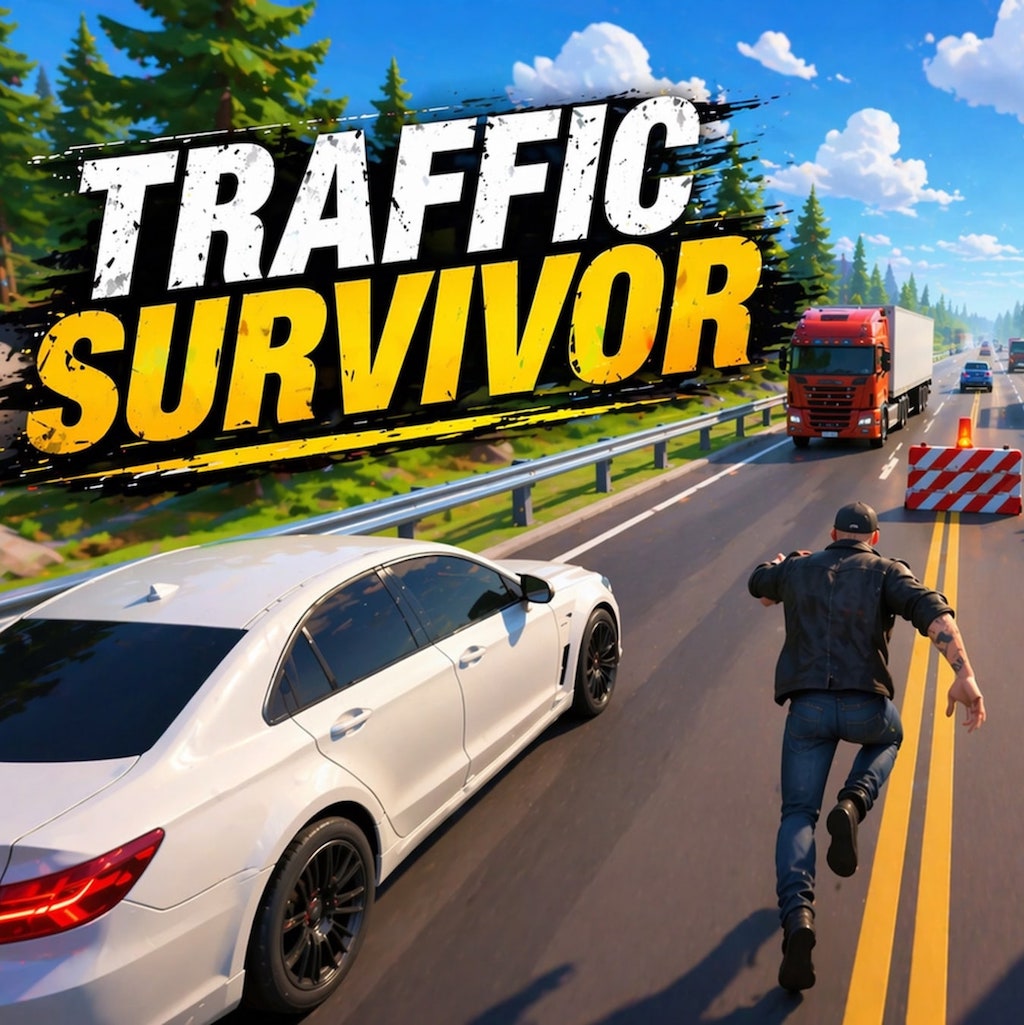
Traffic Survivor is an endless runner that emphasises quick gratification, demands fast reflexes, and inspires players to beat their best scores. From the outset, it captures this core idea by immersing you in a chaotic flow of racing cars, where hesitation is almost instantly penalised.
There is no elaborate narrative or lengthy tutorial waiting in the wings. Instead, the game hands you the controls, points you towards an impossibly busy motorway, and challenges you to survive for as long as possible. Sometimes that simplicity works in its favour, creating an arcade experience that feels perfect for a few minutes during a lunch break or while travelling. At other times, it also exposes how little lies beneath the surface once the initial excitement fades.
Despite its modest ambitions, there is an undeniable charm in chasing ever-higher scores while weaving between lorries, leaping over barriers, and desperately sliding beneath obstacles with only a split second to spare. It knows exactly what kind of game it wants to be, even if it never truly pushes beyond those expectations.
Gameplay
The core gameplay centres on movement and timing. Your character automatically sprints forward while you focus entirely on avoiding disaster. Swapping lanes, jumping, sliding and activating boosts become second nature after only a few runs, making the controls accessible to virtually anyone.
As the pace gradually increases, so does the intensity. Quiet stretches of road quickly give way to frantic obstacle courses, with cars filling nearly every available lane. Trucks suddenly appear without warning, roadblocks force last-second decisions, and the tiniest mistake instantly ends an otherwise promising run.
That gradual escalation creates the addictive rhythm on which every successful endless runner depends. Each failed attempt rarely feels unfair because you almost always know exactly where things went wrong. Instead of blaming the game, you immediately restart in the hope of surviving just a little longer.
Power-ups add occasional variety. Temporary boosts offer brief moments of relief, allowing players to recover from particularly difficult sections while encouraging more aggressive score chasing. They never dramatically change the gameplay, but they provide enough incentive to stay alert even during quieter moments.
Unfortunately, repetition begins to creep in sooner than expected. Although obstacle placement changes from run to run, the overall structure rarely surprises you. Once you’ve experienced the full range of hazards several times, subsequent attempts begin to blur together. The game relies heavily on increasing speed rather than introducing genuinely new mechanics, so long-term variety suffers.
Presentation
Visually, Traffic Survivor adopts a colourful arcade aesthetic that prioritises clarity over realism. Every vehicle is instantly recognisable, obstacles stand out clearly against the road, and animations remain legible even as the action accelerates to increasingly frantic speeds.
That visual clarity proves essential, as this is a game where reaction time matters more than graphical spectacle. You never struggle to understand what killed you, and the clean presentation ensures that failures feel earned rather than caused by visual clutter.
The environments themselves remain fairly straightforward. Highways stretch endlessly into the distance, with occasional cosmetic changes providing brief visual breaks. While there are moments when different scenery helps freshen the atmosphere, the overall presentation lacks the environmental diversity seen in larger endless runners.
Audio follows a similarly functional approach. Sound effects provide satisfying confirmation whenever you narrowly avoid danger or collect bonuses, while the soundtrack keeps energy levels high without becoming distracting. It serves its purpose well, although few tracks linger in the memory after the console is switched off.
Challenge and Progression
Traffic Survivor quickly establishes itself as a game centred on personal improvement rather than structured progression. Success comes from sharpening your reactions and making better decisions rather than unlocking dramatically different gameplay systems.
That old-school arcade philosophy has genuine appeal. Every new personal best feels earned because it reflects improved skill rather than superior equipment or inflated statistics. The further you travel, the more satisfying each achievement becomes.
Cosmetic unlocks and small rewards provide additional motivation, although they never fundamentally alter the experience. Players hoping for extensive progression trees or deep customisation systems may be disappointed, as the focus remains firmly on score chasing above everything else.
For players who enjoy competing against friends or simply chasing ever-higher numbers, this loop can remain surprisingly engaging. Those looking for evolving objectives or meaningful long-term content may find the experience running out of steam far sooner.
Performance and Longevity
Performance is generally stable throughout the experience, which is exactly what a reflex-driven game needs. Controls respond quickly, inputs feel reliable, and the game rarely suggests that technical shortcomings are responsible for a failed run. When success depends on fractions of a second, that consistency matters more than flashy effects or cutting-edge visuals.
Loading times are pleasantly short, encouraging the familiar “one more try” mentality that has kept arcade games relevant for decades. Losing a run never feels like a chore because you’re back on the road almost immediately, ready to challenge your previous score. That seamless flow is one of the game’s strongest qualities, particularly during shorter gaming sessions.
Where Traffic Survivor begins to struggle is in maintaining interest over extended periods. Endless runners naturally embrace repetition, but the best examples introduce fresh mechanics, varied environments, or meaningful unlocks that continually reshape the experience. Here, the formula remains largely unchanged from beginning to end. Faster traffic and denser obstacle placement certainly increase the challenge, but they do not fundamentally change how you approach each run.
That does not mean the game lacks replay value. Players with a competitive streak will find plenty of satisfaction in shaving precious seconds off previous attempts or climbing online leaderboards, if available. Improving through practice remains genuinely rewarding because every successful run reflects sharper reactions and better judgement rather than luck alone.
The issue is that the audience likely divides quite quickly. Casual players may enjoy dipping in for a few rounds every now and then, while dedicated score chasers could spend hours perfecting their routes. Everyone else may reach a point where they have seen everything the game has to offer much sooner than they expected.
Accessibility and Appeal
One of Traffic Survivor’s biggest strengths is its approachability. The controls require very little explanation, making it easy for newcomers to pick up within minutes. Younger players and those unfamiliar with endless runners can jump straight into the action without feeling overwhelmed by complicated systems or lengthy tutorials.
That accessibility also makes it well suited to portable gaming. Whether you have five minutes before work or half an hour to spare in the evening, the game fits neatly into short bursts of play. There is never any pressure to commit to lengthy sessions, and progress is measured entirely by your own improving performance.
At the same time, experienced players may wish the game asked a little more of them. More environmental variety, additional gameplay modifiers, or alternative challenge modes could have transformed a pleasant arcade distraction into something with longer-lasting appeal. The foundations are solid, but they rarely evolve beyond those initial ideas.
Final Verdict
Traffic Survivor never pretends to be anything other than an uncomplicated arcade experience, and there is something refreshing about that honesty. In an era when many games are packed with battle passes, sprawling progression systems, and endless checklists, it simply asks one question: how long can you survive? Sometimes that straightforward design is exactly what players are looking for.
The thrill of narrowly avoiding disaster never completely disappears. Sliding beneath an obstacle at the last possible moment, then weaving between speeding traffic, still creates exciting moments that encourage another attempt. Those flashes of tension capture the spirit of classic arcade design remarkably well.
However, there is also a ceiling to what the game offers. Once you’ve mastered its mechanics and experienced its handful of surprises, the journey becomes one of pure score chasing. For some players, that will be enough. For others, the lack of evolving content or fresh ideas may cause interest to fade sooner than hoped.
Traffic Survivor is enjoyable in small doses, delivering responsive controls and satisfying, reflex-based gameplay that works particularly well as a quick pick-up-and-play title. It may not reinvent the endless-runner genre, but it provides a competent, accessible interpretation that respects your time while offering enough challenge to keep competitive players coming back for another attempt.
If you approach it with realistic expectations, you’ll find a polished little arcade diversion rather than a genre-defining experience. It is unlikely to become your next gaming obsession, yet it delivers exactly what its title promises: surviving impossible traffic for just a few seconds longer than last time.