In a virtual reality landscape that increasingly blurs the line between physical and digital play spaces, Toybox Rebellion stands out as a playful yet explosive mixed-reality shooter that transforms your own surroundings into an active battlefield. Designed for Meta Quest headsets, the game fuses arcade-style action with imaginative mixed-reality implementation, allowing players to wage war against rebellious toy armies directly across tabletops, floors, and living rooms. The result is a title that prioritises fun, immediacy, and spectacle, delivering a distinctive experience even if it occasionally sacrifices depth in the process.
At its best, Toybox Rebellion captures a rare sense of novelty. Few VR games manage to make your personal space feel so directly involved in the action. While its long-term progression systems are relatively light and its narrative ambitions modest, the core gameplay loop is engaging enough to make the experience consistently enjoyable.
Premise and Core Concept
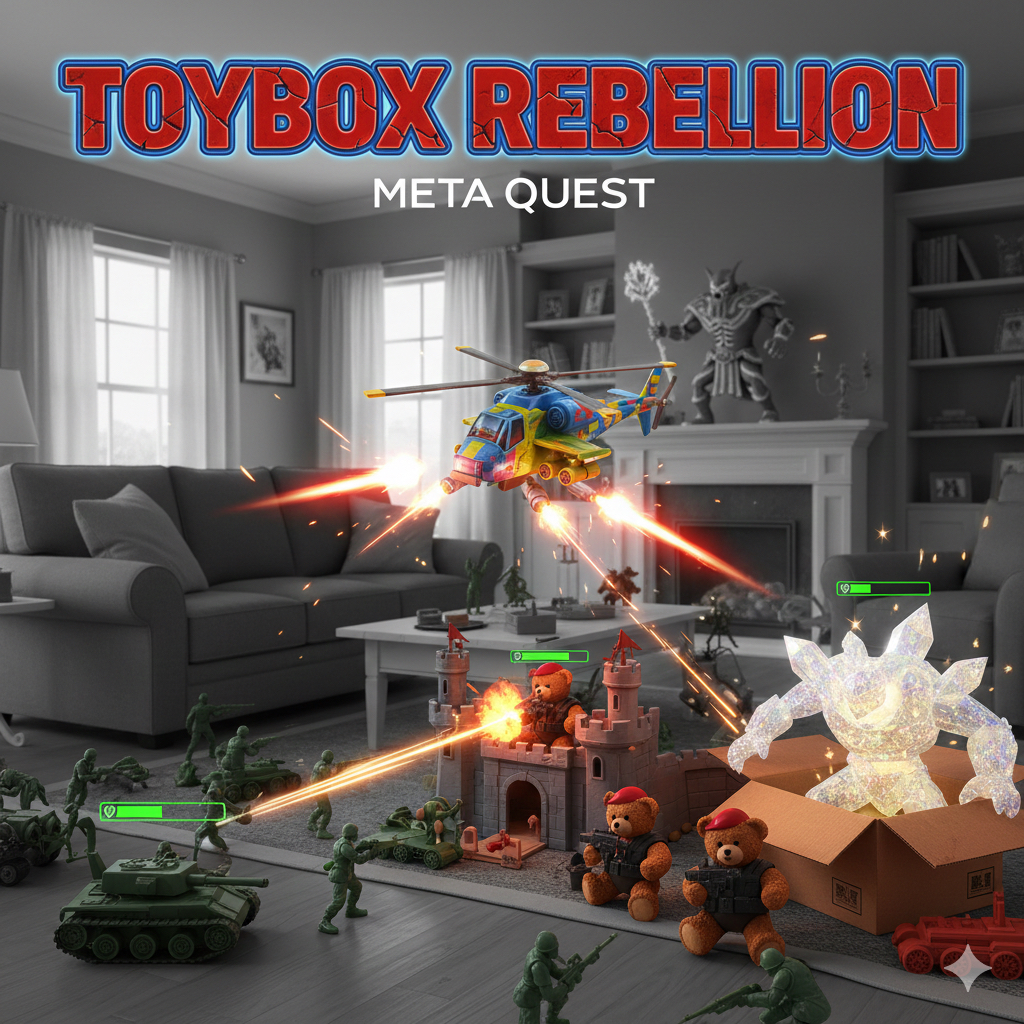
Toybox Rebellion embraces a gleefully absurd premise. Players take control of heavily armed toy helicopters tasked with suppressing a full-scale rebellion by toy soldiers, tanks, and larger-than-life bosses that have broken free from their imaginary confines. Instead of placing this conflict in a traditional virtual environment, the game overlays it onto your real-world surroundings using mixed-reality passthrough.
Tables become battlefields, floors turn into warzones, and entire rooms scale into miniature combat arenas. The sense of personalisation is immediate and effective — this is not just a battlefield, but your battlefield. The narrative itself is light and deliberately secondary, serving mainly as a framing device for escalating combat scenarios rather than a story meant to be dissected or deeply explored.
Gameplay Mechanics and Combat Design
Combat is the heart of Toybox Rebellion, and it is here that the game delivers its strongest moments. Players pilot attack helicopters equipped with a variety of weapons, including machine guns, missiles, and special abilities designed to thin enemy ranks quickly and decisively. Controls are intuitive, responsive, and well-suited to both VR controllers and traditional gamepads, making the experience accessible regardless of preferred input method.
Movement feels fluid without being disorienting. Helicopters respond smoothly to directional input, allowing players to weave through enemy fire, reposition strategically, and maintain situational awareness even as battles intensify. Weapon feedback is punchy and satisfying, with explosions and projectile impacts clearly communicated through both visual and audio cues.
Enemy variety helps maintain momentum. Early encounters feature basic toy infantry and light vehicles, but these soon give way to heavier armour, elite units, and boss-style adversaries that require prioritisation and positioning rather than raw firepower alone. While the core combat loop remains consistent throughout, the escalation of enemy density and complexity keeps encounters engaging for a respectable duration.
That said, repetition does eventually set in. While the moment-to-moment action remains enjoyable, the lack of dramatic shifts in mechanics or objectives means extended sessions can feel slightly formulaic. The game is clearly designed for energetic bursts of play rather than prolonged campaigns.
Mixed Reality Integration
Mixed reality is Toybox Rebellion’s defining feature, and it is implemented with confidence. The game scans and adapts to your environment, dynamically scaling battlefields to fit available space. Smaller surfaces support tabletop-scale encounters, while larger rooms allow for more expansive combat layouts.
This integration is not merely cosmetic. Physical objects in your space influence tactical decisions, encouraging players to reposition themselves physically to gain better vantage points or avoid incoming fire. The illusion of toy armies invading your real-world environment is surprisingly convincing, and the novelty rarely wears thin during early play sessions.
Crucially, the mixed-reality elements feel optional rather than mandatory. Players can engage with the game in a more traditional VR setup if desired, ensuring accessibility for those with limited space or incompatible hardware.
Visual and Audio Presentation
Visually, Toybox Rebellion adopts a vibrant, stylised aesthetic that suits its tone perfectly. Enemy designs are whimsical and readable, favouring personality over realism. Helicopters and weapon effects are detailed enough to feel impactful without overwhelming the screen during hectic encounters.
Performance remains stable even during chaotic sequences, maintaining clarity and responsiveness — an essential requirement for a fast-paced shooter. The game wisely prioritises readability over excessive visual complexity, ensuring that threats and objectives remain clear at all times.
Audio design reinforces immersion effectively. Explosions, gunfire, and enemy sound cues are crisp and spatially accurate, while the musical score ramps up tension during intense moments without becoming intrusive. Together, the audiovisual elements create a cohesive and energetic presentation that complements the game’s arcade roots.
Progression and Replayability
Progression in Toybox Rebellion revolves around unlocking new helicopters, upgrading weapons, and improving performance scores. Each helicopter offers different stats and loadouts, allowing players to tailor their approach to combat. These upgrades provide a tangible sense of advancement, though they do not dramatically alter gameplay strategy.
Replayability is supported through randomly generated encounters and leaderboard tracking, encouraging players to refine their skills and chase higher scores. However, there is little in the way of deeper meta-systems. Narrative progression is minimal, and there are no branching paths, evolving factions, or long-term objectives beyond mechanical mastery.
For many players, this will be perfectly acceptable. Toybox Rebellion is unapologetically arcade-focused, valuing immediacy and fun over layered progression systems. Those seeking deep customisation or narrative depth may find the experience limited, but players who enjoy score-chasing and replayable action loops will find plenty to enjoy.
Accessibility and Comfort
Comfort options are thoughtfully implemented. The game supports seated and standing play, offers multiple movement configurations, and avoids aggressive camera motion that could induce discomfort. Input flexibility further enhances accessibility, allowing a wide range of players to engage comfortably.
The learning curve is gentle. New players can grasp the fundamentals quickly, while higher difficulty encounters reward precision and situational awareness without demanding expert-level skills.
Final Verdict
Toybox Rebellion is a lively, inventive mixed-reality shooter that understands exactly what it wants to be. It transforms everyday spaces into playful battlegrounds and delivers fast, satisfying combat that shines in short, energetic sessions. While its progression systems and narrative depth are limited, its creativity, accessibility, and sheer fun factor more than compensate.