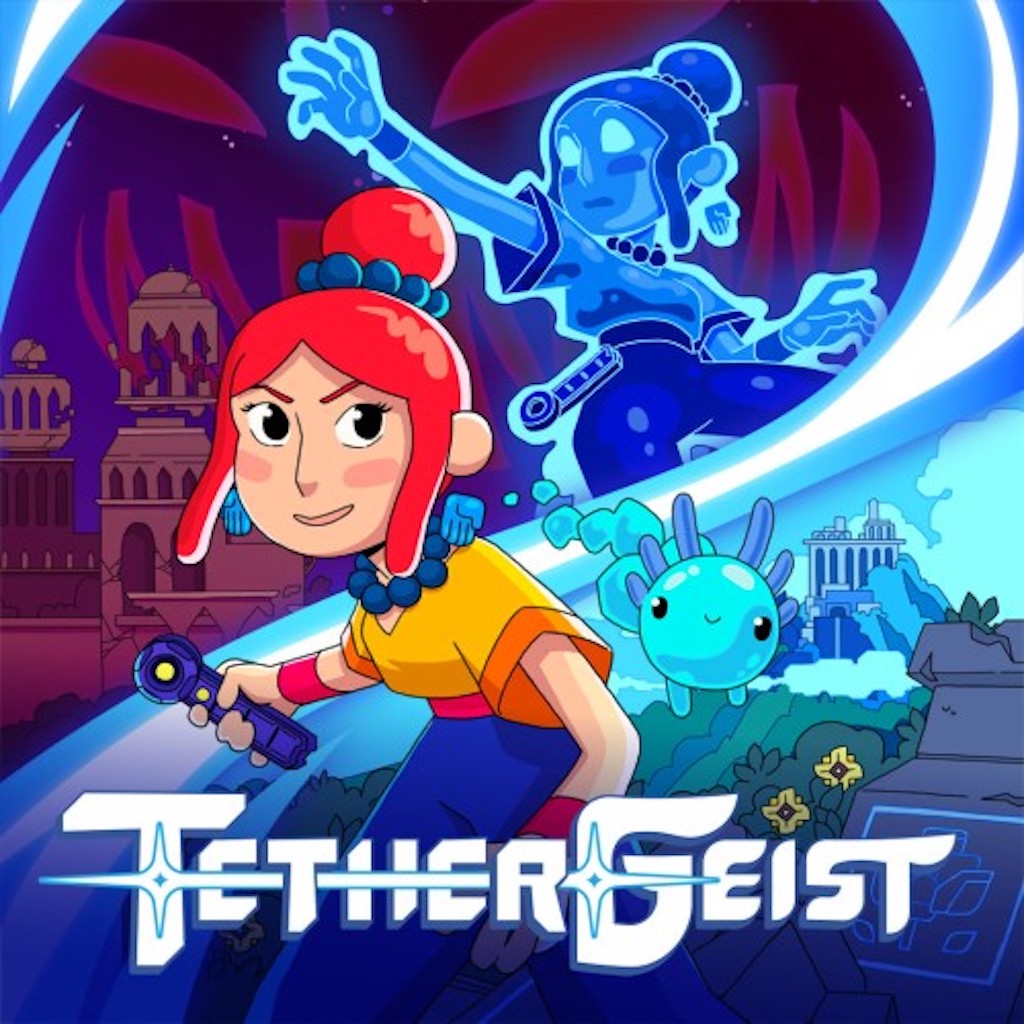
There is a particular heaviness that most of us recognise long before we have the words for it. The feeling of dragging something behind you that refuses to move. A backpack that feels too full. A memory that refuses to stay buried. TetherGeist builds an entire game around that sensation, then asks you to climb through it, one careful movement at a time.
Developed by Nocturne Studios and published by Silesia Games, this physics-driven puzzle adventure is less interested in speed or spectacle and more invested in weight. Emotional weight. Physical weight. The kind that settles into your hands through the controller and refuses to leave even after you stop playing. It is a quiet game, but never an empty one.
A Cathedral Beneath the Surface
TetherGeist unfolds in a submerged cathedral, a vast structure swallowed by water and memory. Pillars stretch into darkness, stained glass fractures light into drifting colour, and corridors vanish into flooded silence. It is one of those settings that feels immediately sacred and abandoned in the same breath.
You play as a lingering spirit bound to an iron lantern, your only anchor to the physical world. This lantern is not merely a tool. It is the reason you cannot simply drift away. Everything you do is shaped, restrained, and occasionally saved by it.
The narrative is entirely silent. No spoken dialogue. No text dumps. Instead, meaning is built through movement, environmental cues, and the slow revelation of spaces that feel like half-remembered memories rather than deliberately designed places. It is a bold approach, and it works more often than not. There is a sense that you are not exploring this cathedral so much as remembering it.
Movement as Meaning
The core mechanic of TetherGeist is what makes it so distinct. Your spirit can launch forward freely, but your lantern remains bound by an elastic spectral tether. You pull it, swing it, drag it, and occasionally use it as a pendulum to break through obstacles or activate ancient mechanisms.
This system turns every puzzle into a negotiation between freedom and restraint. You are never fully in control, and that is the point. Progress feels earned not because of reflexes, but because of patience and understanding.
The closest comparisons might be physics-based games like Getting Over It or Heave Ho, but TetherGeist strips away the frustration-comedy and replaces it with something more contemplative. There is no fail state waiting to punish mistakes. Instead, failure simply becomes another way of learning the space you are in. It is not about doing things quickly. It is about doing them carefully enough that you start to feel the rhythm of the world.
Over time, you begin to think in arcs and weight rather than jumps and inputs. The lantern becomes less of an object and more of a companion you are constantly negotiating with.
The Weight of Every Step
Where TetherGeist truly excels is in how it communicates tension through movement. The elastic physics system is not just a gimmick. It defines everything.
Pull too hard and the lantern resists. Swing too far and you lose control. Let it drag too loosely and you risk falling behind, into environmental hazards that feel more like consequences than punishments. The result is a constant awareness of space and momentum.
Later sections introduce more complex structures within the submerged cathedral. Narrow corridors that demand precise lantern swings. Vertical shafts where timing becomes everything. The infamous Sunken Library stands out in particular, a maze of shifting platforms and waterlogged shelves that forces you to rethink everything you have learned up to that point. It can be overwhelming at times. Not because it is unfair, but because it refuses to simplify itself for comfort.
There were moments when I found myself stopping just to watch the lantern sway behind me, as if waiting for it to settle into the right emotional distance before continuing. That might sound strange. It is also the clearest sign that the game is doing something unusual.
A World That Breathes in Silence
Visually, TetherGeist leans into restraint. Deep blues, fading golds, and heavy shadows dominate every scene. Light behaves as something fragile rather than functional, breaking apart as it passes through submerged architecture.
The water is not merely decorative. It defines visibility, movement, and mood. It turns space into something uncertain. You are always only partially seeing the world, never fully grasping it.
Sound design reinforces this isolation. Echoes stretch unnaturally long. Distant collapses feel like memories rather than events. The absence of traditional music in many sections makes the rare musical cues feel almost intrusive, in the best possible way.
On PlayStation 5, the haptic feedback adds another layer of tension. The triggers resist subtly as the tether strains, giving physical form to something that would otherwise remain abstract. It is not a loud effect, but it is meaningful.
Direction, Drift, and Discovery
If TetherGeist has a weakness, it lies in its structure. Larger, open rooms occasionally lack clear guidance, and the absence of traditional markers can lead to moments when you simply drift, swinging the lantern without immediate purpose.
These stretches are not frequent, but they do interrupt the otherwise tight pacing. Some players will find them meditative. Others may find them slightly aimless.
Still, even in these quieter moments, the game rarely loses its tone. The atmosphere does much of the heavy lifting, and the act of movement itself is usually enough to keep you engaged.
This is a game that trusts you to sit with uncertainty, even when it is not entirely sure you will enjoy doing so.
The Emotional Pull of Letting Go
What TetherGeist ultimately conveys is not a traditional story but a feeling. It is about carrying something you cannot drop, even when it slows you down. It is about learning that progress does not always feel like release. Sometimes it feels like resistance.
The lantern is both a burden and a guide. A reminder that moving forward does not mean leaving everything behind. It means learning to carry it with you without breaking you. That idea lingers long after you stop playing.
Verdict
TetherGeist is not trying to entertain in the conventional sense. It is trying to be understood. Through its elastic physics, submerged world, and silent storytelling, it creates a space where movement and emotion are inseparable.
It is occasionally loose in structure and can test patience in its more open sections, but its atmosphere, mechanical identity, and emotional clarity make it something rare. A game that feels less like a challenge to overcome and more like a weight to learn to carry. It asks you to move forward. It never promises it will feel light.