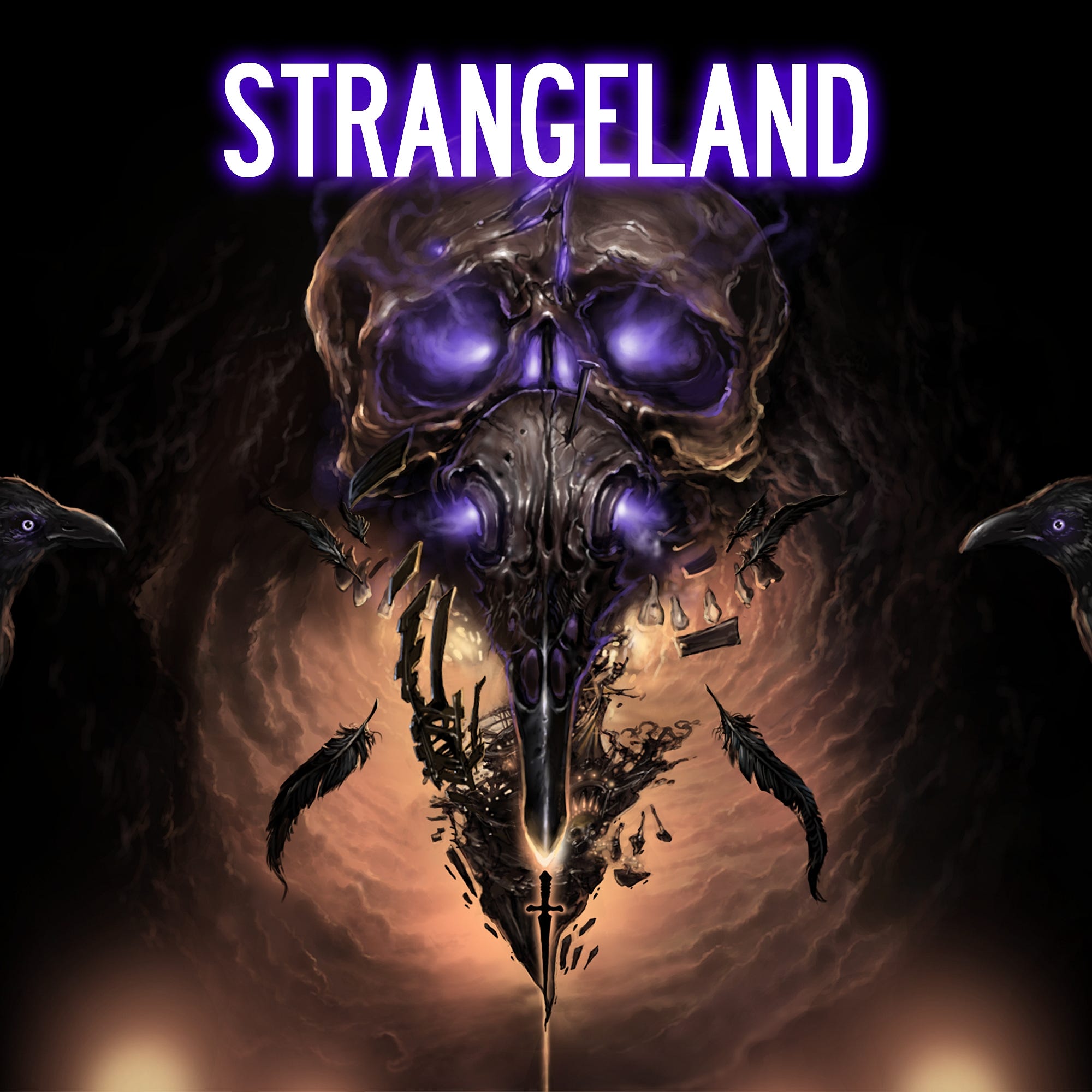
Some games tell stories. Others create worlds. Every so often, a game comes along that feels like stepping into somebody else’s dream. Not a pleasant dream, either, but the sort that leaves you staring at the ceiling at three in the morning, trying to make sense of images still lingering in your mind. That is Strangeland.
Developed by Wormwood Studios and published by Wadjet Eye Games, Strangeland marks the long-awaited return of the team behind Primordia. Rather than revisiting the mechanical wastelands of that beloved science fiction adventure, they plunge headfirst into psychological horror, surreal symbolism, and deeply personal storytelling. The result is a point-and-click adventure that feels at once intimate and cosmic, unsettling and strangely comforting.
From its opening moments, Strangeland establishes itself as something unusual. This is not a game interested in straightforward answers or conventional storytelling. Instead, it invites players into a bizarre carnival suspended somewhere between life, death, memory, and imagination. It is a place filled with monsters, miracles, and metaphors, where every strange encounter feels laden with hidden meaning. Most importantly, it is a game that trusts its audience.
A Cycle of Suffering
The story opens with a haunting image that immediately captures your attention. An unnamed man awakens in a decaying carnival and watches a golden-haired woman throw herself into a seemingly bottomless well. Soon, he uncovers a horrifying truth. She is trapped in an endless cycle, repeatedly sacrificing herself. Worse still, she appears to be doing so for him.
Death, however, behaves differently in Strangeland. The protagonist cannot truly die. Whenever he perishes, he simply returns to the carnival’s entrance, condemned to continue his search for answers. Somewhere high above the twisted fairground sits a mysterious entity known only as the Dark Thing. Destroying it appears to be the only way to break the cycle and save the woman from her endless suffering. That basic premise is easy enough to grasp. What follows, however, is anything but simple.
Strangeland explores themes of grief, depression, guilt, trauma, and self-worth through symbolism rather than exposition. Conversations frequently drift into poetic abstraction. Characters speak in riddles, fragmented memories, and emotional truths rather than direct explanations. The game rarely hands players concrete answers, preferring instead to let them interpret its imagery and draw their own conclusions.
This approach will not work for everyone. Players seeking clear narrative beats and straightforward resolutions may find the experience frustratingly opaque. For those willing to embrace ambiguity, however, Strangeland offers one of the most fascinating stories the genre has produced in years.
The People of Strangeland
Much of the game’s emotional power stems from its remarkable cast of characters. Every inhabitant of the carnival feels at once absurd and deeply human. You encounter sarcastic ravens, an eyeless scribe, a living furnace, grotesque biological anomalies, and countless other bizarre figures scattered throughout the park. On paper, these characters seem completely detached from reality. In practice, they become the emotional backbone of the entire adventure.
Each encounter reveals fragments of the world’s broader themes. Beneath their strange appearances lie reflections of fear, regret, anger, loneliness, and hope. The game excels at making these surreal creatures feel meaningful rather than random. Every conversation carries weight, even when you are not entirely sure what it means in the moment.
What makes these interactions particularly effective is the quality of the writing. The dialogue strikes a difficult balance between literary ambition and emotional sincerity. It often feels poetic without becoming pretentious, and philosophical without losing sight of the very human emotions at its core. By the time the story reaches its conclusion, many of these strange companions feel surprisingly familiar.
Dream Logic Done Right
Adventure games often live or die by their puzzle design. Strangeland succeeds because it grasps an important truth about surrealism. Even the strangest worlds require internal consistency. Players are willing to accept impossible situations as long as those situations obey their own rules.
The puzzles here are wonderfully bizarre. You might forge weapons from impossible materials, barter with grotesque creatures, or manipulate the environment in ways that would make no sense outside this nightmare realm. Yet somehow, the solutions rarely feel arbitrary.
The game’s dream logic remains remarkably coherent throughout. Every puzzle follows a chain of reasoning that fits naturally within the world’s established rules. The result is a series of challenges that feel satisfying rather than frustrating. Equally impressive is the game’s respect for the player’s time. Strangeland avoids many of the classic frustrations associated with older point-and-click adventures. There is no endless wandering across dozens of disconnected locations. There is no obsessive pixel hunting. The world is relatively compact, ensuring that progress feels steady and purposeful. Even when you become stuck, the game provides elegant solutions.
Help When You Need It
One of Strangeland’s smartest features is its built-in hint system. The raven companion offers gentle guidance, providing clues and nudges without revealing solutions outright. These hints are often enough to point players in the right direction while preserving the satisfaction of discovery.
For those who become genuinely stuck, an in-game payphone offers a more direct alternative. Calling it connects you to a delightfully grumpy voice that gradually provides increasingly explicit puzzle solutions. It is a clever, in-universe way to prevent frustration without forcing players to leave the game and search online.
This system feels particularly valuable given the abstract nature of many puzzles. Strangeland constantly challenges players to think differently, but it never leaves them stranded. That balance between challenge and accessibility is difficult to achieve, and Wormwood Studios handles it beautifully.
A Masterclass in Atmosphere
Visually, Strangeland is extraordinary. The pixel art is among the finest examples of the medium in recent years. Every screen feels handcrafted, dripping with personality and unsettling detail. The carnival itself appears both beautiful and rotten, like a memory beginning to decay at the edges.
The colour palette deserves special praise. Muted purples, sickly pinks, cold greys, and bursts of brilliant gold combine to create a visual identity that feels uniquely Strangeland. Every environment reinforces the dreamlike atmosphere while remaining remarkably easy to navigate and understand.
The audio design is equally impressive. The soundtrack quietly weaves melancholy melodies throughout the experience, enhancing the sense of loneliness and introspection that defines the story. Voice acting across the board is exceptional, with Abe Goldfarb delivering a particularly memorable performance as the protagonist. His portrayal captures exhaustion, confusion, vulnerability, and determination in equal measure. Together, the visuals and audio create an atmosphere so immersive that the carnival begins to feel less like a setting and more like a living character.
A Journey Worth Taking
Strangeland’s greatest strength may be its confidence. It never compromises its vision in pursuit of broader appeal. The game commits fully to its surreal storytelling, symbolic imagery, and emotional themes. That commitment inevitably means some players will be put off by its more abstract elements. Not every question receives a clear answer, and not every metaphor comes with an explanation.
Yet that uncertainty is part of the experience. Strangeland is designed to be interpreted rather than simply consumed. It asks players to engage with its ideas, reflect on its imagery, and decide for themselves what its strange world ultimately means. Very few games are willing to take that risk.
Final Verdict
Strangeland is a remarkable achievement in psychological storytelling. It combines intelligent puzzle design, breathtaking pixel art, exceptional audio work, and deeply personal themes into an adventure that feels genuinely unique. While its abstract narrative and symbolic approach may not appeal to every player, those willing to embrace its dreamlike logic will find one of the most memorable point-and-click adventures of the modern era.
What begins as a mystery about a woman trapped in an endless cycle gradually evolves into something far more profound. It becomes a meditation on grief, identity, self-destruction, and healing. Every puzzle solved and every strange encounter experienced contributes to a larger emotional journey that remains compelling from start to finish.
Strangeland is not merely a game about escaping a nightmare. It is a game about understanding why the nightmare exists in the first place. For fans of psychological horror, narrative adventures, and thoughtful storytelling, this is an unforgettable trip through the funhouse mirror.