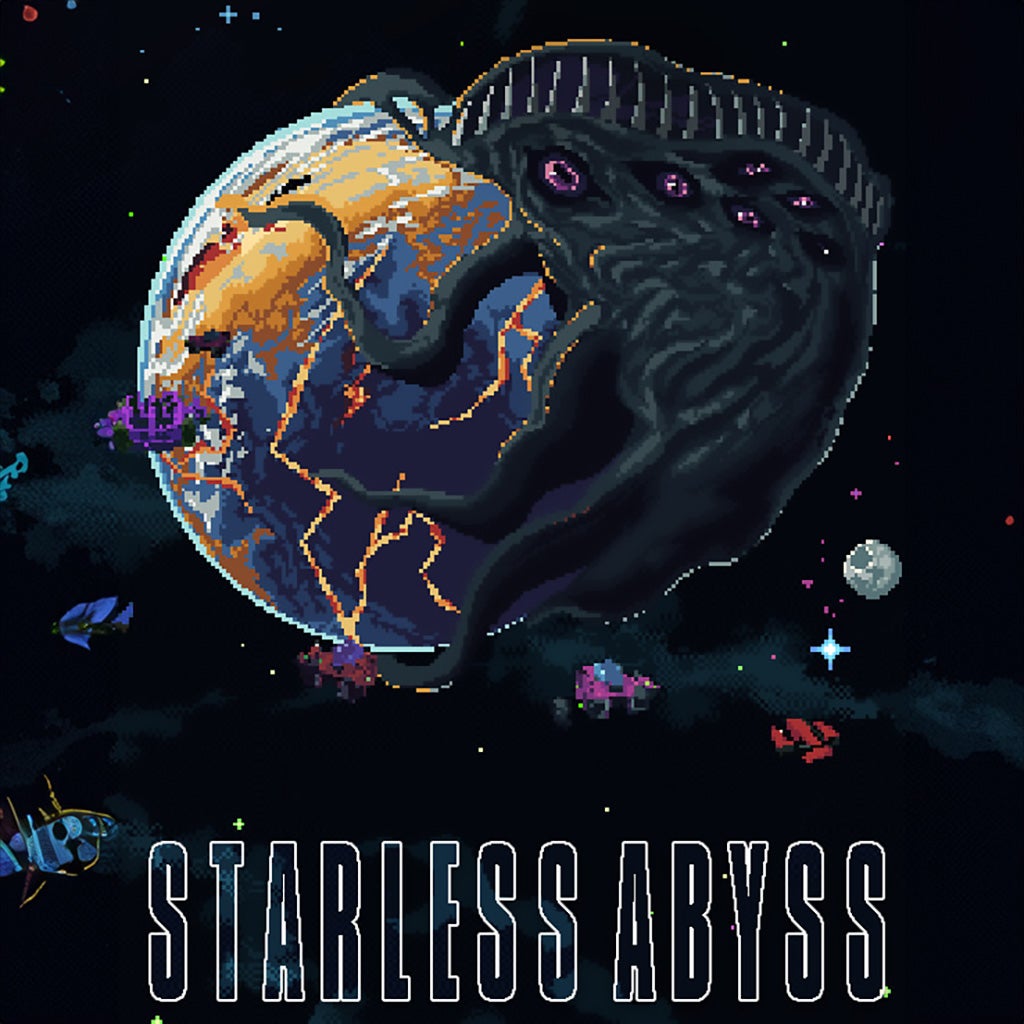
There are deckbuilders that focus on elegant card synergies. There are tactical games that hinge on positioning and calculated movement. And then there’s Starless Abyss — a bleak, brain-burning fusion of both, wrapped in a Lovecraftian nightmare where the universe itself seems hostile to your survival.
Originally released on PC in 2025 to “Very Positive” reception, Konafa Games’ ambitious strategy hybrid now makes the jump to Nintendo Switch. And if there was ever a roguelike that feels like it belongs in handheld mode — one more run before sleep, one more doomed timeline — it’s this one.
But make no mistake: Starless Abyss is not a breezy pick-up-and-play card battler. It’s closer to a digital board game wrapped in cosmic dread.
The Proxima and the Loop
You play as a Proxima — a timeline-hopping operative resurrected by Counter Horror, an uneasy alliance of scientists and occultists attempting to stave off Earth’s annihilation at the hands of the Outer Gods.
The roguelike reset isn’t just mechanical. It’s narrative. Each death is another failed timeline. Each restart is another version of you exploring alternate paths to humanity’s survival.
This framing gives weight to repetition. When you fall — and you will fall — it feels less like a loss screen and more like a branch severed in a multiversal war.
Your psyche degrades the closer you venture toward the eldritch threat. Sanity is a resource. Stability is fleeting. The further you push, the more reality bends.
It’s cosmic horror not just in theme, but in systemic design.
Hexes, Heat, and Hard Choices
Unlike traditional deckbuilders that rely purely on abstract lanes or enemy rows, Starless Abyss plays out on a hexagonal grid.
Positioning matters.
You command a fleet of ships, maneuvering them across space while managing line-of-sight, firing arcs, and distance-based damage modifiers. Movement is limited. Every hex step costs opportunity.
And then there’s heat.
Starships overheat as they unleash powerful attacks. Push too hard and you’ll disable your own fleet at the worst possible moment. Managing aggression becomes as important as optimizing damage.
The result is a layered tactical puzzle. Cards don’t just deal numbers — they alter spatial control. A well-timed reposition can save a run. A miscalculated drift can expose your flagship to catastrophic retaliation.
It’s a design philosophy refined with input from industry veteran Rami Ismail, and it shows. The “juice” — visual feedback, clarity of impact, pacing — is tight. When a plan clicks into place, it feels immensely satisfying.
Rituals, D.I.C.E., and Six Factions
Deckbuilding in Starless Abyss isn’t a simple matter of stacking damage cards.
You combine six distinct factions, each offering unique mechanics and synergies. Some focus on direct firepower. Others manipulate sanity. Some lean into occult rituals.
Ritual cards are especially potent — powerful, often one-time-use effects that can obliterate enemies or dramatically alter the battlefield. They feel dangerous, almost forbidden. Lean too heavily into them, and the cost can echo later in the run.
Then there’s D.I.C.E. — a dice-based system that influences random encounters and certain abilities. Similar to mechanics seen in games like Citizen Sleeper, dice offer controlled unpredictability. You’re never fully at the mercy of chance, but you must decide when to gamble.
Artifacts and sanity shards further complicate builds, transforming ships and redefining synergies mid-run.
The cumulative effect is complexity bordering on intimidating.
This is not a game you master in an evening.
Bosses from Beyond
Each run culminates in encounters with grotesque manifestations of the Outer Gods. These aren’t mere stat walls. They warp mechanics, alter rules, and force adaptation.
Some manipulate the grid itself. Others distort sanity thresholds. A few completely redefine how your deck functions mid-battle.
Victory rarely comes from brute force. It requires understanding systems deeply enough to bend them.
Thematically, these bosses are magnificent. Grotesque, reality-bending entities rendered in highly detailed pixel art — grotesque tendrils, shifting geometries, impossible anatomy.
The contrast between realistic human portraits and abominations from beyond reinforces the game’s tonal tension.
A Digital Board Game in Disguise
Comparisons to a “digital board game” are apt.
Between combat encounters, you’ll make narrative choices that can boost or devastate your run. Do you investigate the anomaly? Bargain with an occult faction? Spend credits upgrading your deck or conserve them for survival?
The map structure feels deliberate and structured, encouraging route planning rather than random wandering.
Every system feeds into another. Cards affect positioning. Positioning affects heat. Heat influences survival. Sanity alters risk thresholds.
It’s a web of mechanics that rewards long-term thinking.
The Switch Experience
Launching on Switch tomorrow, the game translates surprisingly well to handheld.
Turn-based pacing fits portable sessions naturally. UI elements have been scaled effectively, though the density of information means text size can feel slightly cramped in handheld mode during complex encounters.
Performance is stable, and loading times are reasonable. The pixel art retains its clarity on the smaller screen, and the grotesque boss designs remain impactful.
Given its “one more run” nature, Switch feels like a fitting home.
Where It Shines
Strengths:
- Deep, layered tactical deckbuilding
- Strong narrative framing for roguelike resets
- Creative hex-based positioning system
- Distinct faction synergies and build diversity
- Striking cosmic horror pixel art
- Smart difficulty scaling and encounter design
The synergy between positioning and deckbuilding sets it apart from genre peers. This isn’t simply about optimizing a combo — it’s about spatial dominance.
Where It Stumbles
Weaknesses:
- Steep learning curve
- System density may overwhelm newcomers
- Occasional RNG spikes despite D.I.C.E. mitigation
- Text-heavy UI can feel crowded in handheld mode
This is a game that demands patience. Early runs may feel punishing, and understanding faction synergies takes time.
It’s closer to studying a strategy manual than casually flipping cards.
Final Verdict
Starless Abyss is a formidable achievement — a tactical deckbuilder that pushes the genre into spatial strategy while embracing cosmic horror with sincerity and style.
Its systems are dense, sometimes daunting, but rarely arbitrary. Death feels like discovery. Each failed timeline reveals new insight into how the machinery of survival operates.
It’s not for everyone. Casual deckbuilder fans may find it overwhelming. But for players who crave complexity — who relish systems layered upon systems — this is one of the most intellectually satisfying roguelikes of the past few years.
In the end, Starless Abyss captures something uniquely Lovecraftian: the sense that understanding the universe is both terrifying and intoxicating.
And you will die trying.