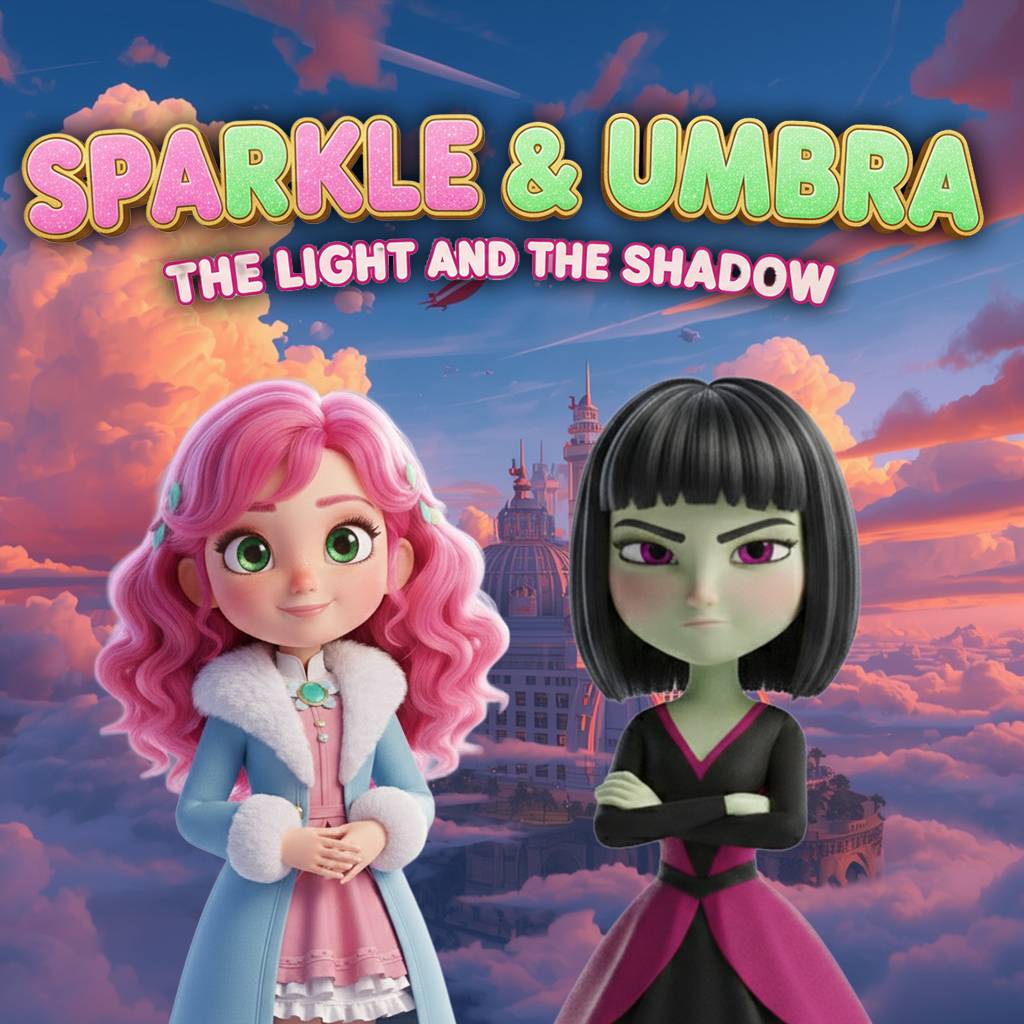
Sparkle & Umbra from Aldora Games is an interactive storybook that tells a deceptively simple yet thematically rich tale. At its core is the city of Aeros, a seemingly perfect world whose glittering exterior hides a rigid system of control. Players follow two protagonists — a teacher of light and a gravity specialist — whose forced partnership reveals that the city’s supposed harmony is a carefully maintained illusion.
The narrative unfolds gradually, emphasizing character development and moral complexity over spectacle. What begins as a story about collaboration and learning quickly transforms into a meditation on duality, control, and the consequences of unquestioned obedience. The two leads, initially defined by their contrasting disciplines and personalities, grow together in a manner that feels organic and satisfying. Their journey asks players to consider whether stability achieved through suppression is truly valuable, or whether the messy, painful process of acknowledging imperfection ultimately leads to a more meaningful coexistence.
Interactive Storytelling for Young Readers
One of the game’s strongest qualities is how it balances accessibility with narrative depth. As a linear, interactive storybook, Sparkle & Umbra is designed to be approachable for young audiences while still engaging enough for older readers who appreciate its layered themes. Players can explore the story at their own pace, reading dialogue, observing the world, and occasionally making minor interactive choices that influence the pacing and tone, even if the overarching plot remains linear.
The game’s format encourages reflective reading. The emphasis is not on complex puzzles or branching storylines, but on letting players absorb the atmosphere, relationships, and thematic resonance. It’s a gentle, meditative experience, with enough subtlety to reward thoughtful readers who notice the small visual and narrative cues peppered throughout Aeros.
World-Building Through Design
Although Sparkle & Umbra is presented as a storybook, the city of Aeros feels remarkably tangible. The world is visually rich, blending luminous, ethereal landscapes with darker, gravity-defying architecture that underscores the tension between light and shadow, order and chaos. Each environment reinforces the narrative themes, emphasizing that beauty and perfection often come at a cost.
The game’s art style is one of its most compelling assets. Bright, sparkling visuals represent order, harmony, and the ideals of the city’s authority, while darker, weightier imagery reflects the complexity and challenges that the protagonists uncover. The contrast between these visual motifs mirrors the story’s philosophical core: stability built on suppression versus the freedom and risk inherent in embracing duality.
Themes That Resonate
At its heart, Sparkle & Umbra is a story about moral ambiguity and the tension between appearance and reality. The partnership between the teacher of light and the gravity specialist allows for a natural exploration of these themes. Light symbolizes clarity, perfection, and social conformity, while gravity embodies resistance, consequence, and the weight of truth. Their dynamic is central to the narrative and provides a lens through which players can examine issues of morality, trust, and cooperation.
The story’s climax forces a decision: preserve the illusion of perfection, or embrace the painful truth of imperfection. While the game’s linear structure guides players to a single conclusion, the journey to that point is filled with emotional resonance and ethical reflection. It’s rare for a storybook-style game to tackle such weighty concepts with such clarity and elegance, and Aldora Games succeeds here without alienating its intended audience.
Accessibility and Pacing
Sparkle & Umbra is deliberately paced. The reading experience is unhurried, allowing younger players to digest both narrative and visual cues. The interactive elements are minimal but meaningful, emphasizing discovery rather than challenge. This approach ensures that the story is approachable to those who may be less familiar with games while still retaining enough narrative intrigue to keep older players engaged.
Audio complements the experience beautifully. A subtle, atmospheric soundtrack underscores moments of tension and reflection without ever overwhelming the dialogue or visuals. Sound effects, from gentle chimes to ambient city noises, subtly reinforce the setting and help immerse players in Aeros.
Minor Limitations
The game’s primary limitation lies in its linearity. Players looking for branching narratives or meaningful gameplay choices may find the experience limited. Interactivity is mostly passive, consisting of reading, viewing, and occasional light interactions. However, given the game’s focus on storytelling and thematic depth, this design choice is understandable and aligns with its target audience.
Another minor consideration is replayability. While the story’s thematic richness and visual details encourage at least one thorough playthrough, the lack of alternative endings or complex mechanics may reduce long-term engagement for older players seeking extended gameplay. Nevertheless, the experience remains satisfying as a self-contained narrative journey.
A Captivating Storybook Experience
Despite its linearity, Sparkle & Umbra excels as an interactive storybook. Its strengths lie in its narrative sophistication, thematic depth, and beautiful presentation. Players are encouraged to pause, reflect, and internalize the story’s lessons, making it a rare blend of educational and entertainment value.
The narrative’s moral complexity, exploration of duality, and the evolving partnership between the protagonists are presented in a way that is both accessible and emotionally resonant. For young readers, it provides a thoughtful introduction to the idea that truth and stability are not always synonymous with control and perfection. For older players, it offers a reflective, meditative experience that is rare in the interactive storybook genre.
Final Verdict
Sparkle & Umbra is a strikingly well-crafted interactive storybook that combines beautiful visuals, thoughtful narrative, and subtle interactivity to explore themes of duality, morality, and the illusion of perfection. Its linear design and gentle pacing make it accessible to younger audiences while still offering thematic depth for older players.
While it may not satisfy those seeking complex gameplay or branching storylines, it delivers a polished, immersive story that lingers long after the experience ends. Sparkle & Umbra is a testament to how interactive storytelling can be both beautiful and meaningful.