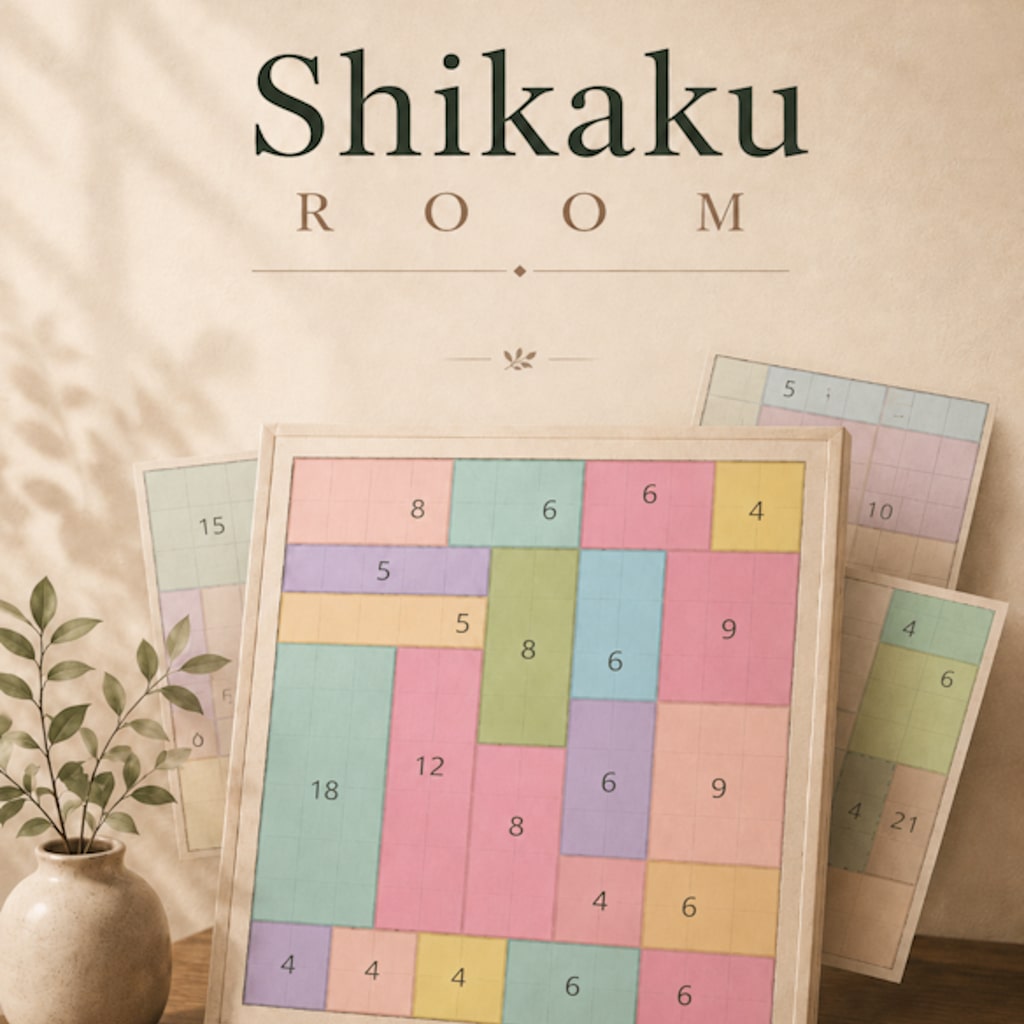
There is something wonderfully refreshing about a game that does not need to shout for your attention. In an industry increasingly filled with explosions, endless progression systems, enormous worlds and interfaces seemingly designed to ensure you are never more than a few seconds away from something demanding your attention, Shikaku Room takes the opposite approach. It places a grid before you, gives you a handful of numbers and quietly asks one simple question: can you work out how everything fits together?
Developed and published by Findon Software, Shikaku Room is a calm, minimalist logic puzzle game built around the classic Shikaku concept. The rules can be explained in a matter of moments, yet that simplicity hides surprising depth. Each puzzle asks you to divide the entire grid into rectangles or squares, with each region containing exactly one numbered clue and covering precisely the number of squares indicated by that clue.
It is an elegantly simple premise, and Shikaku Room understands that the best puzzle games often know when to leave well enough alone. There are no timers, no frantic reactions and no punishment for taking your time. Instead, it offers something increasingly rare in modern gaming: a quiet space in which you can simply think.
A Puzzle Built on Space
The concept behind Shikaku is beautifully straightforward. Imagine a clue marked with the number 6 somewhere on the board. That number must be part of a rectangle containing exactly six squares. It could be a long 1×6 strip, a 2×3 rectangle, or a 3×2 arrangement, provided the resulting shape fits within the grid and does not contain another clue.
That final condition is where things become interesting. At first, you might look at a number and think you have several possible solutions. Then another clue suddenly rules out one shape. A boundary eliminates another. A neighbouring rectangle forces you towards a particular orientation. Before long, you are no longer simply trying shapes at random. You are reasoning your way towards the only arrangement that can possibly work.
There is a lovely sense of progression within each puzzle. Early deductions often feel obvious, but those simple discoveries gradually create a chain reaction. One confirmed rectangle reduces the available space around it, which affects another clue, which then determines another region. Eventually, the entire board seems to click into place almost organically.
That moment is the heart of Shikaku Room. It does not need fireworks or a triumphant musical score to make solving a puzzle feel rewarding. The satisfaction comes from knowing that the solution was there all along and that you managed to uncover it.
Learning the Language
One of the game’s greatest strengths is how naturally it teaches its rules. The Novice puzzles offer small boards where the basic principles are easy to grasp without overwhelming the player with possibilities. You learn how numbers translate into areas, how rectangles interact with one another, and why leaving a clue with nowhere to go can cause problems later.
This gradual introduction is important because Shikaku is one of those puzzle concepts that can initially look easier than it is. A small grid with only a few clues might appear trivial, but even early puzzles can encourage you to think several steps ahead. The game does not need an elaborate tutorial to make its point. It simply lets you solve, observe and learn.
From there, the difficulty increases through Intermediate, Advanced, Expert and finally Master boards. Larger grids naturally create more possible arrangements, and that additional space gives the puzzles considerably more room to breathe. It also gives the player considerably more room to make a wrong assumption.
The progression feels fair because the game does not suddenly throw an enormous puzzle at you and expect you to understand everything. Instead, it gradually increases the number of possibilities you need to consider. By the time you reach the larger boards, the simple rules you learned at the beginning have become the foundation for some genuinely demanding logical deduction.
When Simple Becomes Difficult
The brilliance of Shikaku Room is that its difficulty does not come from adding complicated rules. The rules remain remarkably consistent throughout. What changes is the number of possibilities you have to juggle in your head.
That makes the later puzzles particularly satisfying. A clue containing a large number might have several possible rectangular configurations, and working out which one is viable can require careful consideration of the surrounding clues. Sometimes the answer is not immediately apparent, and you have to temporarily consider what would happen if you extended a region in one direction rather than another.
This is where spatial intuition becomes increasingly important. You are effectively looking at the board as a collection of empty spaces waiting to be divided, rather than simply a collection of numbers. Every rectangle you create changes the remaining puzzle, and the best solutions often emerge from recognising how those spaces must eventually fit together.
The larger Master boards are where the concept really gets to stretch its legs. According to the game’s campaign structure, these can reach substantial dimensions, with boards as large as 32×20. At that scale, a simple little number puzzle can become a surprisingly serious workout for the brain. And yet it remains peaceful.
A Game That Lets You Breathe
That calmness is one of Shikaku Room’s most appealing qualities. There is no countdown clock in the corner, no enemy waiting to attack, and no penalty for staring at a puzzle for five minutes while trying to spot what you have missed. You can put the controller down, think about a particular clue, and come back to it when the solution finally occurs to you.
This makes the game remarkably easy to fit around everyday life. You could solve a small puzzle while enjoying a cup of tea, spend ten minutes working through a particularly awkward section, or settle in for a much longer session and tackle several larger boards. The game accommodates all of those approaches without ever making you feel you should be playing faster.
There is something almost therapeutic about that. The world outside can be noisy enough, and Shikaku Room provides a welcome little pocket of quiet. Its minimalist presentation reinforces that philosophy rather than distracting from it.
For some players, that simplicity may initially seem almost too restrained. There is no grand story, no elaborate character progression, and no attempt to manufacture excitement where none is needed. But that is precisely why the presentation works. The puzzle is the star.
A Gentle Helping Hand
The inclusion of optional hints is another sensible decision. Puzzle games walk a fine line when offering assistance, because too much help can destroy the satisfaction of solving something yourself. Shikaku Room treats hints as a gentle nudge rather than a solution handed to you on a plate.
That distinction matters. There is nothing worse than being stuck on a puzzle and feeling as though your only choices are to stare at it indefinitely or have the game solve the entire thing for you. A well-judged hint can instead point your thinking in the right direction and allow you to make the final discovery yourself.
Accessibility also appears to have been given proper consideration, with features such as high-contrast visual options making the minimalist presentation easier to work with. Being able to skip levels is another welcome touch for players who find themselves genuinely stuck. The campaign can therefore remain a progression rather than becoming a wall that prevents you from seeing anything beyond one particularly troublesome puzzle.
These are not flashy features, but they demonstrate an understanding of what a puzzle game should provide. The objective is to challenge the player’s reasoning, not their patience.
Old School Puzzle Design With Modern Convenience
There is no disguising the fact that Shikaku Room is deliberately traditional. It does not attempt to reinvent the genre with elaborate gimmicks or bolt on an unnecessary story to its puzzles. It takes a well-established logic concept and presents it in a clean digital format.
Some players will undoubtedly find that lack of novelty limiting. If you are looking for a puzzle game filled with unusual mechanics or dramatic presentation, there is very little here beyond the central Shikaku formula. The game is unapologetically focused on one thing.
Personally, that focus is part of its appeal. There is something reassuring about opening a puzzle and immediately knowing what you are supposed to do. No lengthy dialogue needs to be skipped, no complicated skill tree needs to be understood, and no tutorial character needs to explain the same mechanic three times. You simply look at the grid and start thinking.
The result feels much closer to picking up a particularly good puzzle book than to playing a traditional video game, and that is meant as a compliment. Shikaku Room understands the pleasure of a clean idea executed with care.
The Long Road to the Last Square
With 25 handcrafted campaign boards, there is enough here to provide a meaningful journey from beginner puzzles to serious challenges. The variety comes primarily from the size and arrangement of the grids rather than a succession of entirely new mechanics, but that works because the underlying puzzle can generate plenty of difficulty from those basic ingredients.
The later boards demand patience. You might know that a particular rectangle has to contain a certain number of squares, but determining its exact shape can require several deductions elsewhere on the board first. One wrong assumption can create a problem much later, forcing you to retrace your thinking and identify where things went astray.
That process is one of the game’s greatest pleasures. Getting a puzzle wrong is not frustrating in the traditional sense because there is always another deduction waiting to be made. Even mistakes become part of the learning process, helping you understand how the different regions interact.
It is also the sort of game that encourages you to become better without ever explicitly telling you that you are improving. The puzzles simply become larger, and one day you realise that a configuration that would have looked intimidating earlier now seems perfectly manageable.
Verdict
Shikaku Room is a wonderfully focused puzzle game that understands the enduring appeal of simple rules and clever design. Its rectangle-based logic is easy to learn yet capable of surprising depth, while the gradual progression from Novice boards to huge Master puzzles provides a satisfying sense of development. The calm presentation, optional hints, accessibility features and absence of timers all complement the central idea rather than getting in its way.
Its biggest limitation is also its greatest strength. There is no attempt to turn Shikaku into something it is not. Players looking for a narrative adventure or a puzzle game packed with gimmicks will find a very different experience here. This is a game about grids, numbers, deduction and that wonderful little moment when everything finally makes sense.
For anyone who enjoys logic puzzles, Shikaku Room is easy to recommend as a peaceful way to exercise the grey matter. It is the sort of game you can play for five minutes or lose an entire evening to, and there is something rather lovely about a game that asks nothing more of you than to sit down, slow your thoughts and solve one problem at a time.