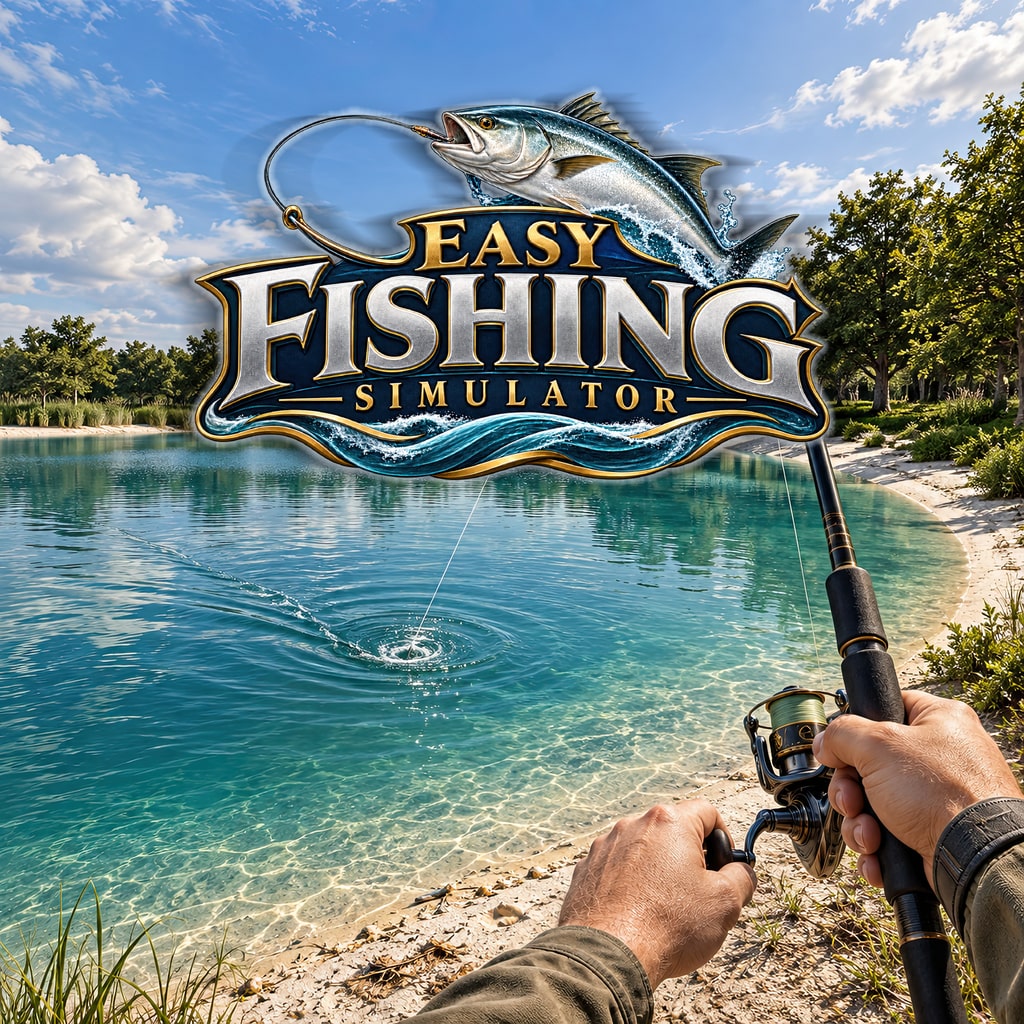
There is something wonderfully simple about fishing. You find a quiet place, cast your line into the water and wait. There is no great rush, no enemy charging towards you and no complicated objective hanging over your head. Easy Fishing Simulator understands that appeal and builds its entire experience around it, offering a deliberately uncomplicated fishing game where the biggest question facing you is whether the next tug on your line will be a tiny minnow or something worth bragging about.
Developed and published by Benoit Varasse under the Pix Arts name, Easy Fishing Simulator is very much aimed at players who want their fishing without the complicated equipment, detailed rigging systems or demanding simulation mechanics that can sometimes make the genre feel like homework. Its philosophy is right there in the title. Everything is designed to be easy to pick up, easy to understand and, ideally, easy to enjoy.
That simplicity can be both its greatest strength and its most obvious limitation. There is a certain charm in being able to pick up the controller, find a spot beside the water and immediately start fishing without spending twenty minutes learning which combination of bait, line and hook you are supposed to be using. Yet once you have mastered the basic rhythm of casting, waiting and reeling, you may find yourself wondering how much more there is beneath the surface.
Cast, Wait, Reel
The basic mechanics are straightforward, but that is very much the point. You cast your line, wait for a fish to take an interest, and then begin reeling in your catch. There is a little tension as you fight the fish, particularly when something larger decides it would rather swim away than become tonight’s dinner.
For experienced anglers, this is unlikely to pose much of a challenge. There are no elaborate rod configurations to master and no complicated mechanics demanding precise knowledge of fishing equipment. Instead, Easy Fishing Simulator strips everything back to the essentials, making it accessible to players who might otherwise be intimidated by more serious fishing simulations.
That accessibility is arguably where the game is at its most successful. It is the sort of experience you can hand to someone who has never played a fishing game before and expect them to understand almost immediately. There is a pleasing lack of fuss about the whole thing, and in an industry where games increasingly seem determined to throw endless systems at the player, there is something refreshing about a title that simply says: cast your line and see what happens.
Life Beneath the Surface
The game also tries to give its aquatic environments a little more life through a variety of fish species and their behaviour. Fish are meant to swim, explore and react to bait, with different species displaying distinct personalities. Cautious bottom-feeders and more aggressive predators are intended to make each encounter feel slightly different, even if the underlying mechanics remain relatively simple.
This is important because fishing can become extremely repetitive if every catch feels identical. Even small differences in behaviour can make the moment before a bite more interesting. You begin to wonder what is lurking below the surface and whether the next fish will be an easy catch or something that puts up a bit more of a fight.
The problem is that the simulation does not always have the sophistication to make these differences feel especially deep. Fish behaviour remains fairly basic, and those expecting a detailed aquatic ecosystem will probably be disappointed. There is enough movement to stop the water from feeling completely lifeless, but this is still a casual fishing experience rather than a serious attempt to recreate every nuance of angling.
A Little Money Goes a Long Way
Catching fish is only part of the experience. Once you have filled your imaginary fishing basket, you can sell your catches to earn money, then use those funds to upgrade your equipment and unlock new fishing spots. It is a simple progression system, but it gives the otherwise repetitive fishing loop a reason to continue.
There is something satisfying about that gradual improvement. Your first catches may not be particularly impressive, but as your equipment improves, the prospect of landing something bigger becomes increasingly appealing. The game understands that one of the pleasures of fishing is not necessarily catching the biggest fish immediately, but building towards the point where you can finally go after it.
You can also decide what happens to individual catches. Keep the fish you particularly like, or release them back into the water, allowing the experience to retain a little of the personal choice that makes recreational fishing appealing. It is not a revolutionary feature, but it helps Easy Fishing Simulator feel less like a simple arcade game and more like a gentle fishing pastime.
No Clock, No Pressure
Perhaps the most important thing about Easy Fishing Simulator is what it chooses not to do. There are no timers demanding that you catch a certain number of fish within a set period, no enemies waiting to interrupt your peaceful afternoon, and no high-stakes challenges forcing you to perform perfectly. It is simply you, your rod and a stretch of water.
That makes the game surprisingly easy to settle into. There are plenty of games that demand concentration, quick reactions or constant decision-making, but Easy Fishing Simulator occupies the opposite end of the spectrum. It is something you can play while relaxing on the sofa, perhaps for twenty minutes, or considerably longer if the lure of the next catch takes hold.
There is a quiet satisfaction in that approach. Not every game needs to make your heart race, and there is definitely a place for experiences that allow the player to slow down for a while. Easy Fishing Simulator is at its best when treated less as a traditional simulation and more as a digital fishing break.
The Catch Is Simplicity
The difficulty is that relaxation and repetition are very close neighbours. Once you have spent enough time casting, catching and selling, the experience’s limitations become increasingly apparent. The environments are fairly static, the visual presentation is basic, and the sound design can grow repetitive over repeated sessions.
This is also where the game’s lack of depth becomes more noticeable. Players seeking a detailed fishing simulation with extensive equipment options, realistic environmental conditions, sophisticated fish behaviour and a wide variety of techniques will find little here to satisfy those ambitions. Easy Fishing Simulator is not trying to compete with the most serious games in the genre, but even casual players may eventually wish there were a few more surprises beneath the surface.
The visual presentation is similarly modest. There is nothing particularly offensive about it, and the calm aquatic environments serve their purpose, but this is clearly a budget production. The fish models, scenery and overall presentation lack the detail and polish that could have made the experience considerably more immersive.
A Digital Fishing Break
What saves Easy Fishing Simulator from being entirely forgettable is that it knows what it wants to be. It does not pretend to offer a highly detailed fishing career or drown the player in complicated systems. Instead, it takes one of gaming’s simplest concepts and makes it accessible to almost anyone.
There is value in that. Someone looking for a relaxing game to dip into after a long day may appreciate the lack of pressure, while younger players or newcomers to fishing games should find the controls easy to understand. Even experienced players might enjoy the occasional quiet session, provided they approach it with the right expectations.
It is perhaps best thought of as a fishing equivalent of a comfort game. You are not here for realism or an epic career mode. You are here because sometimes it is nice to sit beside a virtual lake, cast a line and wait to see what bites.
The Verdict
Easy Fishing Simulator does exactly what its name promises, for better and for worse. The controls are accessible, progression is simple, and the absence of timers or pressure makes it easy to pick up whenever you want something relaxing. There is a pleasant rhythm to catching fish, selling them, upgrading your gear, and heading back out in search of something bigger.
Unfortunately, that simplicity eventually starts to work against it. The basic visuals, repetitive audio, limited environments, and straightforward fish behaviour mean there is only so much depth to discover once the initial novelty has worn off. Serious fishing enthusiasts are unlikely to find the detailed simulation they are looking for, but casual players wanting an uncomplicated way to spend a little time beside the water may find enough here to make a few peaceful fishing trips worthwhile. Sometimes a game does not need to reinvent a genre. Sometimes it just needs to give you somewhere quiet to sit.